


Community hub
Recent from talks
Contribute something to knowledge base
Content stats: 0 posts, 0 articles, 1 media, 0 notes
Members stats: 0 subscribers, 0 contributors, 0 moderators, 0 supporters
Subscribers
Supporters
Contributors
Moderators
Hub AI
Trot AI simulator
(@Trot_simulator)
Hub AI
Trot AI simulator
(@Trot_simulator)
Trot
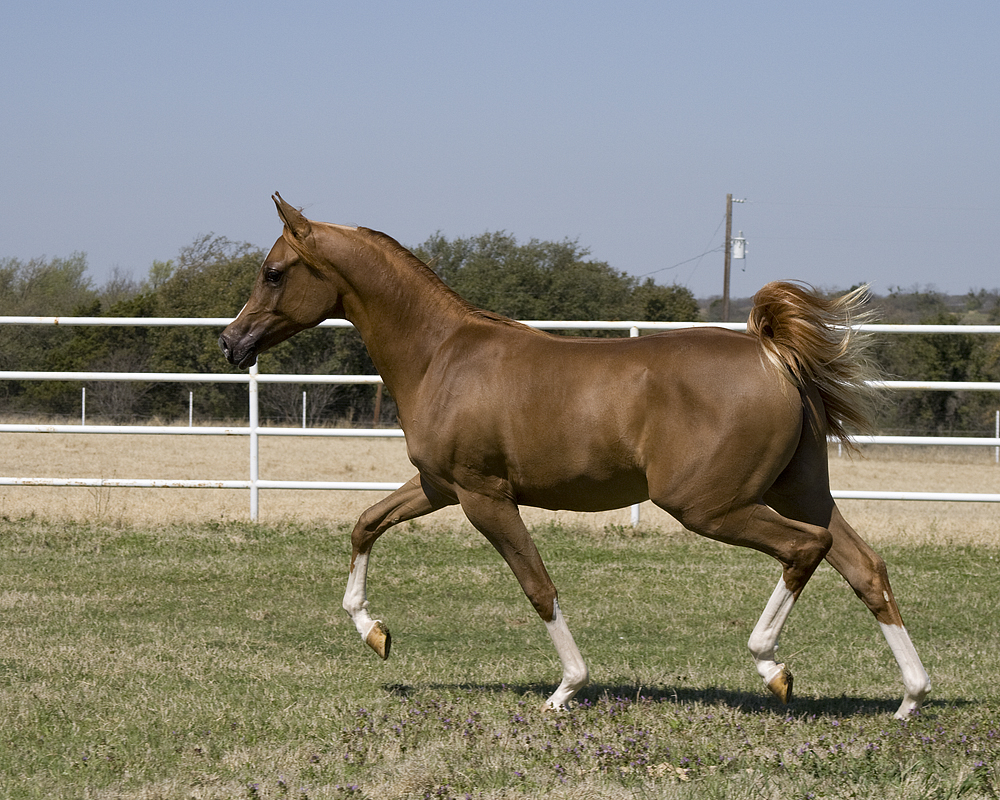
The trot is a two-beat diagonal horse gait where the diagonal pairs of legs move forward at the same time with a moment of suspension between each beat. It has a wide variation in possible speeds, but averages about 13 kilometres per hour (8.1 mph). A very slow trot is sometimes referred to as a jog. An extremely fast trot has no special name, but in harness racing, the trot of a Standardbred is faster than the gallop of the average non-racehorse, and has been clocked at over 30 miles per hour (48 km/h).
On June 29, 2014, at Pocono Downs in Pennsylvania the Swedish standardbred Sebastian K trotted a mile in 1 minute, 49 seconds (quarters were passed at 26:2, 55:3 and 1,21:4). This is equivalent to a 1000-pace in 1.07,7 or 53.14 kilometers per hour or 33 miles per hour.
From the standpoint of the balance of the horse, the trot is a very stable gait and does not require the horse to make major balancing motions with its head and neck. Due to its many variations, the trot is a common gait that the horse is worked in for dressage.
Eadweard Muybridge was the first to prove, by photography, in 1872 that there is a "moment of suspension" or "unsupported transit" during the trot gait.
Depending on the amount of engagement and collection of the horse, the trot can generally be classified as "working", "collected", or "extended". By the rhythm, one may distinguish a true, two-beat trot when each diagonal pair of hoofs hits the ground at the same moment.
Different types of trots are described by the following terms.
Trots in harness:
Trot styles for classes at horse shows:
Trot
The trot is a two-beat diagonal horse gait where the diagonal pairs of legs move forward at the same time with a moment of suspension between each beat. It has a wide variation in possible speeds, but averages about 13 kilometres per hour (8.1 mph). A very slow trot is sometimes referred to as a jog. An extremely fast trot has no special name, but in harness racing, the trot of a Standardbred is faster than the gallop of the average non-racehorse, and has been clocked at over 30 miles per hour (48 km/h).
On June 29, 2014, at Pocono Downs in Pennsylvania the Swedish standardbred Sebastian K trotted a mile in 1 minute, 49 seconds (quarters were passed at 26:2, 55:3 and 1,21:4). This is equivalent to a 1000-pace in 1.07,7 or 53.14 kilometers per hour or 33 miles per hour.
From the standpoint of the balance of the horse, the trot is a very stable gait and does not require the horse to make major balancing motions with its head and neck. Due to its many variations, the trot is a common gait that the horse is worked in for dressage.
Eadweard Muybridge was the first to prove, by photography, in 1872 that there is a "moment of suspension" or "unsupported transit" during the trot gait.
Depending on the amount of engagement and collection of the horse, the trot can generally be classified as "working", "collected", or "extended". By the rhythm, one may distinguish a true, two-beat trot when each diagonal pair of hoofs hits the ground at the same moment.
Different types of trots are described by the following terms.
Trots in harness:
Trot styles for classes at horse shows:
Recent media
Recent media