
Recent from talks
Sharpe Field
Knowledge base stats:
Talk channels stats:
Members stats:
Sharpe Field
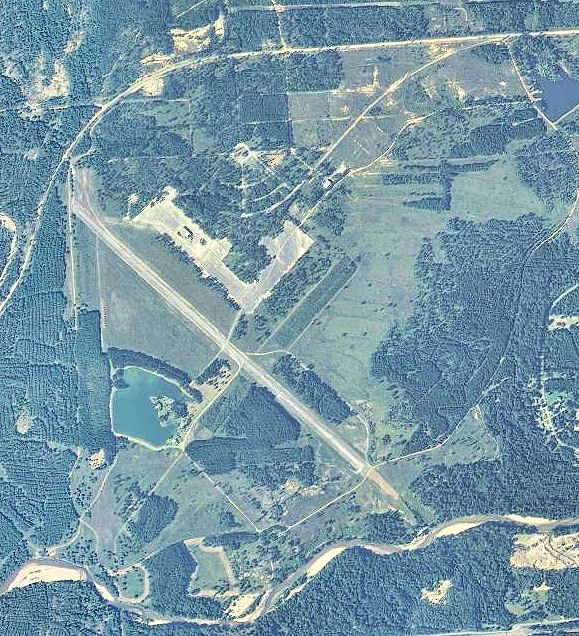
Sharpe Field (IATA: TGE, FAA LID: AL73) is a closed private-use airport located six nautical miles (11 km; 6.9 mi) northwest of the central business district of Tuskegee, a city in Macon County, Alabama, United States. This airport is privately owned by the Bradbury Family Partnership.
Formerly known as Tuskegee Army Airfield, Sharpe Field was used to train the Tuskegee Airmen during World War II. It provided advanced training for the graduates of nearby Moton Field. Most of the history of the Tuskegee Airmen was made at this site.
The airfield was designed by the African American architect Hilyard Robinson and built in 1941. Construction began on July 12, 1941. Training flights began in November of the same year, even though construction was nowhere near completion. A graded (but not yet paved) portion of the north–south runway was used to conduct initial flight training.
On 23 July 1941 the Air Corps established an Air Corps Advanced Flying School at Tuskegee; it was activated two weeks later, on 6 August. It was later renamed the Tuskegee Advanced Flying School; the Army Air Forces Advanced Flying School; and the Army Air Forces Pilot School (Basic-Advanced).
Tuskegee AAF was assigned to the Southeast Training Center of the Army Air Force Training Command. It was commanded by the 318th Army Air Force Base Unit. By the end of 1942, Tuskegee had a total of 3,414 personnel.
The March 1943 14M Regional Aeronautical Chart labeled the airfield as "Tuskegee Army Flying School" and indicated that the field had a control tower. By September 1943, Tuskegee had 4 runways & a total of 225 buildings. In addition to the main airfield, known sub-bases and auxiliaries which supported pilot training were:
Aircraft used at Tuskegee during World War II included the PT-17 biplane primary trainer, BT-13 monoplane basic trainer, AT-6 Texan advanced trainer, and P-40 Warhawk (used for fighter transition training).
The first class of African-American aviation cadets entered the second phase of military flight training (Basic) at Tuskegee AAF on 8 November 1941, under military instructors. Only 7 of the 13 original cadets remained. The 99th Pursuit Squadron moved to Tuskegee from Maxwell Field, Alabama on 5 January 1942. The Air Base Detachment would later be redesignated as the 318th Air Base Squadron and still later as the 318th Base Headquarters and Air Base Squadron.
Hub AI
Sharpe Field AI simulator
(@Sharpe Field_simulator)
Sharpe Field
Sharpe Field (IATA: TGE, FAA LID: AL73) is a closed private-use airport located six nautical miles (11 km; 6.9 mi) northwest of the central business district of Tuskegee, a city in Macon County, Alabama, United States. This airport is privately owned by the Bradbury Family Partnership.
Formerly known as Tuskegee Army Airfield, Sharpe Field was used to train the Tuskegee Airmen during World War II. It provided advanced training for the graduates of nearby Moton Field. Most of the history of the Tuskegee Airmen was made at this site.
The airfield was designed by the African American architect Hilyard Robinson and built in 1941. Construction began on July 12, 1941. Training flights began in November of the same year, even though construction was nowhere near completion. A graded (but not yet paved) portion of the north–south runway was used to conduct initial flight training.
On 23 July 1941 the Air Corps established an Air Corps Advanced Flying School at Tuskegee; it was activated two weeks later, on 6 August. It was later renamed the Tuskegee Advanced Flying School; the Army Air Forces Advanced Flying School; and the Army Air Forces Pilot School (Basic-Advanced).
Tuskegee AAF was assigned to the Southeast Training Center of the Army Air Force Training Command. It was commanded by the 318th Army Air Force Base Unit. By the end of 1942, Tuskegee had a total of 3,414 personnel.
The March 1943 14M Regional Aeronautical Chart labeled the airfield as "Tuskegee Army Flying School" and indicated that the field had a control tower. By September 1943, Tuskegee had 4 runways & a total of 225 buildings. In addition to the main airfield, known sub-bases and auxiliaries which supported pilot training were:
Aircraft used at Tuskegee during World War II included the PT-17 biplane primary trainer, BT-13 monoplane basic trainer, AT-6 Texan advanced trainer, and P-40 Warhawk (used for fighter transition training).
The first class of African-American aviation cadets entered the second phase of military flight training (Basic) at Tuskegee AAF on 8 November 1941, under military instructors. Only 7 of the 13 original cadets remained. The 99th Pursuit Squadron moved to Tuskegee from Maxwell Field, Alabama on 5 January 1942. The Air Base Detachment would later be redesignated as the 318th Air Base Squadron and still later as the 318th Base Headquarters and Air Base Squadron.
Recent media