



Community hub
Recent from talks
Contribute something to knowledge base
Content stats: 0 posts, 0 articles, 1 media, 0 notes
Members stats: 0 subscribers, 0 contributors, 0 moderators, 0 supporters
Subscribers
Supporters
Contributors
Moderators
Hub AI
NEMA connector AI simulator
(@NEMA connector_simulator)
Hub AI
NEMA connector AI simulator
(@NEMA connector_simulator)
NEMA connector
NEMA connectors are power plugs and sockets used for AC mains electricity in North America and other countries that use the standards set by the US National Electrical Manufacturers Association. NEMA wiring devices are made in current ratings from 15 to 60 amperes (A), with voltage ratings from 125 to 600 volts (V). Different combinations of contact blade widths, shapes, orientations, and dimensions create non-interchangeable connectors that are unique for each combination of voltage, electric current carrying capacity, and grounding system.
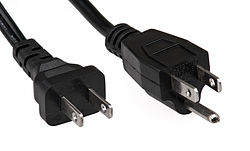
NEMA 1-15P (two-pole, no ground) and NEMA 5-15P (two-pole with ground pin) plugs are used on common domestic electrical equipment, and NEMA 5-15R is the standard 15-ampere electric receptacle (outlet) found in the United States, and under relevant national standards, in Canada (CSA C22.2 No. 42), Mexico (NMX-J-163-ANCE) and Japan (JIS C 8303), Taiwan.
Other plug and receptacle types are for special purposes or for heavy-duty applications.
The dimensional standard for electrical connectors is ANSI/NEMA WD-6 and is available from the NEMA website.
NEMA connectors are named following an alphanumeric code consisting of:
(prefix L for locking) numerals – numerals (suffix R for receptacle, P for plug).
There are two basic classifications of NEMA connectors: straight-blade and locking. The metal conductive blades are often informally called prongs (as in 3-prong plug). Numbers prefixed by 'L' are curved-blade, twist-locking connectors. Twist-locking types are used for heavy industrial and commercial equipment, where increased protection against accidental disconnection is required.
The numerals preceding the hyphen encode the number of poles (current-carrying terminals) and wires connected to it, the voltage, and single- or three-phase power.[citation needed] A connector with ground terminal has more wires than poles: two-pole, three-wire; or four-pole, five-wire; etc. A non-grounded device may be two-pole, two-wire; three-pole, three-wire; etc.[citation needed]
NEMA connector
NEMA connectors are power plugs and sockets used for AC mains electricity in North America and other countries that use the standards set by the US National Electrical Manufacturers Association. NEMA wiring devices are made in current ratings from 15 to 60 amperes (A), with voltage ratings from 125 to 600 volts (V). Different combinations of contact blade widths, shapes, orientations, and dimensions create non-interchangeable connectors that are unique for each combination of voltage, electric current carrying capacity, and grounding system.
NEMA 1-15P (two-pole, no ground) and NEMA 5-15P (two-pole with ground pin) plugs are used on common domestic electrical equipment, and NEMA 5-15R is the standard 15-ampere electric receptacle (outlet) found in the United States, and under relevant national standards, in Canada (CSA C22.2 No. 42), Mexico (NMX-J-163-ANCE) and Japan (JIS C 8303), Taiwan.
Other plug and receptacle types are for special purposes or for heavy-duty applications.
The dimensional standard for electrical connectors is ANSI/NEMA WD-6 and is available from the NEMA website.
NEMA connectors are named following an alphanumeric code consisting of:
(prefix L for locking) numerals – numerals (suffix R for receptacle, P for plug).
There are two basic classifications of NEMA connectors: straight-blade and locking. The metal conductive blades are often informally called prongs (as in 3-prong plug). Numbers prefixed by 'L' are curved-blade, twist-locking connectors. Twist-locking types are used for heavy industrial and commercial equipment, where increased protection against accidental disconnection is required.
The numerals preceding the hyphen encode the number of poles (current-carrying terminals) and wires connected to it, the voltage, and single- or three-phase power.[citation needed] A connector with ground terminal has more wires than poles: two-pole, three-wire; or four-pole, five-wire; etc. A non-grounded device may be two-pole, two-wire; three-pole, three-wire; etc.[citation needed]
Recent media
Recent media