


Community hub
Recent from talks
Knowledge base stats:
Talk channels stats:
Members stats:
Translinear circuit
A translinear circuit is a circuit that carries out its function using the translinear principle. These are current-mode circuits that can be made using transistors that obey an exponential current-voltage characteristic—this includes bipolar junction transistors (BJTs) and CMOS transistors in weak inversion. Translinearity, in a broad sense, is linear dependence of transconductance on current, which occurs in components with exponential current-voltage relationship.
The word translinear (TL) was invented by Barrie Gilbert in 1975 to describe circuits that used the exponential current-voltage relation of BJTs. By using this exponential relationship, this class of circuits can implement multiplication, amplification and power-law relationships. When Barrie Gilbert described this class of circuits he also described the translinear principle (TLP) which made the analysis of these circuits possible in a way that the simplified view of BJTs as linear current amplifiers did not allow. TLP was later extended to include other elements that obey an exponential current-voltage relationship (such as CMOS transistors in weak inversion).
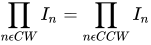
The translinear principle (TLP) is that in a closed loop containing an even number of translinear elements (TEs) with an equal number of them arranged clockwise and counter-clockwise, the product of the currents through the clockwise TEs equals the product of the currents through the counter-clockwise TEs or
The TLP is dependent on the exponential current-voltage relationship of a circuit element. Thus, an ideal TE follows the relationship
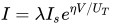
where is a pre-exponential scaling current, is a dimensionless multiplier to , is a dimensionless multiplier to the gate-emitter voltage and is the thermal voltage .


In a circuit, TEs are described as either clockwise (CW) or counterclockwise (CCW). If the arrow on the emitter points clockwise, it is considered a CW TE, if it points counterclockwise, it is considered a CCW TE. Consider an example:
By Kirchhoff's voltage law, the voltage around the loop that goes from to must be 0. In other words, the voltage drops must equal the voltage increases. When a loop that only goes through the emitter-gate connections of TEs exists, we call it a translinear loop. Mathematically, this becomes

Hub AI
Translinear circuit AI simulator
(@Translinear circuit_simulator)
Translinear circuit
A translinear circuit is a circuit that carries out its function using the translinear principle. These are current-mode circuits that can be made using transistors that obey an exponential current-voltage characteristic—this includes bipolar junction transistors (BJTs) and CMOS transistors in weak inversion. Translinearity, in a broad sense, is linear dependence of transconductance on current, which occurs in components with exponential current-voltage relationship.
The word translinear (TL) was invented by Barrie Gilbert in 1975 to describe circuits that used the exponential current-voltage relation of BJTs. By using this exponential relationship, this class of circuits can implement multiplication, amplification and power-law relationships. When Barrie Gilbert described this class of circuits he also described the translinear principle (TLP) which made the analysis of these circuits possible in a way that the simplified view of BJTs as linear current amplifiers did not allow. TLP was later extended to include other elements that obey an exponential current-voltage relationship (such as CMOS transistors in weak inversion).
The translinear principle (TLP) is that in a closed loop containing an even number of translinear elements (TEs) with an equal number of them arranged clockwise and counter-clockwise, the product of the currents through the clockwise TEs equals the product of the currents through the counter-clockwise TEs or
The TLP is dependent on the exponential current-voltage relationship of a circuit element. Thus, an ideal TE follows the relationship
where is a pre-exponential scaling current, is a dimensionless multiplier to , is a dimensionless multiplier to the gate-emitter voltage and is the thermal voltage .
In a circuit, TEs are described as either clockwise (CW) or counterclockwise (CCW). If the arrow on the emitter points clockwise, it is considered a CW TE, if it points counterclockwise, it is considered a CCW TE. Consider an example:
By Kirchhoff's voltage law, the voltage around the loop that goes from to must be 0. In other words, the voltage drops must equal the voltage increases. When a loop that only goes through the emitter-gate connections of TEs exists, we call it a translinear loop. Mathematically, this becomes