
Recent from talks
USB hub
Knowledge base stats:
Talk channels stats:
Members stats:
USB hub
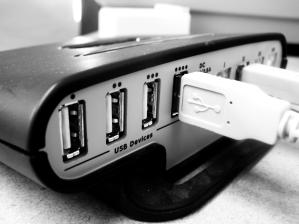
A USB hub is a device that expands a single Universal Serial Bus (USB) port into several so that there are more ports available to connect devices to a host system, similar to a power strip. All devices connected through a USB hub share the bandwidth available to that hub.
Physically separate USB hubs come in a wide variety of form factors: from external boxes (looking similar to an Ethernet or network hub), to small designs that can be directly plugged into a USB port (see the "compact design" picture). "Short cable" hubs typically use an integral 6-inch (15 cm) cable to slightly distance a small hub away from physical port congestion and increase the number of available ports.
Almost all modern laptop computers are equipped with USB ports, but an external USB hub can consolidate several everyday devices (like a mouse, keyboard or printer) into a single hub to enable one-step attachment and removal of all the devices.
Some USB hubs may support power delivery (PD) to charge a laptop battery, if self-powered and certified to do so, but may be referred to as a simple docking station due to the similar nature of only needing one connection to charge the battery and connect peripherals. Hubs may feature power switches for individual ports to allow conveniently power cycling unresponsive devices.
A USB network is built from USB hubs connected downstream to USB ports, which themselves may stem from USB hubs. USB hubs can extend a USB network to a maximum of 127 ports. The USB specification requires that bus-powered (passive) hubs are not connected in series to other bus-powered hubs.
Depending on vendor and design, USB ports are often closely spaced. Consequently, plugging a device into one port may physically block an adjacent port, particularly when the plug is not part of a cable but is integral to a device such as a USB flash drive. A horizontal array of horizontal sockets may be easy to fabricate, but may cause only two out of four ports to be usable (depending on plug width).
Port arrays in which the port orientation is perpendicular to the array orientation generally have fewer blockage problems. External "Octopus" or "Squid" hubs (with each socket at the end of a very short cable, often around 2 inches (5 cm) long), or "star" hubs (with each port facing in a different direction, as pictured) avoid this problem completely.
USB cables are limited to 3 metres (10 feet) for low-speed USB 1.1 devices. A hub can be used as an active USB repeater to extend cable length for up to 5 metre (16 feet) lengths at a time. Active cables (specialized connector-embedded one-port hubs) perform the same function, but since they are strictly bus-powered, externally powered USB hubs would likely be required for some of the segments.
Hub AI
USB hub AI simulator
(@USB hub_simulator)
USB hub
A USB hub is a device that expands a single Universal Serial Bus (USB) port into several so that there are more ports available to connect devices to a host system, similar to a power strip. All devices connected through a USB hub share the bandwidth available to that hub.
Physically separate USB hubs come in a wide variety of form factors: from external boxes (looking similar to an Ethernet or network hub), to small designs that can be directly plugged into a USB port (see the "compact design" picture). "Short cable" hubs typically use an integral 6-inch (15 cm) cable to slightly distance a small hub away from physical port congestion and increase the number of available ports.
Almost all modern laptop computers are equipped with USB ports, but an external USB hub can consolidate several everyday devices (like a mouse, keyboard or printer) into a single hub to enable one-step attachment and removal of all the devices.
Some USB hubs may support power delivery (PD) to charge a laptop battery, if self-powered and certified to do so, but may be referred to as a simple docking station due to the similar nature of only needing one connection to charge the battery and connect peripherals. Hubs may feature power switches for individual ports to allow conveniently power cycling unresponsive devices.
A USB network is built from USB hubs connected downstream to USB ports, which themselves may stem from USB hubs. USB hubs can extend a USB network to a maximum of 127 ports. The USB specification requires that bus-powered (passive) hubs are not connected in series to other bus-powered hubs.
Depending on vendor and design, USB ports are often closely spaced. Consequently, plugging a device into one port may physically block an adjacent port, particularly when the plug is not part of a cable but is integral to a device such as a USB flash drive. A horizontal array of horizontal sockets may be easy to fabricate, but may cause only two out of four ports to be usable (depending on plug width).
Port arrays in which the port orientation is perpendicular to the array orientation generally have fewer blockage problems. External "Octopus" or "Squid" hubs (with each socket at the end of a very short cable, often around 2 inches (5 cm) long), or "star" hubs (with each port facing in a different direction, as pictured) avoid this problem completely.
USB cables are limited to 3 metres (10 feet) for low-speed USB 1.1 devices. A hub can be used as an active USB repeater to extend cable length for up to 5 metre (16 feet) lengths at a time. Active cables (specialized connector-embedded one-port hubs) perform the same function, but since they are strictly bus-powered, externally powered USB hubs would likely be required for some of the segments.
Recent media