


Community hub
Universal hashing
View on WikipediaIn mathematics and computing, universal hashing (in a randomized algorithm or data structure) refers to selecting a hash function at random from a family of hash functions with a certain mathematical property (see definition below). This guarantees a low number of collisions in expectation, even if the data is chosen by an adversary. Many universal families are known (for hashing integers, vectors, strings), and their evaluation is often very efficient. Universal hashing has numerous uses in computer science, for example in implementations of hash tables, randomized algorithms, and cryptography.
Introduction
[edit]Assume we want to map keys from some universe into bins (labelled ). The algorithm will have to handle some data set of keys, which is not known in advance. Usually, the goal of hashing is to obtain a low number of collisions (keys from that land in the same bin). A deterministic hash function cannot offer any guarantee in an adversarial setting if , since the adversary may choose to be precisely the preimage of a bin. This means that all data keys land in the same bin, making hashing useless. Furthermore, a deterministic hash function does not allow for rehashing: sometimes the input data turns out to be bad for the hash function (e.g. there are too many collisions), so one would like to change the hash function.


![{\displaystyle [m]=\{0,\dots ,m-1\}}](https://wikimedia.org/api/rest_v1/media/math/render/svg/d9353ecda11480fd9431a5a15de494b7827f0020)


The solution to these problems is to pick a function randomly from a family of hash functions. A family of functions is called a universal family if, .
![{\displaystyle H=\{h:U\to [m]\}}](https://wikimedia.org/api/rest_v1/media/math/render/svg/07dbe0dc6d02fc97f45867f07178c7000d6343b9)

In other words, any two different keys of the universe collide with probability at most when the hash function is drawn uniformly at random from . This is exactly the probability of collision we would expect if the hash function assigned truly random hash codes to every key.


Sometimes, the definition is relaxed by a constant factor, only requiring collision probability rather than . This concept was introduced by Carter and Wegman[1] in 1977, and has found numerous applications in computer science (see, for example[2]).


If we have an upper bound of on the collision probability, we say that we have -almost universality. So for example, a universal family has -almost universality.


Many, but not all, universal families have the following stronger uniform difference property:
- , when is drawn randomly from the family , the difference is uniformly distributed in .


![{\displaystyle [m]}](https://wikimedia.org/api/rest_v1/media/math/render/svg/b649f5418f2ac84d66063f41319368b0926ccec4)
Note that the definition of universality is only concerned with whether , which counts collisions. The uniform difference property is stronger.

(Similarly, a universal family can be XOR universal if , the value is uniformly distributed in where is the bitwise exclusive or operation. This is only possible if is a power of two.)


An even stronger condition is pairwise independence: we have this property when we have the probability that will hash to any pair of hash values is as if they were perfectly random: . Pairwise independence is sometimes called strong universality.



Another property is uniformity. We say that a family is uniform if all hash values are equally likely: for any hash value . Universality does not imply uniformity. However, strong universality does imply uniformity.


Given a family with the uniform distance property, one can produce a pairwise independent or strongly universal hash family by adding a uniformly distributed random constant with values in to the hash functions. (Similarly, if is a power of two, we can achieve pairwise independence from an XOR universal hash family by doing an exclusive or with a uniformly distributed random constant.) Since a shift by a constant is sometimes irrelevant in applications (e.g. hash tables), a careful distinction between the uniform distance property and pairwise independent is sometimes not made.[3]
For some applications (such as hash tables), it is important for the least significant bits of the hash values to be also universal. When a family is strongly universal, this is guaranteed: if is a strongly universal family with , then the family made of the functions for all is also strongly universal for . Unfortunately, the same is not true of (merely) universal families. For example, the family made of the identity function is clearly universal, but the family made of the function fails to be universal.



UMAC and Poly1305-AES and several other message authentication code algorithms are based on universal hashing.[4][5] In such applications, the software chooses a new hash function for every message, based on a unique nonce for that message.
Several hash table implementations are based on universal hashing. In such applications, typically the software chooses a new hash function only after it notices that "too many" keys have collided; until then, the same hash function continues to be used over and over. (Some collision resolution schemes, such as dynamic perfect hashing, pick a new hash function every time there is a collision. Other collision resolution schemes, such as cuckoo hashing and 2-choice hashing, allow a number of collisions before picking a new hash function). A survey of fastest known universal and strongly universal hash functions for integers, vectors, and strings is found in.[6]
Mathematical guarantees
[edit]For any fixed set of keys, using a universal family guarantees the following properties.

- For any fixed in , the expected number of keys in the bin is . When implementing hash tables by chaining, this number is proportional to the expected running time of an operation involving the key (for example a query, insertion or deletion).
- The expected number of pairs of keys in with that collide () is bounded above by , which is of order . When the number of bins, is chosen linear in (i.e., is determined by a function in ), the expected number of collisions is . When hashing into bins, there are no collisions at all with probability at least a half.
- The expected number of keys in bins with at least keys in them is bounded above by .[7] Thus, if the capacity of each bin is capped to three times the average size (), the total number of keys in overflowing bins is at most . This only holds with a hash family whose collision probability is bounded above by . If a weaker definition is used, bounding it by , this result is no longer true.[7]





As the above guarantees hold for any fixed set , they hold if the data set is chosen by an adversary. However, the adversary has to make this choice before (or independent of) the algorithm's random choice of a hash function. If the adversary can observe the random choice of the algorithm, randomness serves no purpose, and the situation is the same as deterministic hashing.
The second and third guarantee are typically used in conjunction with rehashing. For instance, a randomized algorithm may be prepared to handle some number of collisions. If it observes too many collisions, it chooses another random from the family and repeats. Universality guarantees that the number of repetitions is a geometric random variable.
Constructions
[edit]Since any computer data can be represented as one or more machine words, one generally needs hash functions for three types of domains: machine words ("integers"); fixed-length vectors of machine words; and variable-length vectors ("strings").
Hashing integers
[edit]This section refers to the case of hashing integers that fit in machines words; thus, operations like multiplication, addition, division, etc. are cheap machine-level instructions. Let the universe to be hashed be .

The original proposal of Carter and Wegman[1] was to pick a prime and define


where are randomly chosen integers modulo with . (This is a single iteration of a linear congruential generator.)


To see that is a universal family, note that only holds when


for some integer between and . Since , if their difference is nonzero and has an inverse modulo . Solving for yields


- .

There are possible choices for (since is excluded) and, varying in the allowed range, possible non-zero values for the right hand side. Thus the collision probability is


- .

Another way to see is a universal family is via the notion of statistical distance. Write the difference as

- .

Since is nonzero and is uniformly distributed in , it follows that modulo is also uniformly distributed in . The distribution of is thus almost uniform, up to a difference in probability of between the samples. As a result, the statistical distance to a uniform family is , which becomes negligible when .
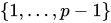


The family of simpler hash functions

is only approximately universal: for all .[1] Moreover, this analysis is nearly tight; Carter and Wegman [1] show that whenever .



Avoiding modular arithmetic
[edit]The state of the art for hashing integers is the multiply-shift scheme described by Dietzfelbinger et al. in 1997.[8] By avoiding modular arithmetic, this method is much easier to implement and also runs significantly faster in practice (usually by at least a factor of four[9]). The scheme assumes the number of bins is a power of two, . Let be the number of bits in a machine word. Then the hash functions are parametrised over odd positive integers (that fit in a word of bits). To evaluate , multiply by modulo and then keep the high order bits as the hash code. In mathematical notation, this is


This scheme does not satisfy the uniform difference property and is only -almost-universal; for any , .

To understand the behavior of the hash function, notice that, if and have the same highest-order 'M' bits, then has either all 1's or all 0's as its highest order M bits (depending on whether or is larger). Assume that the least significant set bit of appears on position . Since is a random odd integer and odd integers have inverses in the ring , it follows that will be uniformly distributed among -bit integers with the least significant set bit on position . The probability that these bits are all 0's or all 1's is therefore at most . On the other hand, if , then higher-order M bits of contain both 0's and 1's, so it is certain that . Finally, if then bit of is 1 and if and only if bits are also 1, which happens with probability .





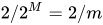


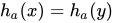

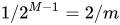
This analysis is tight, as can be shown with the example and . To obtain a truly 'universal' hash function, one can use the multiply-add-shift scheme that picks higher-order bits



where is a random positive integer with and is a random non-negative integer with . This requires doing arithmetic on -bit unsigned integers. This version of multiply-shift is due to Dietzfelbinger, and was later analyzed more precisely by Woelfel.[10]


Hashing vectors
[edit]This section is concerned with hashing a fixed-length vector of machine words. Interpret the input as a vector of machine words (integers of bits each). If is a universal family with the uniform difference property, the following family (dating back to Carter and Wegman[1]) also has the uniform difference property (and hence is universal):


- , where each is chosen independently at random.


If is a power of two, one may replace summation by exclusive or.[11]
In practice, if double-precision arithmetic is available, this is instantiated with the multiply-shift hash family of hash functions.[12] Initialize the hash function with a vector of random odd integers on bits each. Then if the number of bins is for :


- .

It is possible to halve the number of multiplications, which roughly translates to a two-fold speed-up in practice.[11] Initialize the hash function with a vector of random odd integers on bits each. The following hash family is universal:[13]
- .

If double-precision operations are not available, one can interpret the input as a vector of half-words (-bit integers). The algorithm will then use multiplications, where was the number of half-words in the vector. Thus, the algorithm runs at a "rate" of one multiplication per word of input.


The same scheme can also be used for hashing integers, by interpreting their bits as vectors of bytes. In this variant, the vector technique is known as tabulation hashing and it provides a practical alternative to multiplication-based universal hashing schemes.[14]
Strong universality at high speed is also possible.[15] Initialize the hash function with a vector of random integers on bits. Compute

- .

The result is strongly universal on bits. Experimentally, it was found to run at 0.2 CPU cycle per byte on recent Intel processors for .

Hashing strings
[edit]This refers to hashing a variable-sized vector of machine words. If the length of the string can be bounded by a small number, it is best to use the vector solution from above (conceptually padding the vector with zeros up to the upper bound). The space required is the maximal length of the string, but the time to evaluate is just the length of . As long as zeroes are forbidden in the string, the zero-padding can be ignored when evaluating the hash function without affecting universality.[11] Note that if zeroes are allowed in the string, then it might be best to append a fictitious non-zero (e.g., 1) character to all strings prior to padding: this will ensure that universality is not affected.[15]


Now assume we want to hash , where a good bound on is not known a priori. A universal family proposed by [12] treats the string as the coefficients of a polynomial modulo a large prime. If , let be a prime and define:


![{\displaystyle x_{i}\in [u]}](https://wikimedia.org/api/rest_v1/media/math/render/svg/c1a8f3e58fea39996cd65abcad5c67a60498d29a)

- , where is uniformly random and is chosen randomly from a universal family mapping integer domain .

![{\displaystyle a\in [p]}](https://wikimedia.org/api/rest_v1/media/math/render/svg/4136076074610e0f9ddbf1c3504b44dbeff8ae8a)

![{\displaystyle [p]\mapsto [m]}](https://wikimedia.org/api/rest_v1/media/math/render/svg/bb01b98752c60514a0ad7be0f93c91a90c6935af)
Using properties of modular arithmetic, above can be computed without producing large numbers for large strings as follows:[16]
uint hash(String x, int a, int p)
	uint h = INITIAL_VALUE
	for (uint i = 0; i < x.length; ++i)
		h = ((h*a) + x[i]) mod p
	return h
This Rabin-Karp rolling hash is based on a linear congruential generator.[17] Above algorithm is also known as Multiplicative hash function.[18] In practice, the mod operator and the parameter p can be avoided altogether by allowing integer to overflow because it is equivalent to mod (Max-Int-Value + 1) in many programming languages. However, using the non-prime modulus is prone to collisions with certain inputs, regardless of the value of a. Below table shows values chosen to initialize h and a for some of the popular implementations.

| Implementation | INITIAL_VALUE | a |
|---|---|---|
| Bernstein's hash function djb2[19] | 5381 | 33 |
| STLPort 4.6.2 | 0 | 5 |
| Kernighan and Ritchie's hash function[20] | 0 | 31 |
java.lang.String.hashCode()[21]
|
0 | 31 |
Consider two strings and let be length of the longer one; for the analysis, the shorter string is conceptually padded with zeros up to length . A collision before applying implies that is a root of the polynomial with coefficients . This polynomial has at most roots modulo , so the collision probability is at most . The probability of collision through the random brings the total collision probability to . Thus, if the prime is sufficiently large compared to the length of strings hashed, the family is very close to universal (in statistical distance).


Other universal families of hash functions used to hash unknown-length strings to fixed-length hash values include the Rabin fingerprint and the Buzhash.
Avoiding modular arithmetic
[edit]To mitigate the computational penalty of modular arithmetic, three tricks are used in practice:[11]
- One chooses the prime to be close to a power of two, such as a Mersenne prime. This allows arithmetic modulo to be implemented without division (using faster operations like addition and shifts). For instance, on modern architectures one can work with , while 's are 32-bit values.
- One can apply vector hashing to blocks. For instance, one applies vector hashing to each 16-word block of the string, and applies string hashing to the results. Since the slower string hashing is applied on a substantially smaller vector, this will essentially be as fast as vector hashing.
- One chooses a power-of-two as the divisor, allowing arithmetic modulo to be implemented without division (using faster operations of bit masking). The NH hash-function family takes this approach.


See also
[edit]- k-independent hashing – Family of hash functions
- Rolling hashing – Type of hash function
- Tabulation hashing – Hash functions computed by exclusive or
- Min-wise independence – Data mining technique
- Universal one-way hash function
- Low-discrepancy sequence – Type of mathematical sequence
- Perfect hashing – Hash function without any collisions
References
[edit]- ^ a b c d e Carter, Larry; Wegman, Mark N. (1979). "Universal Classes of Hash Functions". Journal of Computer and System Sciences. 18 (2): 143–154. doi:10.1016/0022-0000(79)90044-8. Conference version in STOC'77.
- ^ Miltersen, Peter Bro. "Universal Hashing" (PDF). Archived from the original (PDF) on 24 May 2011. Retrieved 24 June 2009.
- ^ Motwani, Rajeev; Raghavan, Prabhakar (1995). Randomized Algorithms. Cambridge University Press. p. 221. ISBN 0-521-47465-5.
- ^ David Wagner, ed. "Advances in Cryptology - CRYPTO 2008". p. 145.
- ^ Jean-Philippe Aumasson, Willi Meier, Raphael Phan, Luca Henzen. "The Hash Function BLAKE". 2014. p. 10.
- ^ Thorup, Mikkel (2015). "High Speed Hashing for Integers and Strings". arXiv:1504.06804 [cs.DS].
- ^ a b Baran, Ilya; Demaine, Erik D.; Pătraşcu, Mihai (2008). "Subquadratic Algorithms for 3SUM" (PDF). Algorithmica. 50 (4): 584–596. doi:10.1007/s00453-007-9036-3. S2CID 9855995.
- ^ Dietzfelbinger, Martin; Hagerup, Torben; Katajainen, Jyrki; Penttonen, Martti (1997). "A Reliable Randomized Algorithm for the Closest-Pair Problem" (Postscript). Journal of Algorithms. 25 (1): 19–51. doi:10.1006/jagm.1997.0873. Retrieved 10 February 2011.
- ^ Thorup, Mikkel (18 December 2009). "Text-book algorithms at SODA".
- ^ Woelfel, Philipp (1999). Efficient Strongly Universal and Optimally Universal Hashing. Mathematical Foundations of Computer Science 1999. LNCS. Vol. 1672. pp. 262–272. doi:10.1007/3-540-48340-3_24.
- ^ a b c d Thorup, Mikkel (2009). String hashing for linear probing. Proc. 20th ACM-SIAM Symposium on Discrete Algorithms (SODA). pp. 655–664. CiteSeerX 10.1.1.215.4253. doi:10.1137/1.9781611973068.72. ISBN 978-0-89871-680-1., section 5.3
- ^ a b Dietzfelbinger, Martin; Gil, Joseph; Matias, Yossi; Pippenger, Nicholas (1992). Polynomial Hash Functions Are Reliable (Extended Abstract). Proc. 19th International Colloquium on Automata, Languages and Programming (ICALP). pp. 235–246.
- ^ Black, J.; Halevi, S.; Krawczyk, H.; Krovetz, T. (1999). UMAC: Fast and Secure Message Authentication (PDF). Advances in Cryptology (CRYPTO '99)., Equation 1
- ^ Pătraşcu, Mihai; Thorup, Mikkel (2011). The power of simple tabulation hashing. Proceedings of the 43rd annual ACM Symposium on Theory of Computing (STOC '11). pp. 1–10. arXiv:1011.5200. doi:10.1145/1993636.1993638. ISBN 9781450306911.
- ^ a b Kaser, Owen; Lemire, Daniel (2013). "Strongly universal string hashing is fast". Computer Journal. 57 (11). Oxford University Press: 1624–1638. arXiv:1202.4961. doi:10.1093/comjnl/bxt070.
- ^ "Hebrew University Course Slides" (PDF).
- ^ Robert Uzgalis. "Library Hash Functions". 1996.
- ^ Kankowsk, Peter. "Hash functions: An empirical comparison".
- ^ Yigit, Ozan. "String hash functions".
- ^ Kernighan; Ritchie (1988). "6". The C Programming Language (2nd ed.). Prentice Hall. pp. 118. ISBN 0-13-110362-8.
{{cite book}}: CS1 maint: multiple names: authors list (link) - ^ "String (Java Platform SE 6)". docs.oracle.com. Retrieved 2015-06-10.
Further reading
[edit]- Knuth, Donald Ervin (1998). The Art of Computer Programming, Vol. III: Sorting and Searching (3rd ed.). Reading, Mass; London: Addison-Wesley. ISBN 0-201-89685-0.