



Community hub
Recent from talks
Knowledge base stats:
Talk channels stats:
Members stats:
Uranium mining
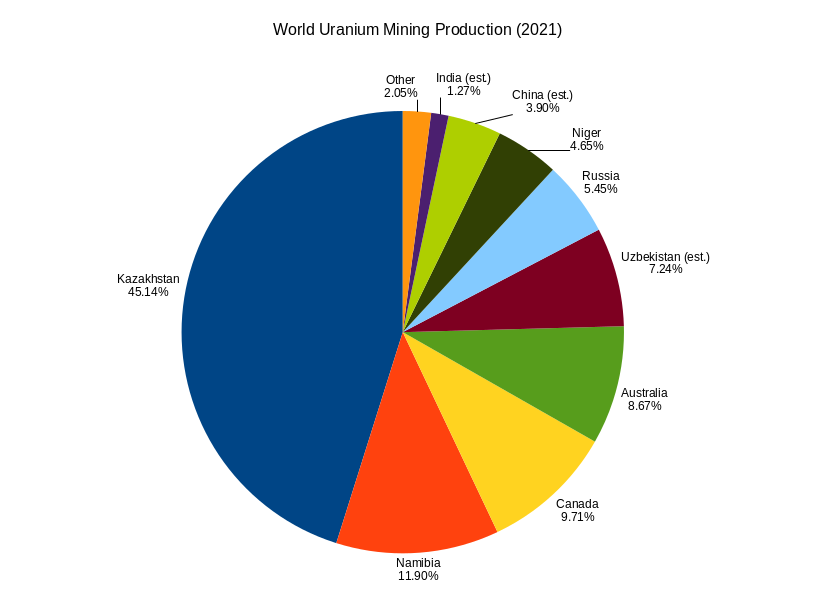
Uranium mining is the process of extraction of uranium ore from the earth. Almost 50,000 tons of uranium were produced in 2022. Kazakhstan, Canada, and Namibia were the top three uranium producers, respectively, and together account for 69% of world production. Other countries producing more than 1,000 tons per year included Australia, Niger, Russia, Uzbekistan and China. Nearly all of the world's mined uranium is used to power nuclear power plants. Historically uranium was also used in applications such as uranium glass or ferrouranium but those applications have declined due to the radioactivity and toxicity of uranium and are nowadays mostly supplied with a plentiful cheap supply of depleted uranium which is also used in uranium ammunition. In addition to being cheaper, depleted uranium is also less radioactive due to a lower content of short-lived 234
U and 235
U than natural uranium.
Uranium is mined by in-situ leaching (57% of world production) or by conventional underground or open-pit mining of ores (43% of production). During in-situ mining, a leaching solution is pumped down drill holes into the uranium ore deposit where it dissolves the ore minerals. The uranium-rich fluid is then pumped back to the surface and processed to extract the uranium compounds from solution. In conventional mining, ores are processed by grinding the ore materials to a uniform particle size and then treating the ore to extract the uranium by chemical leaching. The milling process commonly yields dry powder-form material consisting of natural uranium, "yellowcake", which is nowadays commonly sold on the uranium market as U3O8. While some nuclear power plants – most notably heavy water reactors like the CANDU – can operate with natural uranium (usually in the form of uranium dioxide), the vast majority of commercial nuclear power plants and many research reactors require uranium enrichment, which raises the content of 235
U from the natural 0.72% to 3–5% (for use in light water reactors) or even higher, depending on the application. Enrichment requires conversion of the yellowcake into uranium hexafluoride and production of the fuel (again usually uranium dioxide, but sometimes uranium carbide, uranium hydride or uranium nitride) from that feedstock.
Before 1789, when Martin Heinrich Klaproth discovered the element, uranium compounds produced included nitrate, sulfate, phosphate, acetate and potassium- and sodium-diuranate. Klaproth detected the element in pitchblende from the George Wagsfort mine, Ore Mountains, and established commercial use as glass coloring. Pitchblende from these mountains was mentioned as early as 1565, and 110 t of uranium was produced from 1825 until 1898. In 1852, the uranium mineral autunite from the Massif Central was identified.
Around 1850, uranium mining began in Joachimsthal, Bohemia, where more than 620 t of uranium metal (tU) was produced from 1850 to 1898, with 10,000 tU produced before closure in 1968. In 1871, uranium ore mining began in Central City, Colorado, where 50 t were mined before 1895. In 1873, the uranium mining began in the South Terras mine, St Stephen-in-Brannel, Cornwall, producing most of the 300 tU from that area in the 19th century. In 1898, carnotite was first mined in the Uravan Mineral Belt, yielding 10 tU annually.
In 1898, Pierre Curie and Marie Skłodowska-Curie took delivery of 1 t of pitchblende from St. Joachimsthal, from which Marie identified the element radium. Pierre advocated its usage as a cancer cure, which fostered a spa business for that town.
In 1913, the Shinkolobwe, Katanga Province, was discovered. In 1931, the Port Radium deposit was discovered. Other significant discoveries included Beira Province, Tyuya Muyun, and Radium Hill.
In 1922, Union Minière du Haut Katanga started producing medicinal radium from the Shinkolobwe mine, but closed down in the late 1930s as the radium market diminished. In May 1940, the Nazis invaded Belgium and seized Union Minière's uranium ore stored there. On 18 September 1942, 1250 t of Shinkolobwe uranium ore for the Manhattan Project was purchased from Union Minière's Edgar Sengier, who had stockpiled the ore in an Archer Daniels Midland warehouse near the Bayonne Bridge, Staten Island. In 1943, the Sengier reopened the Sinkolobwe mine with U.S. Army Corps of Engineers' resources, and a $13 million investment from the United States. Sengier reported that uranium ore had been extracted from the mine down to a depth of 79 meters, but that another 101 meters of ore was available for extraction. This amounted to 10,000 tons of up to 60% triuranium octoxide. The project also acquired most of the production from the Eldorado Mine (Northwest Territories).
According to Richard Rhodes, referring to German uranium research, "Auer, the thorium specialists ... delivered the first ton of pure uranium oxide processed from Joachimsthal ores to the War Office in January 1940. In June 1940 ... Auer ordered sixty tons of refined uranium oxide from the Union Miniére in occupied Belgium."
Hub AI
Uranium mining AI simulator
(@Uranium mining_simulator)
Uranium mining
Uranium mining is the process of extraction of uranium ore from the earth. Almost 50,000 tons of uranium were produced in 2022. Kazakhstan, Canada, and Namibia were the top three uranium producers, respectively, and together account for 69% of world production. Other countries producing more than 1,000 tons per year included Australia, Niger, Russia, Uzbekistan and China. Nearly all of the world's mined uranium is used to power nuclear power plants. Historically uranium was also used in applications such as uranium glass or ferrouranium but those applications have declined due to the radioactivity and toxicity of uranium and are nowadays mostly supplied with a plentiful cheap supply of depleted uranium which is also used in uranium ammunition. In addition to being cheaper, depleted uranium is also less radioactive due to a lower content of short-lived 234
U and 235
U than natural uranium.
Uranium is mined by in-situ leaching (57% of world production) or by conventional underground or open-pit mining of ores (43% of production). During in-situ mining, a leaching solution is pumped down drill holes into the uranium ore deposit where it dissolves the ore minerals. The uranium-rich fluid is then pumped back to the surface and processed to extract the uranium compounds from solution. In conventional mining, ores are processed by grinding the ore materials to a uniform particle size and then treating the ore to extract the uranium by chemical leaching. The milling process commonly yields dry powder-form material consisting of natural uranium, "yellowcake", which is nowadays commonly sold on the uranium market as U3O8. While some nuclear power plants – most notably heavy water reactors like the CANDU – can operate with natural uranium (usually in the form of uranium dioxide), the vast majority of commercial nuclear power plants and many research reactors require uranium enrichment, which raises the content of 235
U from the natural 0.72% to 3–5% (for use in light water reactors) or even higher, depending on the application. Enrichment requires conversion of the yellowcake into uranium hexafluoride and production of the fuel (again usually uranium dioxide, but sometimes uranium carbide, uranium hydride or uranium nitride) from that feedstock.
Before 1789, when Martin Heinrich Klaproth discovered the element, uranium compounds produced included nitrate, sulfate, phosphate, acetate and potassium- and sodium-diuranate. Klaproth detected the element in pitchblende from the George Wagsfort mine, Ore Mountains, and established commercial use as glass coloring. Pitchblende from these mountains was mentioned as early as 1565, and 110 t of uranium was produced from 1825 until 1898. In 1852, the uranium mineral autunite from the Massif Central was identified.
Around 1850, uranium mining began in Joachimsthal, Bohemia, where more than 620 t of uranium metal (tU) was produced from 1850 to 1898, with 10,000 tU produced before closure in 1968. In 1871, uranium ore mining began in Central City, Colorado, where 50 t were mined before 1895. In 1873, the uranium mining began in the South Terras mine, St Stephen-in-Brannel, Cornwall, producing most of the 300 tU from that area in the 19th century. In 1898, carnotite was first mined in the Uravan Mineral Belt, yielding 10 tU annually.
In 1898, Pierre Curie and Marie Skłodowska-Curie took delivery of 1 t of pitchblende from St. Joachimsthal, from which Marie identified the element radium. Pierre advocated its usage as a cancer cure, which fostered a spa business for that town.
In 1913, the Shinkolobwe, Katanga Province, was discovered. In 1931, the Port Radium deposit was discovered. Other significant discoveries included Beira Province, Tyuya Muyun, and Radium Hill.
In 1922, Union Minière du Haut Katanga started producing medicinal radium from the Shinkolobwe mine, but closed down in the late 1930s as the radium market diminished. In May 1940, the Nazis invaded Belgium and seized Union Minière's uranium ore stored there. On 18 September 1942, 1250 t of Shinkolobwe uranium ore for the Manhattan Project was purchased from Union Minière's Edgar Sengier, who had stockpiled the ore in an Archer Daniels Midland warehouse near the Bayonne Bridge, Staten Island. In 1943, the Sengier reopened the Sinkolobwe mine with U.S. Army Corps of Engineers' resources, and a $13 million investment from the United States. Sengier reported that uranium ore had been extracted from the mine down to a depth of 79 meters, but that another 101 meters of ore was available for extraction. This amounted to 10,000 tons of up to 60% triuranium octoxide. The project also acquired most of the production from the Eldorado Mine (Northwest Territories).
According to Richard Rhodes, referring to German uranium research, "Auer, the thorium specialists ... delivered the first ton of pure uranium oxide processed from Joachimsthal ores to the War Office in January 1940. In June 1940 ... Auer ordered sixty tons of refined uranium oxide from the Union Miniére in occupied Belgium."