



Community hub
Recent from talks
Knowledge base stats:
Talk channels stats:
Members stats:
Volkswagen Type 181
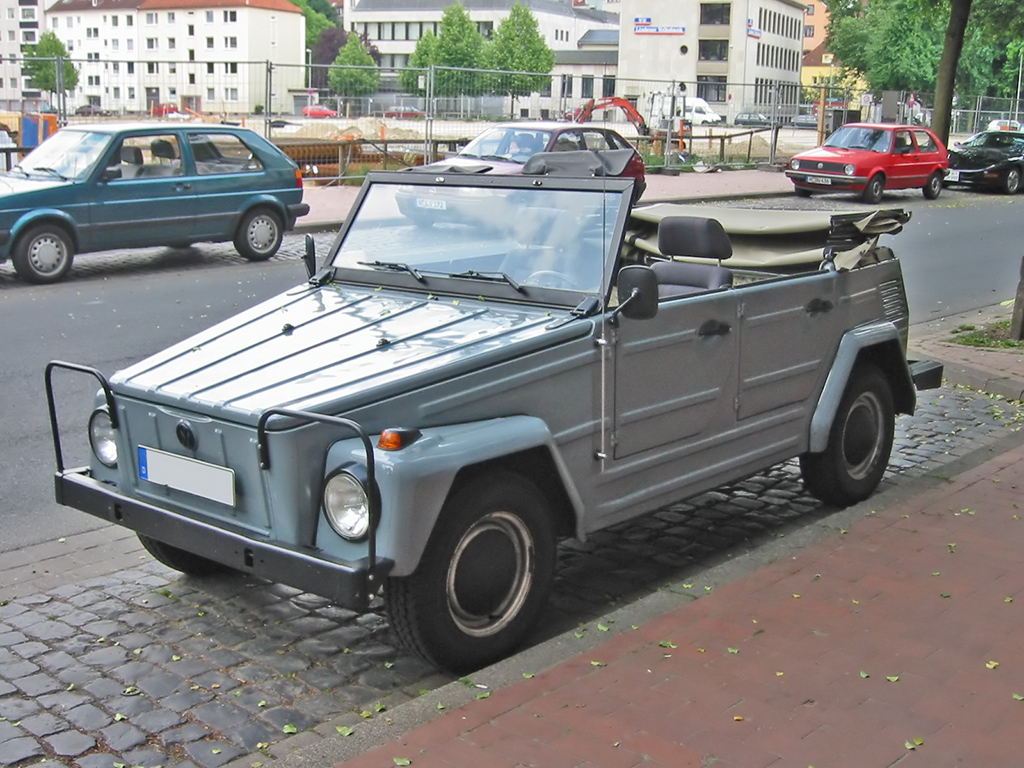
The Volkswagen Type 181 is a two-wheel drive, four-door convertible, manufactured and marketed by Volkswagen from 1968 until 1983. Originally developed for the West German Army as a successor to the 1956 Auto Union two-stroke–engined DKW Munga, the Type 181 also entered the civilian market as the Kurierwagen (“courier car”) in West Germany, the Trekker (RHD Type 182) in the United Kingdom, the Thing in the United States and Canada (1973–74), the Safari in Mexico and South America, and Pescaccia in Italy. Civilian sales ended after model year 1980.
Manufactured in Wolfsburg, West Germany (1968–1974), Hannover, West Germany (1974–1975), Emden, West Germany (1975–1978), Puebla, Mexico (1970–1980), and Jakarta, Indonesia (1972–1980), the Type 181 shared its mechanicals with Volkswagen's Type 1 (Beetle) and the pre-1968 Volkswagen Microbus, its floor pan with the Type 1 Karmann Ghia, and its concept with the company's Kübelwagen, which had been used by the German military during World War II.
The overall configuration loosely recalls the chic, open beach cars of the 1960s, including the BMC Mini Moke, Fiat Ghia Jolly, Renault Rodeo, Citroën Méhari and Meyers Manx. All four doors were removable and interchangeable, the windshield folded flat, and the convertible roof could be removed for al fresco driving. The spartan interior featured vinyl covered bucket seats, painted sheet metal, drain holes and perforated rubber mats. A fiberglass hardtop and trunk-mounted auxiliary heater were optional.
A 1953 tender for a future West German Army was won by Auto Union that had developed the DKW Munga from their Two-stroke engine vehicles DKW 3=6 and DKW Schnellaster. The Porsche 597 was considered too expensive, and Volkswagen itself did not enter with a new Volkswagen Kübelwagen. By the 1960s, the simple two-stroke concept became outdated, and as the DKW brand was associated with it, Auto Union dropped it in 1965 in favour of reintroducing the brand Audi when updating the DKW F102 to the four stroke Audi F103 that used the Mercedes-Benz M118 engine.
During the 1960s, several European governments began cooperating on development of a vehicle known as the Europa Jeep, a lightweight, amphibious four-wheel drive vehicle that could be mass-produced for use by various national military and government groups. Development of the design by committee vehicle proved time-consuming, however, and the West German government was in need of a limited number of light, inexpensive, durable transport vehicles that could fulfil their basic needs while the Europa Jeep was being developed and put into production.
Although Volkswagen had been approached during the 1950s about building such a vehicle, and had subsequently passed on the proposition, the then-current management of the company saw the project as having some amount of potential as a consumer vehicle; Mexican customers were asking for something that could handle rural roads better than the Type 1, which was a large seller in Mexico at the time, and the popularity of VW-based dune buggies within the U.S. made executives think that a durable, fun, off-road-capable vehicle would become attractive to many buyers. VW could keep cost to a minimum and thus maximize profitability by using existing parts.
Like the World War II era Type 82 Kübelwagen, the Type 181 used mechanical parts and a rear-engine platform, manual transmission and a flat-4 engine derived from that of the Type 1.
The floorpans came from the Type 1 Karmann Ghia, which had a wider floorpan than the Beetle. Rear swing axle suspension with reduction gearing from the discontinued split-screen Volkswagen Transporter was used until 1973, when it was replaced with double-jointed axles used by Porsche and IRS semi-trailing arm setup as used on the 1303 and US-spec Beetles.
Hub AI
Volkswagen Type 181 AI simulator
(@Volkswagen Type 181_simulator)
Volkswagen Type 181
The Volkswagen Type 181 is a two-wheel drive, four-door convertible, manufactured and marketed by Volkswagen from 1968 until 1983. Originally developed for the West German Army as a successor to the 1956 Auto Union two-stroke–engined DKW Munga, the Type 181 also entered the civilian market as the Kurierwagen (“courier car”) in West Germany, the Trekker (RHD Type 182) in the United Kingdom, the Thing in the United States and Canada (1973–74), the Safari in Mexico and South America, and Pescaccia in Italy. Civilian sales ended after model year 1980.
Manufactured in Wolfsburg, West Germany (1968–1974), Hannover, West Germany (1974–1975), Emden, West Germany (1975–1978), Puebla, Mexico (1970–1980), and Jakarta, Indonesia (1972–1980), the Type 181 shared its mechanicals with Volkswagen's Type 1 (Beetle) and the pre-1968 Volkswagen Microbus, its floor pan with the Type 1 Karmann Ghia, and its concept with the company's Kübelwagen, which had been used by the German military during World War II.
The overall configuration loosely recalls the chic, open beach cars of the 1960s, including the BMC Mini Moke, Fiat Ghia Jolly, Renault Rodeo, Citroën Méhari and Meyers Manx. All four doors were removable and interchangeable, the windshield folded flat, and the convertible roof could be removed for al fresco driving. The spartan interior featured vinyl covered bucket seats, painted sheet metal, drain holes and perforated rubber mats. A fiberglass hardtop and trunk-mounted auxiliary heater were optional.
A 1953 tender for a future West German Army was won by Auto Union that had developed the DKW Munga from their Two-stroke engine vehicles DKW 3=6 and DKW Schnellaster. The Porsche 597 was considered too expensive, and Volkswagen itself did not enter with a new Volkswagen Kübelwagen. By the 1960s, the simple two-stroke concept became outdated, and as the DKW brand was associated with it, Auto Union dropped it in 1965 in favour of reintroducing the brand Audi when updating the DKW F102 to the four stroke Audi F103 that used the Mercedes-Benz M118 engine.
During the 1960s, several European governments began cooperating on development of a vehicle known as the Europa Jeep, a lightweight, amphibious four-wheel drive vehicle that could be mass-produced for use by various national military and government groups. Development of the design by committee vehicle proved time-consuming, however, and the West German government was in need of a limited number of light, inexpensive, durable transport vehicles that could fulfil their basic needs while the Europa Jeep was being developed and put into production.
Although Volkswagen had been approached during the 1950s about building such a vehicle, and had subsequently passed on the proposition, the then-current management of the company saw the project as having some amount of potential as a consumer vehicle; Mexican customers were asking for something that could handle rural roads better than the Type 1, which was a large seller in Mexico at the time, and the popularity of VW-based dune buggies within the U.S. made executives think that a durable, fun, off-road-capable vehicle would become attractive to many buyers. VW could keep cost to a minimum and thus maximize profitability by using existing parts.
Like the World War II era Type 82 Kübelwagen, the Type 181 used mechanical parts and a rear-engine platform, manual transmission and a flat-4 engine derived from that of the Type 1.
The floorpans came from the Type 1 Karmann Ghia, which had a wider floorpan than the Beetle. Rear swing axle suspension with reduction gearing from the discontinued split-screen Volkswagen Transporter was used until 1973, when it was replaced with double-jointed axles used by Porsche and IRS semi-trailing arm setup as used on the 1303 and US-spec Beetles.