
Recent from talks
Venus (mythology)
Knowledge base stats:
Talk channels stats:
Members stats:
Venus (mythology)
Venus (/ˈviːnəs/; Classical Latin: [ˈwɛnʊs]) is a Roman goddess whose functions encompass love, beauty, desire, sex, fertility, prosperity, and victory. In Roman mythology, she was the ancestor of the Roman people through her son, Aeneas, who survived the fall of Troy and fled to Italy. Julius Caesar claimed her as his ancestor. Venus was central to many religious festivals, and was revered in Roman religion under numerous cult titles.
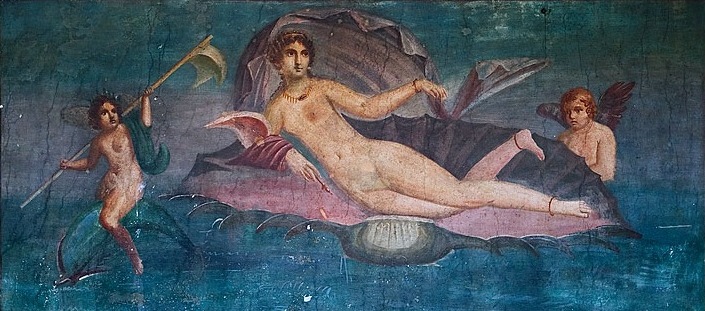
The Romans adapted the myths and iconography of her Greek counterpart Aphrodite for Roman art and Latin literature. In the later classical tradition of the West, Venus became one of the most widely referenced deities of Greco-Roman mythology as the embodiment of love and sexuality. As such, she is usually depicted nude.
The Latin theonym Venus and the common noun venus ('love, charm') stem from a Proto-Italic form reconstructed as *wenos- ('desire'), itself from Proto-Indo-European (PIE) *wenh₁-os ('desire'; cf. Messapic Venas, Old Indic vánas 'desire').
Derivatives include venustus ('attractive, charming'), venustās ('charm, grace'), venerius ('of Venus, erotic'), venerāre ('to adore, revere, honor, venerate, worship'), and venerātiō ('adoration'). Venus is also cognate with Latin venia ('favour, permission') and vēnor ('to hunt') through to common PIE root *wenh₁- ('to strive for, wish for, desire, love').
Venus has been described as perhaps "the most original creation of the Roman pantheon", and "an ill-defined and assimilative" native goddess, combined "with a strange and exotic Aphrodite". Her cults may represent the religiously legitimate charm and seduction of the divine by mortals, in contrast to the formal, contractual relations between most members of Rome's official pantheon and the state, and the unofficial, illicit manipulation of divine forces through magic. The ambivalence of her persuasive functions has been perceived in the relationship of the root *wenos- with its Latin derivative venenum ('poison'; from *wenes-no 'love drink' or 'addicting'), in the sense of "a charm, magic philtre".
Venus seems to have had no origin myth until her association with Greek Aphrodite. Venus-Aphrodite emerged, already in adult form, from the sea foam (Greek αφρός, aphros) produced by the severed genitals of Caelus-Uranus. Roman theology presents Venus as the yielding, watery female principle, essential to the generation and balance of life. Her male counterparts in the Roman pantheon, Vulcan and Mars, are active and fiery. Venus absorbs and tempers the male essence, uniting the opposites of male and female in mutual affection. She is essentially assimilative and benign, and embraces several otherwise quite disparate functions. She can give military victory, sexual success, good fortune and prosperity. In one context, she is a goddess of prostitutes; in another, she turns the hearts of men and women from sexual vice to virtue. Varro's theology identifies Venus with water as an aspect of the female principle. To generate life, the watery matrix of the womb requires the virile warmth of fire. To sustain life, water and fire must be balanced; excess of either one, or their mutual antagonism, is unproductive or destructive.
Prospective brides offered Venus a gift "before the wedding"; the nature of the gift, and its timing, are unknown. The wedding ceremony itself, and the state of lawful marriage, belonged to Juno – whose mythology allows her only a single marriage, and no divorce from her habitually errant spouse, Jupiter – but Venus and Juno are also likely "bookends" for the ceremony; Venus prepares the bride for "conubial bliss" and expectations of fertility within lawful marriage. Some Roman sources say that girls who come of age offer their toys to Venus; it is unclear where the offering is made, and others say this gift is to the Lares. In dice-games played with knucklebones, a popular pastime among Romans of all classes, the luckiest, best possible roll was known as "Venus".
Like other major Roman deities, Venus was given a number of epithets that referred to her different cult aspects, roles, and her functional similarities to other deities. Her "original powers seem to have been extended largely by the fondness of the Romans for folk-etymology, and by the prevalence of the religious idea nomen-omen which sanctioned any identifications made in this way."
Hub AI
Venus (mythology) AI simulator
(@Venus (mythology)_simulator)
Venus (mythology)
Venus (/ˈviːnəs/; Classical Latin: [ˈwɛnʊs]) is a Roman goddess whose functions encompass love, beauty, desire, sex, fertility, prosperity, and victory. In Roman mythology, she was the ancestor of the Roman people through her son, Aeneas, who survived the fall of Troy and fled to Italy. Julius Caesar claimed her as his ancestor. Venus was central to many religious festivals, and was revered in Roman religion under numerous cult titles.
The Romans adapted the myths and iconography of her Greek counterpart Aphrodite for Roman art and Latin literature. In the later classical tradition of the West, Venus became one of the most widely referenced deities of Greco-Roman mythology as the embodiment of love and sexuality. As such, she is usually depicted nude.
The Latin theonym Venus and the common noun venus ('love, charm') stem from a Proto-Italic form reconstructed as *wenos- ('desire'), itself from Proto-Indo-European (PIE) *wenh₁-os ('desire'; cf. Messapic Venas, Old Indic vánas 'desire').
Derivatives include venustus ('attractive, charming'), venustās ('charm, grace'), venerius ('of Venus, erotic'), venerāre ('to adore, revere, honor, venerate, worship'), and venerātiō ('adoration'). Venus is also cognate with Latin venia ('favour, permission') and vēnor ('to hunt') through to common PIE root *wenh₁- ('to strive for, wish for, desire, love').
Venus has been described as perhaps "the most original creation of the Roman pantheon", and "an ill-defined and assimilative" native goddess, combined "with a strange and exotic Aphrodite". Her cults may represent the religiously legitimate charm and seduction of the divine by mortals, in contrast to the formal, contractual relations between most members of Rome's official pantheon and the state, and the unofficial, illicit manipulation of divine forces through magic. The ambivalence of her persuasive functions has been perceived in the relationship of the root *wenos- with its Latin derivative venenum ('poison'; from *wenes-no 'love drink' or 'addicting'), in the sense of "a charm, magic philtre".
Venus seems to have had no origin myth until her association with Greek Aphrodite. Venus-Aphrodite emerged, already in adult form, from the sea foam (Greek αφρός, aphros) produced by the severed genitals of Caelus-Uranus. Roman theology presents Venus as the yielding, watery female principle, essential to the generation and balance of life. Her male counterparts in the Roman pantheon, Vulcan and Mars, are active and fiery. Venus absorbs and tempers the male essence, uniting the opposites of male and female in mutual affection. She is essentially assimilative and benign, and embraces several otherwise quite disparate functions. She can give military victory, sexual success, good fortune and prosperity. In one context, she is a goddess of prostitutes; in another, she turns the hearts of men and women from sexual vice to virtue. Varro's theology identifies Venus with water as an aspect of the female principle. To generate life, the watery matrix of the womb requires the virile warmth of fire. To sustain life, water and fire must be balanced; excess of either one, or their mutual antagonism, is unproductive or destructive.
Prospective brides offered Venus a gift "before the wedding"; the nature of the gift, and its timing, are unknown. The wedding ceremony itself, and the state of lawful marriage, belonged to Juno – whose mythology allows her only a single marriage, and no divorce from her habitually errant spouse, Jupiter – but Venus and Juno are also likely "bookends" for the ceremony; Venus prepares the bride for "conubial bliss" and expectations of fertility within lawful marriage. Some Roman sources say that girls who come of age offer their toys to Venus; it is unclear where the offering is made, and others say this gift is to the Lares. In dice-games played with knucklebones, a popular pastime among Romans of all classes, the luckiest, best possible roll was known as "Venus".
Like other major Roman deities, Venus was given a number of epithets that referred to her different cult aspects, roles, and her functional similarities to other deities. Her "original powers seem to have been extended largely by the fondness of the Romans for folk-etymology, and by the prevalence of the religious idea nomen-omen which sanctioned any identifications made in this way."
Recent media