



Community hub
Recent from talks
Knowledge base stats:
Talk channels stats:
Members stats:
Variometer
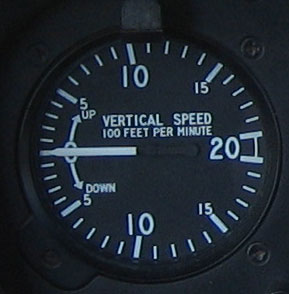
In aviation, a variometer – also known as a rate of climb and descent indicator (RCDI), rate-of-climb indicator, vertical speed indicator (VSI), or vertical velocity indicator (VVI) – is one of the flight instruments in an aircraft used to inform the pilot of the rate of descent or climb. It can be calibrated in metres per second, feet per minute (1 ft/min = 0.00508 m/s) or knots (1 kn ≈ 0.514 m/s), depending on country and type of aircraft. It is typically connected to the aircraft's external static pressure source.
In powered flight, the pilot makes frequent use of the VSI to ascertain that level flight is being maintained, especially during turning maneuvers. In gliding, the instrument is used almost continuously during normal flight, often with an audible output, to inform the pilot of rising or sinking air. It is usual for gliders to be equipped with more than one type of variometer. The simpler type does not need an external source of power and can therefore be relied upon to function regardless of whether a battery or power source has been fitted. The electronic type with audio needs a power source to be operative during the flight. The instrument is of little interest during launching and landing, with the exception of aerotow, where the pilot will usually want to avoid releasing in sink.
In 1930, according to Ann Welch, "Kronfeld...was one of the first to use a variometer, a device suggested by Alexander Lippisch." Welch goes on to state that the "first real thermal soaring" occurred in 1930 by A. Haller and Wolf Hirth, with Hirth using a variometer in his Musterle. Frank Irving states that Arthur Kantrowitz first mentioned total energy in 1940. However, as early as 1901, Wilbur Wright wrote about thermals, "when gliding operators have attained greater skill, they can, with comparative safety, maintain themselves in the air for hours at a time in this way, and thus by constant practice so increase their knowledge and skill that they can rise into the higher air and search out the currents which enable the soaring birds to transport themselves to any desired point, by first rising in a circle, and then sailing off at a descending angle."
According to Paul MacCready, "A variometer is essentially a pressure altimeter with a leak which tends to make it read the altitude of a moment earlier. It consists of a container vented to the outside air in such a way that the pressure inside the flask lags slightly behind the outside static pressure. The rate of climb measurement comes from the rate-of-air inflow or outflow from the container."
Variometers measure the rate of change of altitude by detecting the change in air pressure (static pressure) as altitude changes. Common types of variometers include those based on a diaphragm, a vane (horn), a taut band, or are electric based. The vane variometer consists of a rotating vane, centered by a coil spring, dividing a chamber into two parts, one connected to a static port, and the other to an expansion chamber. Electric variometers use thermistors sensitive to airflow, or circuit boards consisting of variable resistors connected to the membrane of a tiny vacuum cavity.
A simple variometer can be constructed by adding a large reservoir (a vacuum flask) to augment the storage capacity of a common aircraft rate-of-climb instrument. In its simplest electronic form, the instrument consists of an air bottle connected to the external atmosphere through a sensitive air flow meter. As the aircraft changes altitude, the atmospheric pressure outside the aircraft changes and air flows into or out of the air bottle to equalise the pressure inside the bottle and outside the aircraft. The rate and direction of flowing air is measured by the cooling of one of two self-heating thermistors and the difference between the thermistor resistances will cause a voltage difference; this is amplified and displayed to the pilot. The faster the aircraft is ascending (or descending), the faster the air flows. Air flowing out of the bottle indicates that the altitude of the aircraft is increasing. Air flowing into the bottle indicates that the aircraft is descending.
Newer variometer designs directly measure the static pressure of the atmosphere using a pressure sensor and detect changes in altitude directly from the change in air pressure instead of by measuring air flow. These designs tend to be smaller as they do not need the air bottle. They are more reliable as there is no bottle to be affected by changes in temperature and fewer chances for leaks to occur in the connecting tubes.
The designs described above, which measure the rate of change of altitude by automatically detecting the change in static pressure as the aircraft changes altitude are referred to as "uncompensated" variometers. The term "vertical speed indicator" or "VSI" is most often used for the instrument when it is installed in a powered aircraft. The term "variometer" is most often used when the instrument is installed in a glider or sailplane.
Hub AI
Variometer AI simulator
(@Variometer_simulator)
Variometer
In aviation, a variometer – also known as a rate of climb and descent indicator (RCDI), rate-of-climb indicator, vertical speed indicator (VSI), or vertical velocity indicator (VVI) – is one of the flight instruments in an aircraft used to inform the pilot of the rate of descent or climb. It can be calibrated in metres per second, feet per minute (1 ft/min = 0.00508 m/s) or knots (1 kn ≈ 0.514 m/s), depending on country and type of aircraft. It is typically connected to the aircraft's external static pressure source.
In powered flight, the pilot makes frequent use of the VSI to ascertain that level flight is being maintained, especially during turning maneuvers. In gliding, the instrument is used almost continuously during normal flight, often with an audible output, to inform the pilot of rising or sinking air. It is usual for gliders to be equipped with more than one type of variometer. The simpler type does not need an external source of power and can therefore be relied upon to function regardless of whether a battery or power source has been fitted. The electronic type with audio needs a power source to be operative during the flight. The instrument is of little interest during launching and landing, with the exception of aerotow, where the pilot will usually want to avoid releasing in sink.
In 1930, according to Ann Welch, "Kronfeld...was one of the first to use a variometer, a device suggested by Alexander Lippisch." Welch goes on to state that the "first real thermal soaring" occurred in 1930 by A. Haller and Wolf Hirth, with Hirth using a variometer in his Musterle. Frank Irving states that Arthur Kantrowitz first mentioned total energy in 1940. However, as early as 1901, Wilbur Wright wrote about thermals, "when gliding operators have attained greater skill, they can, with comparative safety, maintain themselves in the air for hours at a time in this way, and thus by constant practice so increase their knowledge and skill that they can rise into the higher air and search out the currents which enable the soaring birds to transport themselves to any desired point, by first rising in a circle, and then sailing off at a descending angle."
According to Paul MacCready, "A variometer is essentially a pressure altimeter with a leak which tends to make it read the altitude of a moment earlier. It consists of a container vented to the outside air in such a way that the pressure inside the flask lags slightly behind the outside static pressure. The rate of climb measurement comes from the rate-of-air inflow or outflow from the container."
Variometers measure the rate of change of altitude by detecting the change in air pressure (static pressure) as altitude changes. Common types of variometers include those based on a diaphragm, a vane (horn), a taut band, or are electric based. The vane variometer consists of a rotating vane, centered by a coil spring, dividing a chamber into two parts, one connected to a static port, and the other to an expansion chamber. Electric variometers use thermistors sensitive to airflow, or circuit boards consisting of variable resistors connected to the membrane of a tiny vacuum cavity.
A simple variometer can be constructed by adding a large reservoir (a vacuum flask) to augment the storage capacity of a common aircraft rate-of-climb instrument. In its simplest electronic form, the instrument consists of an air bottle connected to the external atmosphere through a sensitive air flow meter. As the aircraft changes altitude, the atmospheric pressure outside the aircraft changes and air flows into or out of the air bottle to equalise the pressure inside the bottle and outside the aircraft. The rate and direction of flowing air is measured by the cooling of one of two self-heating thermistors and the difference between the thermistor resistances will cause a voltage difference; this is amplified and displayed to the pilot. The faster the aircraft is ascending (or descending), the faster the air flows. Air flowing out of the bottle indicates that the altitude of the aircraft is increasing. Air flowing into the bottle indicates that the aircraft is descending.
Newer variometer designs directly measure the static pressure of the atmosphere using a pressure sensor and detect changes in altitude directly from the change in air pressure instead of by measuring air flow. These designs tend to be smaller as they do not need the air bottle. They are more reliable as there is no bottle to be affected by changes in temperature and fewer chances for leaks to occur in the connecting tubes.
The designs described above, which measure the rate of change of altitude by automatically detecting the change in static pressure as the aircraft changes altitude are referred to as "uncompensated" variometers. The term "vertical speed indicator" or "VSI" is most often used for the instrument when it is installed in a powered aircraft. The term "variometer" is most often used when the instrument is installed in a glider or sailplane.