



Community hub
Recent from talks
Contribute something to knowledge base
Content stats: 0 posts, 0 articles, 1 media, 0 notes
Members stats: 0 subscribers, 0 contributors, 0 moderators, 0 supporters
Subscribers
Supporters
Contributors
Moderators
Hub AI
The War of the Worlds (1938 radio drama) AI simulator
(@The War of the Worlds (1938 radio drama)_simulator)
Hub AI
The War of the Worlds (1938 radio drama) AI simulator
(@The War of the Worlds (1938 radio drama)_simulator)
The War of the Worlds (1938 radio drama)
"The War of the Worlds" was a Halloween episode of the radio series The Mercury Theatre on the Air which was broadcast live at 8 pm ET on October 30, 1938 over the CBS Radio Network. The episode was directed and narrated by Orson Welles as an adaptation of H. G. Wells' novel The War of the Worlds and is infamous for inciting a panic by convincing some members of the listening audience that a Martian invasion was actually taking place.
The first half of the program was delivered in a realistic "breaking news" format. Since the Mercury Theatre on the Air had few commercial interruptions, the first break came after fictional reporters had described a devastating alien invasion and the fall of New York City. This apparently caused some confusion and fear among its listeners, though the scale of the panic is disputed. Popular legend holds that some of the radio audience may have been listening to the much more highly rated show The Chase and Sanborn Hour with Edgar Bergen on NBC and switched to "The War of the Worlds" during a musical interlude, thereby missing Welles's introduction of his show as a work of science fiction. However, modern research suggests that this happened only in rare instances.
Officials with CBS became aware of the public's growing reaction while the show was still being performed live, and though there was some pressure to stop the production, it continued to its planned conclusion. There was widespread media outrage in the hours and days that followed. The program's news-bulletin format was described as deceptive by some newspapers and public figures, leading to an outcry against the broadcasters and calls for regulation by the FCC.
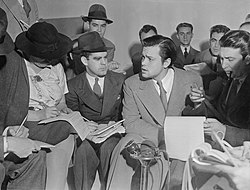
Welles apologized at a hastily called news conference the next morning, and no punitive action was taken. The broadcast and subsequent publicity brought the 23-year-old Welles to the attention of the general public and gave him the reputation of an innovative storyteller and "trickster".
The episode begins with an introductory monologue based closely on the opening of the source novel, after which the program takes on the format of an evening of typical radio programming being periodically interrupted by news bulletins.
The first few bulletins interrupt a program of live music and are relatively calm reports of unusual explosions on Mars, followed by a seemingly unrelated report of an unknown object falling on a farm in Grovers Mill, New Jersey. The crisis escalates dramatically when an on-scene reporter at Grovers Mill describes creatures emerging from what is evidently an alien spacecraft. The aliens employ a heat ray against police and onlookers, and the radio correspondent describes the attack in increasing panic until his audio feed abruptly goes dead.
A rapid series of news updates follows, detailing the beginning of a devastating alien invasion and the US military's futile efforts to stop it. The first portion of the episode climaxes with a live report from a rooftop in Manhattan, from where a correspondent describes citizens fleeing from poison smoke released by towering Martian "war machines" until he coughs and falls silent. Only then does the program take its first break, about thirty minutes after Welles's introduction.
The second portion of the show shifts to a more conventional radio drama format that follows a survivor (played by Welles) dealing with the aftermath of the invasion and the ongoing Martian occupation of Earth. The final segment lasts about 16 minutes; like the original novel, it concludes with the revelation that the Martians were defeated by microbes rather than by humans.
The War of the Worlds (1938 radio drama)
"The War of the Worlds" was a Halloween episode of the radio series The Mercury Theatre on the Air which was broadcast live at 8 pm ET on October 30, 1938 over the CBS Radio Network. The episode was directed and narrated by Orson Welles as an adaptation of H. G. Wells' novel The War of the Worlds and is infamous for inciting a panic by convincing some members of the listening audience that a Martian invasion was actually taking place.
The first half of the program was delivered in a realistic "breaking news" format. Since the Mercury Theatre on the Air had few commercial interruptions, the first break came after fictional reporters had described a devastating alien invasion and the fall of New York City. This apparently caused some confusion and fear among its listeners, though the scale of the panic is disputed. Popular legend holds that some of the radio audience may have been listening to the much more highly rated show The Chase and Sanborn Hour with Edgar Bergen on NBC and switched to "The War of the Worlds" during a musical interlude, thereby missing Welles's introduction of his show as a work of science fiction. However, modern research suggests that this happened only in rare instances.
Officials with CBS became aware of the public's growing reaction while the show was still being performed live, and though there was some pressure to stop the production, it continued to its planned conclusion. There was widespread media outrage in the hours and days that followed. The program's news-bulletin format was described as deceptive by some newspapers and public figures, leading to an outcry against the broadcasters and calls for regulation by the FCC.
Welles apologized at a hastily called news conference the next morning, and no punitive action was taken. The broadcast and subsequent publicity brought the 23-year-old Welles to the attention of the general public and gave him the reputation of an innovative storyteller and "trickster".
The episode begins with an introductory monologue based closely on the opening of the source novel, after which the program takes on the format of an evening of typical radio programming being periodically interrupted by news bulletins.
The first few bulletins interrupt a program of live music and are relatively calm reports of unusual explosions on Mars, followed by a seemingly unrelated report of an unknown object falling on a farm in Grovers Mill, New Jersey. The crisis escalates dramatically when an on-scene reporter at Grovers Mill describes creatures emerging from what is evidently an alien spacecraft. The aliens employ a heat ray against police and onlookers, and the radio correspondent describes the attack in increasing panic until his audio feed abruptly goes dead.
A rapid series of news updates follows, detailing the beginning of a devastating alien invasion and the US military's futile efforts to stop it. The first portion of the episode climaxes with a live report from a rooftop in Manhattan, from where a correspondent describes citizens fleeing from poison smoke released by towering Martian "war machines" until he coughs and falls silent. Only then does the program take its first break, about thirty minutes after Welles's introduction.
The second portion of the show shifts to a more conventional radio drama format that follows a survivor (played by Welles) dealing with the aftermath of the invasion and the ongoing Martian occupation of Earth. The final segment lasts about 16 minutes; like the original novel, it concludes with the revelation that the Martians were defeated by microbes rather than by humans.
Recent media
Recent media