
Recent from talks
Water skiing
Knowledge base stats:
Talk channels stats:
Members stats:
Water skiing
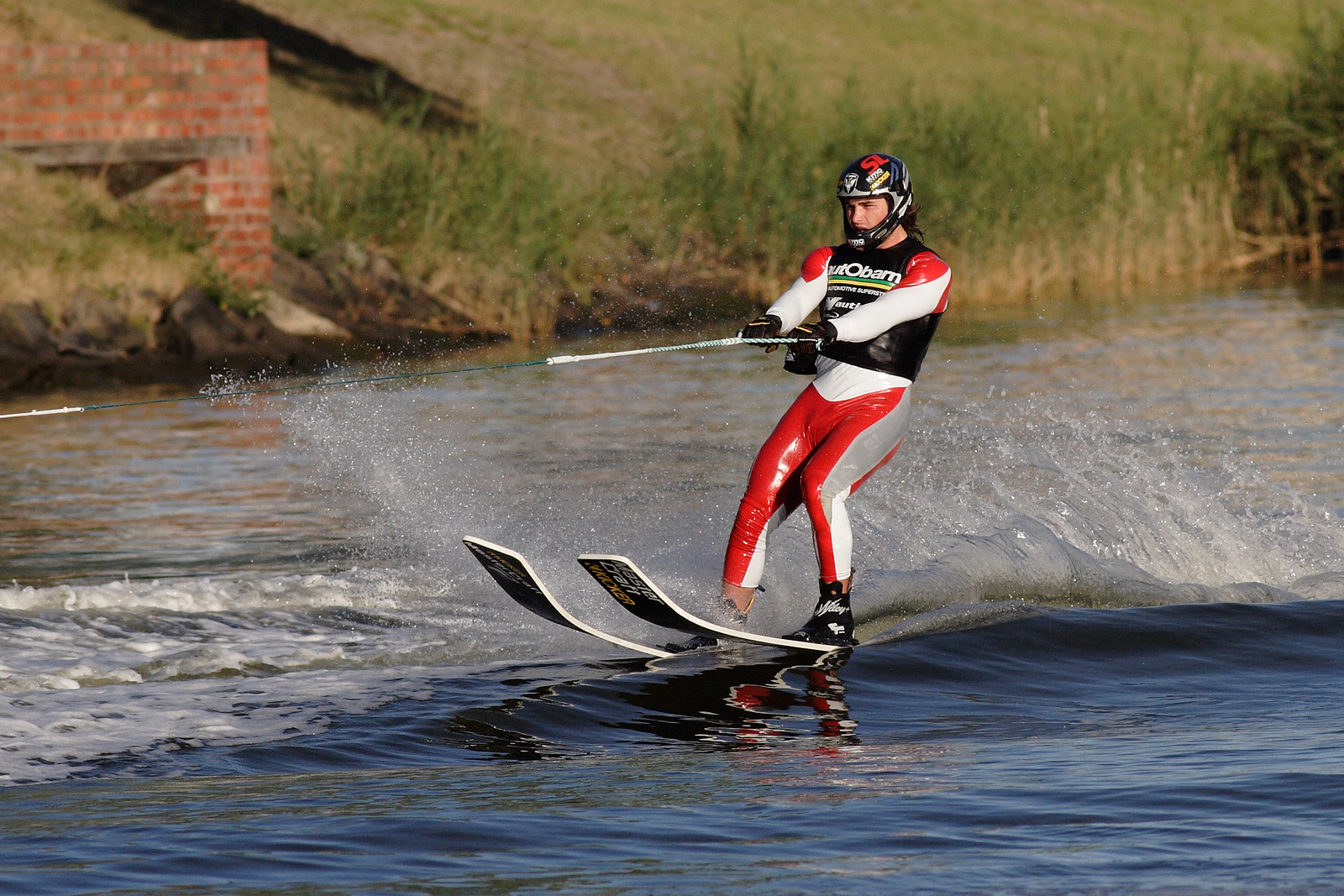
Water skiing (also waterskiing or water-skiing) is a surface water sport in which an individual is pulled behind a boat or a cable ski installation over a body of water, skimming the surface on one or two skis. The sport requires sufficient area on a stretch of water, one or two skis, a tow boat with tow rope, two or three people (depending on local boating laws), and a personal flotation device. In addition, the skier must have adequate upper and lower body strength, muscular endurance, and good balance.
There are water ski participants around the world, in Asia and Australia, Europe, Africa, and the Americas. In the United States alone, there are approximately 11 million water skiers and over 900 sanctioned water ski competitions every year. Australia boasts 1.3 million water skiers.
There are many options for recreational or competitive water skiers. These include speed skiing, trick skiing, show skiing, slaloming, jumping, barefoot skiing and wakeski. Similar, related sports are wakeboarding, kneeboarding, discing, tubing, and sit-down hydrofoil.
Water skiers can start their ski set in one of two ways: wet is the most common, but dry is possible. Water skiing typically begins with a deep-water start. The skier enters the water with their skis on or they jump in without the skis on their feet, having the skis floated to them, and put them on while in the water. Most times it can be easier to put the skis on when they are wet. Once the skier has their skis on they will be thrown a tow rope from the boat, which they position between their skis or, if on only one ski, to the left if right foot forward and to the right if left foot forward. In the deep-water start, the skier crouches down in the water while holding onto the ski rope; they are in a cannonball position with their legs tucked into their chest, with skis pointing towards the sky and approximately 30 cm (0.98 ft) of the ski out of the water. The skier can also perform a "dry start" by standing on the shore or a pier; however, this type of entry is recommended for professionals only. When the skier is ready (usually acknowledged by them yelling "in gear,": followed by "hit it"), the driver accelerates the boat. As the boat accelerates and takes up the slack on the rope, the skier allows the boat to pull them out of the water by applying some muscle strength to get into an upright body position.
By leaning back and keeping the legs slightly bent, the skis will eventually plane out and the skier will start to glide over the water. The skier turns by shifting weight left or right. The skier's body weight should be balanced between the balls of the feet and the heels. While being towed, the skier's arms should be relaxed but still fully extended so as to reduce stress on the arms. The handle can be held vertically or horizontally, depending on whichever position is more comfortable for the skier.
In addition to the driver and the skier, a third person known as the spotter or the observer should be present. The spotter's job is to watch the skier and inform the driver if the skier falls. The spotter usually sits in a chair on the boat facing backwards to see the skier. The skier and the boat's occupants communicate using hand signals (see the Safety section below).
Water skiing can take place on any type of water – such as a river, lake, or ocean – but calmer waters are ideal for recreational skiing. There should be a 60-metre-wide (200 ft) skiing space and the water should be at least 1.5 to 1.8 metres (5 to 6 ft) deep. There must be enough space for the water skier to safely "get up", or successfully be in the upright skiing position. Skiers and their boat drivers must also have sufficient room to avoid hazards. Most competitive skiers ski on man-made ski lakes. The first was in Barstow, California, built by Jack Horton in 1969. The second, built by Herb O'Brien, was built in 1972 in Redmond Washington.[citation needed]
Younger skiers generally start out on children's skis, which consist of two skis tied together at their back and front. These connections mean that less strength is necessary for the child to keep the skis together. Sometimes these skis can come with a handle to help balance the skier as well. Children's skis are short – usually 110–150 centimetres (45–60 in) long – reflecting the skier's smaller size. Once a person is strong enough to hold the skis together themselves there are various options depending upon their skill level and weight.
Hub AI
Water skiing AI simulator
(@Water skiing_simulator)
Water skiing
Water skiing (also waterskiing or water-skiing) is a surface water sport in which an individual is pulled behind a boat or a cable ski installation over a body of water, skimming the surface on one or two skis. The sport requires sufficient area on a stretch of water, one or two skis, a tow boat with tow rope, two or three people (depending on local boating laws), and a personal flotation device. In addition, the skier must have adequate upper and lower body strength, muscular endurance, and good balance.
There are water ski participants around the world, in Asia and Australia, Europe, Africa, and the Americas. In the United States alone, there are approximately 11 million water skiers and over 900 sanctioned water ski competitions every year. Australia boasts 1.3 million water skiers.
There are many options for recreational or competitive water skiers. These include speed skiing, trick skiing, show skiing, slaloming, jumping, barefoot skiing and wakeski. Similar, related sports are wakeboarding, kneeboarding, discing, tubing, and sit-down hydrofoil.
Water skiers can start their ski set in one of two ways: wet is the most common, but dry is possible. Water skiing typically begins with a deep-water start. The skier enters the water with their skis on or they jump in without the skis on their feet, having the skis floated to them, and put them on while in the water. Most times it can be easier to put the skis on when they are wet. Once the skier has their skis on they will be thrown a tow rope from the boat, which they position between their skis or, if on only one ski, to the left if right foot forward and to the right if left foot forward. In the deep-water start, the skier crouches down in the water while holding onto the ski rope; they are in a cannonball position with their legs tucked into their chest, with skis pointing towards the sky and approximately 30 cm (0.98 ft) of the ski out of the water. The skier can also perform a "dry start" by standing on the shore or a pier; however, this type of entry is recommended for professionals only. When the skier is ready (usually acknowledged by them yelling "in gear,": followed by "hit it"), the driver accelerates the boat. As the boat accelerates and takes up the slack on the rope, the skier allows the boat to pull them out of the water by applying some muscle strength to get into an upright body position.
By leaning back and keeping the legs slightly bent, the skis will eventually plane out and the skier will start to glide over the water. The skier turns by shifting weight left or right. The skier's body weight should be balanced between the balls of the feet and the heels. While being towed, the skier's arms should be relaxed but still fully extended so as to reduce stress on the arms. The handle can be held vertically or horizontally, depending on whichever position is more comfortable for the skier.
In addition to the driver and the skier, a third person known as the spotter or the observer should be present. The spotter's job is to watch the skier and inform the driver if the skier falls. The spotter usually sits in a chair on the boat facing backwards to see the skier. The skier and the boat's occupants communicate using hand signals (see the Safety section below).
Water skiing can take place on any type of water – such as a river, lake, or ocean – but calmer waters are ideal for recreational skiing. There should be a 60-metre-wide (200 ft) skiing space and the water should be at least 1.5 to 1.8 metres (5 to 6 ft) deep. There must be enough space for the water skier to safely "get up", or successfully be in the upright skiing position. Skiers and their boat drivers must also have sufficient room to avoid hazards. Most competitive skiers ski on man-made ski lakes. The first was in Barstow, California, built by Jack Horton in 1969. The second, built by Herb O'Brien, was built in 1972 in Redmond Washington.[citation needed]
Younger skiers generally start out on children's skis, which consist of two skis tied together at their back and front. These connections mean that less strength is necessary for the child to keep the skis together. Sometimes these skis can come with a handle to help balance the skier as well. Children's skis are short – usually 110–150 centimetres (45–60 in) long – reflecting the skier's smaller size. Once a person is strong enough to hold the skis together themselves there are various options depending upon their skill level and weight.
Recent media