Hubbry Logo
Commander-in-Chief, Western ApproachesCommander-in-Chief, Western ApproachesMain
Open search
Commander-in-Chief, Western Approaches
Community hub
Commander-in-Chief, Western Approaches
logo
8 pages, 0 posts
0 subscribers
Be the first to start a discussion here.
Commander-in-Chief, Western Approaches
from Wikipedia

53°24′27″N 2°59′36″W / 53.4074°N 2.9932°W / 53.4074; -2.9932

Western Approaches Command
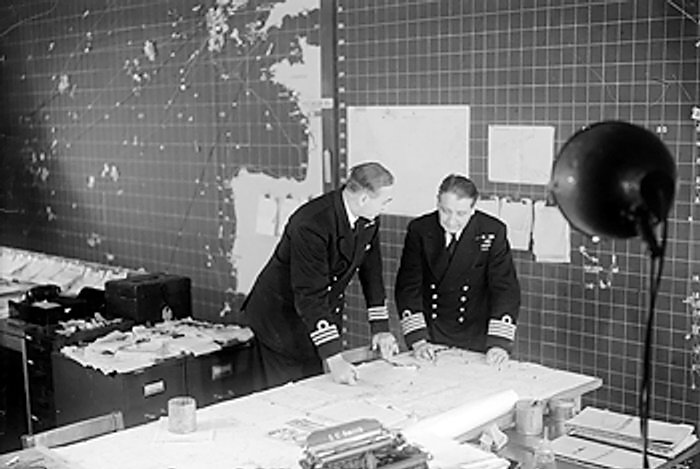
Commander RDS Crosse, Staff Officer Convoys, (left) discussing a special convoy movement map with Captain Lake, RN, Duty Officer in the Operations Room at Derby House, Liverpool.
Active1939–1945
Country United Kingdom
Branch Royal Navy
TypeMilitary formation
Part ofRoyal Navy
Garrison/HQLiverpool
Commanders
Notable
commanders
Martin Dunbar-Nasmith (1939–1941)
Percy Noble (1941–1942)
Max Horton (1942–1945)

Commander-in-Chief, Western Approaches was the commander of a major operational command of the Royal Navy during World War II. The admiral commanding, and his forces, sometimes informally known as 'Western Approaches Command,' were responsible for the safety of British shipping in the Western Approaches.

History

[edit]

Admiral Martin Dunbar-Nasmith, who had been Commander-in-Chief, Plymouth, also took over responsibility for the Western Approaches from the start of World War II.[1]

After the fall of France in June 1940, the main North Atlantic convoy routes were diverted around the north of Ireland through the north-western approaches.[2] By late 1940, the location of the Combined Operations headquarters at Plymouth was increasingly awkward and the decision was taken to move the Combined Operations headquarters to Liverpool.[2] On 7 February 1941, the headquarters was established at Derby House, Liverpool,[2] with a secondary control bunker built in Magee College, Derry.[3] Derby House was designated HMS Eaglet; shore establishments were often given ship ("stone frigate") names to meet the requirement that their Navy personnel be borne upon the books of a specific ship. The headquarters of No. 15 Group RAF (part of Coastal Command) moved to Liverpool at the same time.[4] On 17 February 1941 Admiral Sir Percy Noble was appointed as the new Commander-in-Chief, Western Approaches Command.[2] The Western Approaches Tactical Unit (WATU) was formed in January 1942 to develop and disseminate new tactics to counter German submarine attacks on trans-Atlantic shipping convoys. WATU took up residency on the top floor of Derby House.[5]

Over the next two years, Admiral Noble built up the bases for the North Atlantic escort groups at Greenock on the Clyde, Derry and Liverpool and set up the training facilities that were the foundations for eventual victory in the Battle of the Atlantic.[6]

Derby House, Liverpool, in 2013

On 19 November 1942, Admiral Max Horton replaced Admiral Noble; Horton then was Commander-in-Chief until Western Approaches Command closed on 15 August 1945.[2]

Horton’s leadership played a vital role in the final defeat of the U-boat menace. Horton used the increasing number of escorts that were available to the command to organize "support groups" that were used to reinforce convoys that came under attack.[7] Unlike the regular escort groups, the support groups were not directly responsible for the safety of any particular convoy. This freedom gave them much greater tactical flexibility, allowing the support groups to detach ships to hunt submarines spotted by reconnaissance or picked up by high-frequency direction finding (HF/DF). In situations where the regular escorts would have had to return to their convoy, the support groups were able to persist in hunting a submarine for many hours until it was forced to the surface.

The Western Approaches Tactical Unit (WATU) was also based in Western Approaches HQ and was located in the top floor of the original Exchange Buildings on the opposite side of Exchange Square to Derby House. The unit was commanded by Captain Gilbert Roberts and was staffed almost entirely by women.

Museum

[edit]

The reinforced central core of the command bunker at Derby House proved too costly to demolish, and so whilst the rest of the building has been converted to modern offices, the bunker has been restored as a museum, open to the public. The areas open to visitors are only a small part of the original complex. The museum is known as the Western Approaches Museum.[2]

Following years of neglect, the site was taken over by non-profit organisation Big Heritage in 2017,[8] which saw an extensive restoration of the site and the discovery of new hidden parts of the bunker complex . The reopened site has seen a large increase in visitor numbers, and now ranks as one of the most popular historic sites in Liverpool.

During the lockdown as a result of COVID-19, Big Heritage reopened several previously undiscovered rooms, as well as restored the main chart in the operations room.[9]

Commanders-in-Chief, Western Approaches

[edit]
Plaque in Liverpool at Western Approaches HQ
Commander-in-Chief, Western Approaches[10]
Rank Name Term began Term ended
Admiral Martin Dunbar-Nasmith 9 September 1939 17 February 1941
Admiral Sir Percy Noble 17 February 1941 19 November 1942
Admiral Max Horton 19 November 1942 15 August 1945

See also

[edit]

References

[edit]
[edit]
Revisions and contributorsEdit on WikipediaRead on Wikipedia
from Grokipedia
The Commander-in-Chief, Western Approaches was the senior officer responsible for leading Command, a critical operational headquarters during tasked with coordinating the defense of Allied shipping convoys against German attacks in the north-eastern , known as the . Established on 24 October 1939 in Plymouth amid the escalating , the command initially merged naval and Coastal Command efforts to protect vital supply lines to Britain, which described as the war's "dominating factor." In February 1941, the headquarters relocated to a fortified underground bunker beneath Derby House in , spanning 55,000 square feet with over 100 rooms, a 7-foot-thick , and advanced plotting tables for real-time tracking and tactical decision-making. This move centralized operations closer to major assembly ports, enabling more effective through innovations like the , formed in January 1942 to simulate and refine escort tactics. The first holder of the position was , who served from 1939 until February 1941. He was succeeded by Noble, who assumed command in February 1941 and directed operations until November 1942, overseeing the integration of radar, air support, and escort groups that began turning the tide against wolf packs. Noble was in turn succeeded by Max Horton on 19 November 1942, whose aggressive leadership—emphasizing hunter-killer groups and close air cover—proved instrumental in the Allies' ultimate victory in the by May 1945. Horton retained the role until the command's closure on 15 August 1945, following Germany's surrender, after which the underground facility was sealed and later preserved as a .

Overview

Establishment

The Western Approaches Command was established by the Royal Navy on the outbreak of in (with some sources citing formal operational inception on 24 October 1939), as a strategic response to the anticipated threats to British shipping in the Atlantic. Prior to the war, naval responsibilities in the region were primarily handled under the Plymouth Command, which oversaw the south-western approaches to the . However, with the declaration of war against on 3 , the Admiralty reorganized its structure to prioritize the protection of merchant convoys, expecting intensified German submarine () activity and surface raider attacks on vital supply lines from and other Allied sources. This led to the creation of the dedicated Command by renaming and extending the scope of Plymouth Command's western elements, focusing on the rectangular area of the North Atlantic known as the —extending from the to approximately 45 degrees west longitude. The command's formation was driven by the need to centralize convoy escort operations, particularly for routes departing from the and navigating around the south of to avoid immediate exposure to German naval forces in the . Initial responsibilities included coordinating anti-submarine patrols, escort groups comprising destroyers and smaller warships, and defensive measures in the western Channel, South-West Approaches, , and . , a submariner veteran of , was appointed as the first Commander-in-Chief, Western Approaches, bringing expertise in undersea warfare to the role. Based initially at Plymouth, the command quickly integrated with the broader Admiralty convoy system, which had been planned pre-war but expanded rapidly to safeguard the approximately 4 million tons of monthly imports essential for Britain's survival. By early , escalating successes—exacerbated by the German occupation of bases in western , such as Brest and , which extended operational range—necessitated further reorganization. On 7 February , the relocated northward to Derby House in , the primary assembly port, transforming it into a fortified underground operations center equipped with plotting rooms, communication hubs, and staff quarters to withstand air raids. This move effectively re-established the Command as a distinct four-star operational entity, while Plymouth Command reverted to its pre-war focus on coastal defense in the south-west. The relocation enhanced coordination with merchant shipping and air cover from , marking a pivotal evolution in the command's structure amid the intensifying . Admiral Sir Percy Noble succeeded Dunbar-Nasmith on 17 February , overseeing the transition and initial operations from the new base.

Primary Responsibilities

The Commander-in-Chief, Western Approaches held overarching responsibility for directing efforts in the north-eastern Atlantic during , focusing on safeguarding vital maritime supply lines to Britain. This role encompassed the coordination of Allied naval and air forces to protect convoys from German attacks, aerial threats, and surface raiders, ensuring the uninterrupted flow of essential resources such as food, fuel, and munitions. Established in 1939, the command's scope extended to a defined rectangular area west of the , where it managed the defense of shipping routes critical to the Allied . Central to these duties was the oversight of escort operations for convoys departing British ports, including those routed to , , and . The Commander-in-Chief controlled all relevant escort groups, anti-submarine vessels, and support aircraft, directing their deployment to counter wolf packs through tactics like close escort and hunter-killer groups. From the underground headquarters at Derby House in —relocated there in February 1941 for better operational efficiency—the command integrated intelligence from the Admiralty's Submarine Tracking Room and the to plot real-time positions of Allied ships and enemy submarines on a large operations map. This enabled rapid decision-making, such as rerouting convoys or launching air strikes, with the primary aim of achieving the "safe and timely arrival of the convoys." Beyond convoy protection, the position included command of port defenses and coastal approaches, particularly the and the west of Portland, where it supervised minefields, patrol activities, and shore-based anti-submarine measures. Joint operations with the Royal Air Force's Coastal Command—transferred to Admiralty control in April 1941—were a key aspect, involving the allocation of long-range for and attack roles. The also influenced tactical development through units like the , which simulated engagements to refine escort strategies, contributing to innovations used in major operations such as . Throughout the war, these responsibilities supported over 1,000 convoys arriving at , playing a pivotal role in securing victory in the .

Organization

Headquarters and Bases

The Commander-in-Chief, Western Approaches, initially established its headquarters at Mount Wise in Plymouth upon the command's formation in October 1939, serving as the primary operational center for coordinating and convoy protection in the Atlantic approaches to the . This location was chosen for its strategic position on the southwest coast, but increasing bombing raids prompted a relocation. In February 1941, the headquarters transferred to Derby House in Liverpool's Exchange Flags area, a site acquired by the Royal Navy in 1939 and converted into a fortified underground bunker spanning 55,000 square feet with reinforced concrete walls up to 7 feet thick. The bunker, located two floors below street level, featured a two-story operations room with a massive wall map for real-time tracking of convoys and positions, accommodating nearly 1,000 personnel, including Wrens from the . A secondary control bunker was constructed at in Derry (Londonderry), , to provide redundancy and support communication during the . Liverpool served as the command's flagship base, hosting HMS Eaglet, a shore establishment and converted First World War sloop that functioned as the administrative hub for escort groups and convoy operations. As Britain's primary convoy port, it handled over 1,000 transatlantic convoys, with assembly and dispersal activities centered on the Mersey docks. Supporting bases included the Clyde estuary ( and ), where escort forces and merchant vessels gathered for outbound convoys, and , home to trawler and anti-submarine bases like HMS Antrim. Londonderry also emerged as a key northern base for U.S. and escorts, facilitating repairs and logistics for the growing fleet of convoy protectors. These facilities enabled centralized control over the , the vast oceanic area west of and Britain critical to Allied supply lines.

Key Units and Innovations

The Western Approaches Command oversaw several key naval units dedicated to convoy protection and during the . Central to its structure were the groups, first formalized in February 1941, which typically consisted of 4 to 8 warships operating as cohesive teams to defend merchant against wolfpacks. By 1943, twelve such groups were active under British operational control, including seven British-designated groups (B1–B7), four Canadian (C1–C4), and one American (A3), enabling specialized training and tactical cohesion that reduced convoy vulnerabilities. A prominent example was the 36th , commanded by Frederick John Walker from October 1941, which employed aggressive maneuvers like the "Buttercup" tactic—featuring outward turns and star shell illumination—to sink multiple , such as during the defense of convoy HG 76 in December 1941. Complementing the escort groups were support groups, introduced by Admiral Sir Max Horton in 1942 as a flexible response to convoys under heavy attack. These units, drawn from surplus escorts and vessels from other theaters like the Arctic convoys, operated independently to reinforce threatened formations and pursue U-boats offensively; by March 1943, five such groups were operational, with Walker's leadership in one contributing to the sinking of seven U-boats during the crisis of in May 1943. The integration of escort carriers into these groups by early 1943 addressed the critical "air gap" in mid-Atlantic coverage, providing continuous aerial patrols that extended and depth-charge capabilities beyond land-based range. Among the command's major innovations was the establishment of the (WATU) in January 1942, led by Captain Gilbert Roberts, which pioneered wargaming simulations using abstract models on floorboards to analyze attacks and refine escort tactics. WATU developed techniques like the maneuver, where escorts raced astern at full speed after a hit to sweep for submerged with ASDIC , challenging prior defensive doctrines and disseminating these through 132 training courses that educated over 3,585 officers from the Royal Navy and by 1945. This organizational learning fostered double-loop adaptations, such as questioning assumptions about U-boat evasion and promoting devolved command within the Atlantic Convoy Instructions, which correlated with a sharp decline in merchant losses—from 120 ships in October 1942 to 31 by October 1943. Technological and doctrinal shifts further enhanced effectiveness. High-frequency direction-finding (HF/DF, or "Huff-Duff") equipment became standard on escorts by 1943, allowing rapid triangulation of radio signals and contributing to 23 of 41 sinkings in via coordinated air and surface actions. The adoption of undetectable 10-cm centimetric on ships and aircraft disrupted surface attacks, as seen in the ONS 5 battle where it enabled night engagements without alerting enemies via their Metox detectors. Under Horton's from 1942, the command pivoted to an offensive posture, deliberately routing s into patrol lines to concentrate forces and accept short-term merchant losses (averaging two per destroyed) in exchange for submarine attrition, a formalized at the Atlantic Conference.

Historical Operations

Pre-1941 Developments

The Commander-in-Chief, Western Approaches was established in , coinciding with the outbreak of , by renaming the existing Plymouth Command to reflect its expanded role in safeguarding Atlantic trade routes. This reorganization anticipated major convoy movements through the and around southern , with the command's area of responsibility encompassing the western , south-west approaches, , and . Headquarters remained at Admiralty House in Plymouth, and Admiral Sir , who had assumed the role in 1938 as Commander-in-Chief Plymouth, continued in command. The primary focus was on organizing convoy escorts to counter the emerging threat, drawing on pre-war planning that emphasized and trade protection. From September 1939 to March 1940, during the so-called "," Command implemented systems for merchant shipping, with initial successes in minimizing losses despite the deployment of 57 German s. Escorts were limited, often consisting of just one or two destroyers or sloops per , hampered by the prior loss of bases in Ireland (, Berehaven, and ) under the 1938 , which restricted refueling and repair capabilities to a range of only 200-250 miles. s nonetheless sank 222 British, Allied, and neutral ships totaling 765,000 gross tons in the , , and coastal waters, primarily through tactics. These early operations highlighted the command's reliance on Asdic () technology, which proved ineffective against surfaced attacks at night. The fall of in dramatically escalated challenges for , as German U-boats relocated to Atlantic-facing bases in occupied ports like and Brest, enabling direct access to routes. This period marked the start of the U-boat "Happy Time," with intensified surface and submerged attacks; from to December 1940, 878 ships (3,441,000 gross tons) were lost in the Atlantic, including 363 sunk by U-boats (1,842,000 tons), averaging 382,000 tons per month. In response, routes shifted northward around to avoid air and threats from the south, straining escort availability and exposing vulnerabilities in the north-west approaches. The introduction of Focke-Wulf Condor long-range aircraft in August 1940 further compounded losses by shadowing and attacking unescorted ships, while the first wolf-pack tactics appeared in , overwhelming convoys SC 2 and HX 72 with the sinking of 16 vessels. These developments underscored the command's urgent need for enhanced inter-service coordination with and additional escort vessels, setting the stage for the 1941 headquarters relocation to .

1941–1942: Crisis Period

In early 1941, the Command relocated its headquarters from Plymouth to Derby House in , enhancing coordination for operations in the North Atlantic. Under Admiral Sir Percy Noble, who assumed command in February 1941, the focus intensified on protecting merchant shipping from German attacks amid Britain's precarious supply situation. This move centralized operations, incorporating real-time intelligence from the Admiralty and improved Navy-RAF collaboration, including the transfer of to Admiralty control on April 11, 1941. Noble's leadership emphasized systematic routing north of to evade initial threats, while establishing the Newfoundland Escort Force under Canadian Commodore in May 1941 to extend protection westward to 35° W longitude by July. The period marked a severe escalation in the , with German wolf packs exploiting the mid-Atlantic "air gap" or "Black Pit" south of , where Allied aircraft could not provide cover. In alone, U-boats sank over 454,000 tons of Allied shipping, straining Britain's as imports dwindled critically. Losses mounted through , with nearly 400 merchant vessels sunk off North American coasts between January and July, and a peak of 117 ships (approximately 700,000 tons) lost in amid intensified operations under Karl Dönitz. Convoys like those in the fall of faced attacks from up to 20 U-boats simultaneously, highlighting the vulnerability of stretched escort resources and the command's struggle to maintain sea lanes. Western Approaches responded by bolstering measures, including enhanced training for escort groups and the gradual introduction of technologies like high-frequency direction-finding (HF/DF) . Noble's tenure, lasting until , prioritized and procedural improvements, though critics noted a lack of aggressive offensive tactics against U-boats. Allied efforts, particularly Canada's expansion of and production to 188 warships by late 1942, provided some relief, but the crisis persisted, underscoring the command's pivotal role in averting potential starvation and logistical collapse for the . By late 1942, these pressures culminated in the transition to Max Horton, signaling the need for a more proactive approach to reverse the tide.

1943–1945: Victory Phase

In 1943, the Command, under Sir Max Horton, transitioned from defensive protection to aggressive , marking the beginning of the Allied victory in the . Horton's strategies emphasized the formation of dedicated support groups and hunter-killer teams, which operated independently to hunt s rather than merely escorting convoys. These groups, often comprising destroyers, frigates, and later escort carriers, exploited intelligence from decrypted Enigma signals and high-frequency direction-finding (HF/DF) equipment to intercept German wolf packs. A pivotal moment came in May 1943, known as "Black May," when Allied forces sank 41 s—23 by aircraft alone—while losing only 34 merchant ships; this prompted to withdraw most submarines from the North Atlantic on May 24, effectively ending the immediate U-boat threat to transatlantic shipping. Technological and tactical innovations further bolstered the command's effectiveness throughout 1943 and into 1944. The introduction of centimetric ASV radar on aircraft and ships allowed for precise detection and night attacks, while weapons like the mortar and projector replaced less accurate depth charges, increasing kill rates against submerged . Horton's coordination with extended air cover across the "air gap," reducing unprotected convoy zones; for instance, during the offensive from May to December 1943, Allied patrols sank 32 transiting to and from French bases. By late 1943, losses reached 263 for the year—more than double the total—while merchant sinkings dropped sharply to under 212,000 tons in May alone, ensuring the buildup of supplies for the impending Normandy invasion. Support groups, such as the 3rd , exemplified this shift, sinking multiple in actions like the battle (April-May 1943), where six submarines were destroyed despite heavy weather. In 1944, as commenced, Western Approaches focused on securing western sea lanes to support the invasion's logistical demands, routing over 12,900 ships across the Atlantic with minimal losses—only 10 vessels sunk, a rate of 0.08%. Horton's forces protected coastal convoys and countered renewed U-boat forays into the , employing hunter-killer groups with escort carriers like HMS Biter to neutralize threats; notable successes included the sinking of U-66 on May 5, 1944, by the USS Block Island group and the capture of on June 4, 1944, providing invaluable codebooks. These efforts prevented significant interference with the cross-Channel assault forces. By 1945, the command oversaw the final collapse of the amid Germany's defeat. Operations like TEARDROP (March-May 1945) deployed barrier forces with escort carriers to interdict outbound submarines, sinking five U-boats including U-546 on 24 April 1945; overall, 159 were lost that year (537,280 tons), a fraction of earlier tolls. With the war's end on May 8, 1945, 181 U-boats surrendered and 217 were scuttled, totaling 699 sunk since May 1943. Horton's relentless offensive posture and integration of Allied resources had secured the Atlantic, enabling the flow of 2.8 million tons of supplies monthly by war's end.

Commanders

Martin Dunbar-Nasmith (1939–1941)

Admiral Sir Martin Eric Dunbar-Nasmith, VC, KCB, KCMG, a distinguished Royal Navy officer and World War I submarine commander who earned the Victoria Cross for his actions in the Dardanelles campaign, was appointed as the inaugural Commander-in-Chief, Western Approaches on 9 September 1939, coinciding with the outbreak of World War II. Prior to this, he had served as Commander-in-Chief, Plymouth since 1938, a position that naturally extended to encompass the newly formed Western Approaches Command, responsible for safeguarding Atlantic convoys entering British waters. His extensive experience in submarine operations, including commanding HMS E11 during daring penetrations of enemy waters, positioned him to address the emerging U-boat threat in the early stages of the Battle of the Atlantic. During his tenure, Dunbar-Nasmith oversaw the protection of merchant convoys along the primary route south of Ireland, coordinating Royal Navy escorts and limited air cover to counter German submarine attacks that intensified from late 1939 onward. The command, headquartered in Plymouth, focused on organizing outbound and inbound convoys from North America, vital for supplying Britain with food, fuel, and materials amid the blockade. A notable early contribution came in June 1939, shortly before the war, when as Commander-in-Chief, Plymouth, he assumed control of the response to the sinking of HMS Thetis during trials in Liverpool Bay, which resulted in 99 fatalities. Drawing on his submarine expertise, he chaired an Admiralty committee later that year to investigate and recommend improvements in escape apparatus and procedures for submerged submarines, influencing safety protocols amid rising wartime submarine risks. Dunbar-Nasmith's leadership navigated the command through the "" period and the escalation of operations in 1940, though resources were stretched thin with only a handful of submarines active in the at times. His tenure ended on 7 February 1941, when the headquarters relocated to for better centralization near major assembly ports, and he was succeeded by Percy Noble. This transition marked a pivotal shift as the entered a more acute crisis phase, building on the foundational defenses established under Dunbar-Nasmith's direction.

Percy Noble (1941–1942)

Admiral Sir Percy Lockhart Harnam Noble assumed command of on 17 February 1941, succeeding Admiral Sir , amid escalating threats from German U-boats during the . Prior to this appointment, Noble had served as head of the British Admiralty Delegation in , where he coordinated Anglo-American naval relations; his return to Britain was prompted by the urgent need for experienced leadership to safeguard transatlantic convoys. At 61 years old, Noble brought a reputation as a versatile strategist, having commanded destroyers, cruisers, and battleships, as well as the China Station from 1938 to 1940, emphasizing strict discipline and diplomatic acumen. One of Noble's first major initiatives was relocating the command headquarters from Plymouth to Derby House in , a bomb-proof underground bunker spanning 55,000 square feet, which centralized operations and improved coordination with the Admiralty in . This move, completed in February 1941, staffed by nearly 1,000 personnel—80% women ()—enabled real-time tracking of s, escorts, and positions on a massive wall chart in the operations room. From his office overlooking the , Noble directed tactical responses, receiving Admiralty recommendations on convoy routes and issuing orders to escort forces, typically comprising two destroyers and occasionally a for groups of 20 to 60 . He also facilitated the transfer of operational control of to the Admiralty on 11 April 1941, enhancing air-sea cooperation to counter wolf packs and aerial threats north of . Noble prioritized organizational reforms to address inadequate anti-submarine resources, ordering the formation of dedicated Escort Groups trained in advanced tactics at Tobermory, . This initiative yielded rapid results: by mid-March 1941, these groups sank four U-boats in ten days, eliminating three of Germany's top commanders and demonstrating the effectiveness of concentrated, skilled escorts against wolf pack attacks. The establishment brought a "sudden improvement" in British convoy defenses, maximizing limited assets to protect vital supply lines from . In January 1942, under his oversight, the (WATU) was created to develop and disseminate anti-submarine strategies through wargaming simulations, addressing incoherent tactics and training officers in convoy protection. During Noble's tenure, which lasted until , Command played a pivotal role in sustaining Britain's lifeline, despite heavy losses in ; his assiduous efforts in and inter-service laid essential groundwork for later successes, earning praise for transforming a strained organization into a viable defense against predation. Noble was relieved by Sir Max Horton on 19 , after which he returned to Washington as head of the British Admiralty Technical Mission. His leadership during this crisis period is credited with stabilizing operations at a critical juncture.

Max Horton (1942–1945)

Admiral Sir Max Kennedy Horton, a submariner by training with extensive experience from , was appointed Commander-in-Chief, Western Approaches on 19 November 1942, succeeding Admiral Sir Percy Noble. His selection leveraged his deep knowledge of submarine operations, gained from commanding HMS E9 and leading British submarine flotillas in the and Baltic during the earlier conflict, where he earned the for sinking German vessels including the cruiser Hela. At the time of his appointment, the was at a critical juncture, with German U-boats inflicting severe losses on Allied merchant shipping—117 ships totaling 700,000 gross tons sunk in November 1942 alone—threatening Britain's supply lines from . Horton assumed command from headquarters, directing efforts to protect convoys and neutralize the threat. Horton immediately addressed resource constraints and tactical shortcomings by reorganizing escort forces into dedicated support groups of six to eight vessels, designed specifically to hunt and destroy U-boats rather than merely shadowing convoys. These groups operated independently to pursue submerged s, drawing on Horton's submarine expertise to anticipate enemy tactics. He also advocated vigorously for expanded air cover, pressing and the Royal Air Force to allocate more long-range such as Consolidated B-24 Liberators to close the "Black Pit"—the beyond land-based fighter range where U-boats previously operated with impunity. Innovations under his leadership included the widespread adoption of advanced anti-submarine weapons like mortar and depth-charge projector, which improved detection and attack accuracy against diving U-boats. To enhance training, Horton established the North Atlantic Tactical Training School in and a "school of battle" at in February 1943, where escort groups practiced coordinated maneuvers against simulated submarine attacks, fostering a more aggressive and proficient Allied response. The period under Horton's command saw pivotal turning points that shifted the balance in the . In April-May 1943, during the defense of Convoy ONS-5 (28 April to 6 May), his support groups destroyed seven U-boats while losing 12 merchant ships, demonstrating the effectiveness of offensive hunting tactics amid brutal weather conditions. This engagement, combined with intensified air patrols and improved intelligence from decrypted Enigma signals, contributed to a devastating toll on the German submarine fleet: by mid-May 1943, U-boats suffered a 30% loss rate, prompting Admiral to withdraw them from the North Atlantic on 24 May. Subsequent months underscored the reversal; in September-October 1943, only nine of 2,468 ships in convoys were lost, with 25 U-boats sunk, and from January to March 1944, losses dropped to three ships out of 3,360 while 36 U-boats were destroyed. Horton's strategies not only neutralized the U-boat menace by mid-1943 but also ensured secure sea lanes essential for , the D-Day invasion of on 6 June 1944. By the war's end in summer 1945, over 150 German submarines had surrendered to Allied forces under his oversight, marking the culmination of a campaign that safeguarded Britain's lifeline and enabled the broader Allied victory in . Horton retired shortly after the command's closure on 15 August 1945, having transformed into a highly effective organization through relentless efficiency and innovation.

Legacy

Dissolution and Post-War Impact

The Western Approaches Command was formally disbanded on 15 August 1945, marking the cessation of organized convoy defense operations following Japan's surrender and the end of World War II. Its headquarters at Derby House in Liverpool, including the operational rooms and associated units like the Western Approaches Tactical Unit (WATU), were sealed shortly thereafter, with equipment left in place as a precautionary measure against potential renewed threats. The command's dissolution reflected the broader demobilization of Royal Navy forces. However, the organizational innovations and tactical doctrines developed under , particularly WATU's wargaming-based (ASW) methods, had enduring effects on . These approaches, which emphasized coordinated escort formations, , and adaptive convoy routing, addressed the "learning paradox" in hierarchical militaries by enabling rapid doctrinal evolution amid combat. The command's emphasis on integrated air-surface operations and intelligence-driven tactics became models for subsequent exercises and force structures, ensuring the security of in an era of nuclear deterrence and potential undersea conflict. This legacy underscored the value of specialized tactical units in modern , influencing ongoing ASW initiatives into the .

Western Approaches Museum

The , located in the basement of Derby House within Liverpool's Exchange Flags, preserves the underground headquarters of the Command, a critical facility during . Following the command's disbandment on 15 August 1945, the bunker was sealed and mothballed, falling into disuse and obscurity for nearly five decades. In the early , local historians and preservationists rediscovered and advocated for its restoration to honor the site's role in Allied victory. The museum officially opened to the public in 1993, meticulously restored to its wartime configuration without modern alterations, transforming the forgotten complex into a living memorial. Key preservation features include the intact Operations Room, frozen in time since 1945, with its massive wall map of the Atlantic, plotting tables, and original teletype machines used to track and enemy vessels in real-time. Other exhibits highlight the (), established in 1942 under Captain Gilbert Roberts, which developed innovative escort tactics, and include Admiral Sir Max Horton's office from his tenure as (1942–1945). The museum's significance lies in its role as a tangible link to the Commander-in-Chief, Western Approaches, illustrating the command's evolution from crisis to triumph in the , which Winston deemed the war's "dominating factor." It emphasizes the contributions of commanders like Noble and Horton, whose leadership integrated intelligence, technology, and personnel to secure vital supply lines, ultimately tipping the scales against the U-boat threat. Today, visitors experience self-guided tours of the bunker, interactive displays on code-breaking and women's wartime roles, and memorials to the fallen, such as the Canada Room honoring Canadian sacrifices. By maintaining historical authenticity, the museum educates on the command's post-war legacy, underscoring Liverpool's pivotal place in naval history. In 2024, the museum, operated by Big Heritage, became the first in the UK to receive a Gold Award from the for its military heritage preservation efforts. It is also partnering with the new in Birkenhead, scheduled to open in 2026, to further commemorate the campaign.

References

Add your contribution
Related Hubs
User Avatar
No comments yet.