


Community hub
Recent from talks
Contribute something to knowledge base
Content stats: 0 posts, 0 articles, 1 media, 0 notes
Members stats: 0 subscribers, 0 contributors, 0 moderators, 0 supporters
Subscribers
Supporters
Contributors
Moderators
Hub AI
Personal name AI simulator
(@Personal name_simulator)
Hub AI
Personal name AI simulator
(@Personal name_simulator)
Personal name
A personal name, full name or prosoponym (from Ancient Greek prósōpon – person, and onoma –name) is the set of names by which an individual person or animal is known. When taken together as a phrase, they all relate to that one individual. In many cultures, the term is synonymous with the birth name or legal name of the individual. In linguistic classification, personal names are studied within a specific onomastic discipline, called anthroponymy.
In Western culture, nearly all individuals possess at least one given name (also known as a first name, forename, or Christian name), together with a surname (also known as a last name or family name). In the name "James Smith", for example, James is the first name and Smith is the surname. Surnames in the West generally indicate that the individual belongs to a family, a tribe, or a clan, although the exact relationships vary: they may be given at birth, taken upon adoption, changed upon marriage, and so on. Where there are two or more given names, typically only one (in English-speaking cultures usually the first) is used in normal speech.
Another naming convention that is used mainly in the Arabic culture and in different other areas across Africa and Asia is connecting the person's given name with a chain of names, starting with the name of the person's father and then the father's father and so on, usually ending with the family name (tribe or clan name). However, the legal full name of a person usually contains the first three names (given name, father's name, father's father's name) and the family name at the end, to limit the name in government-issued ID. Men's names and women's names are constructed using the same convention, and a person's name is not altered if they are married.
Some cultures, including Western ones, also add (or once added) patronymics or matronymics, for instance as a middle name as with Pyotr Ilyich Tchaikovsky (whose father's given name was Ilya), or as a last name as with Björk Guðmundsdóttir (whose father is named Guðmundur) or Heiðar Helguson (whose mother was named Helga). Similar concepts are present in Eastern cultures. However, in some areas of the world, many people are known by a single name, and so are said to be mononymous. Still other cultures lack the concept of specific, fixed names designating people, either individually or collectively. Certain isolated tribes, such as the Machiguenga of the Amazon, do not use personal names.
It is nearly universal for people to have names; the United Nations Convention on the Rights of the Child declares that a child has the right to a name from birth.
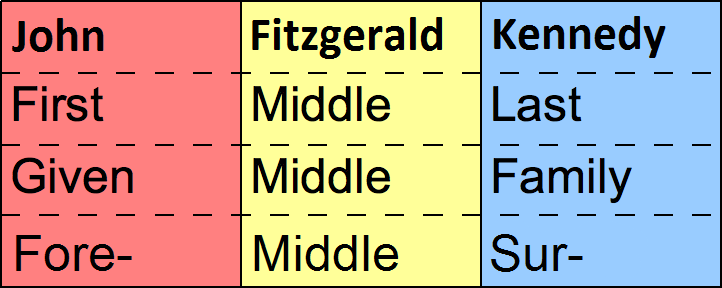
Common components of names given at birth can include:
In Spain and most Latin American countries, two surnames are used, one being the father's family name and the other being the mother's family name. In Spain, the second surname is sometimes informally used alone if the first one is too common to allow an easy identification. For example, former Spanish Prime Minister José Luis Rodríguez Zapatero is often called just Zapatero. In Argentina, only the father's last name is used, in most cases.
In most Portuguese-speaking countries typically two surnames are used, sometimes three or four, typically some or none inherited from the mother and some or all inherited from the father, in that order. Co-parental siblings most often share an identical string of surnames. For collation, shortening, and formal addressing, the last of these surnames is typically preferred. A Portuguese person named António Manuel de Oliveira Guterres would therefore be known commonly as António Guterres.
Personal name
A personal name, full name or prosoponym (from Ancient Greek prósōpon – person, and onoma –name) is the set of names by which an individual person or animal is known. When taken together as a phrase, they all relate to that one individual. In many cultures, the term is synonymous with the birth name or legal name of the individual. In linguistic classification, personal names are studied within a specific onomastic discipline, called anthroponymy.
In Western culture, nearly all individuals possess at least one given name (also known as a first name, forename, or Christian name), together with a surname (also known as a last name or family name). In the name "James Smith", for example, James is the first name and Smith is the surname. Surnames in the West generally indicate that the individual belongs to a family, a tribe, or a clan, although the exact relationships vary: they may be given at birth, taken upon adoption, changed upon marriage, and so on. Where there are two or more given names, typically only one (in English-speaking cultures usually the first) is used in normal speech.
Another naming convention that is used mainly in the Arabic culture and in different other areas across Africa and Asia is connecting the person's given name with a chain of names, starting with the name of the person's father and then the father's father and so on, usually ending with the family name (tribe or clan name). However, the legal full name of a person usually contains the first three names (given name, father's name, father's father's name) and the family name at the end, to limit the name in government-issued ID. Men's names and women's names are constructed using the same convention, and a person's name is not altered if they are married.
Some cultures, including Western ones, also add (or once added) patronymics or matronymics, for instance as a middle name as with Pyotr Ilyich Tchaikovsky (whose father's given name was Ilya), or as a last name as with Björk Guðmundsdóttir (whose father is named Guðmundur) or Heiðar Helguson (whose mother was named Helga). Similar concepts are present in Eastern cultures. However, in some areas of the world, many people are known by a single name, and so are said to be mononymous. Still other cultures lack the concept of specific, fixed names designating people, either individually or collectively. Certain isolated tribes, such as the Machiguenga of the Amazon, do not use personal names.
It is nearly universal for people to have names; the United Nations Convention on the Rights of the Child declares that a child has the right to a name from birth.
Common components of names given at birth can include:
In Spain and most Latin American countries, two surnames are used, one being the father's family name and the other being the mother's family name. In Spain, the second surname is sometimes informally used alone if the first one is too common to allow an easy identification. For example, former Spanish Prime Minister José Luis Rodríguez Zapatero is often called just Zapatero. In Argentina, only the father's last name is used, in most cases.
In most Portuguese-speaking countries typically two surnames are used, sometimes three or four, typically some or none inherited from the mother and some or all inherited from the father, in that order. Co-parental siblings most often share an identical string of surnames. For collation, shortening, and formal addressing, the last of these surnames is typically preferred. A Portuguese person named António Manuel de Oliveira Guterres would therefore be known commonly as António Guterres.
Recent media
Recent media