



Community hub
Recent from talks
Knowledge base stats:
Talk channels stats:
Members stats:
Pinus albicaulis
Pinus albicaulis, known by the common names whitebark pine, white bark pine, white pine, pitch pine, scrub pine, and creeping pine, is a conifer tree native to the mountains of the western United States and Canada, specifically subalpine areas of the Sierra Nevada, Cascade Range, Pacific Coast Ranges, Rocky Mountains, and Ruby Mountains. It shares the common name "creeping pine" with several other plants.
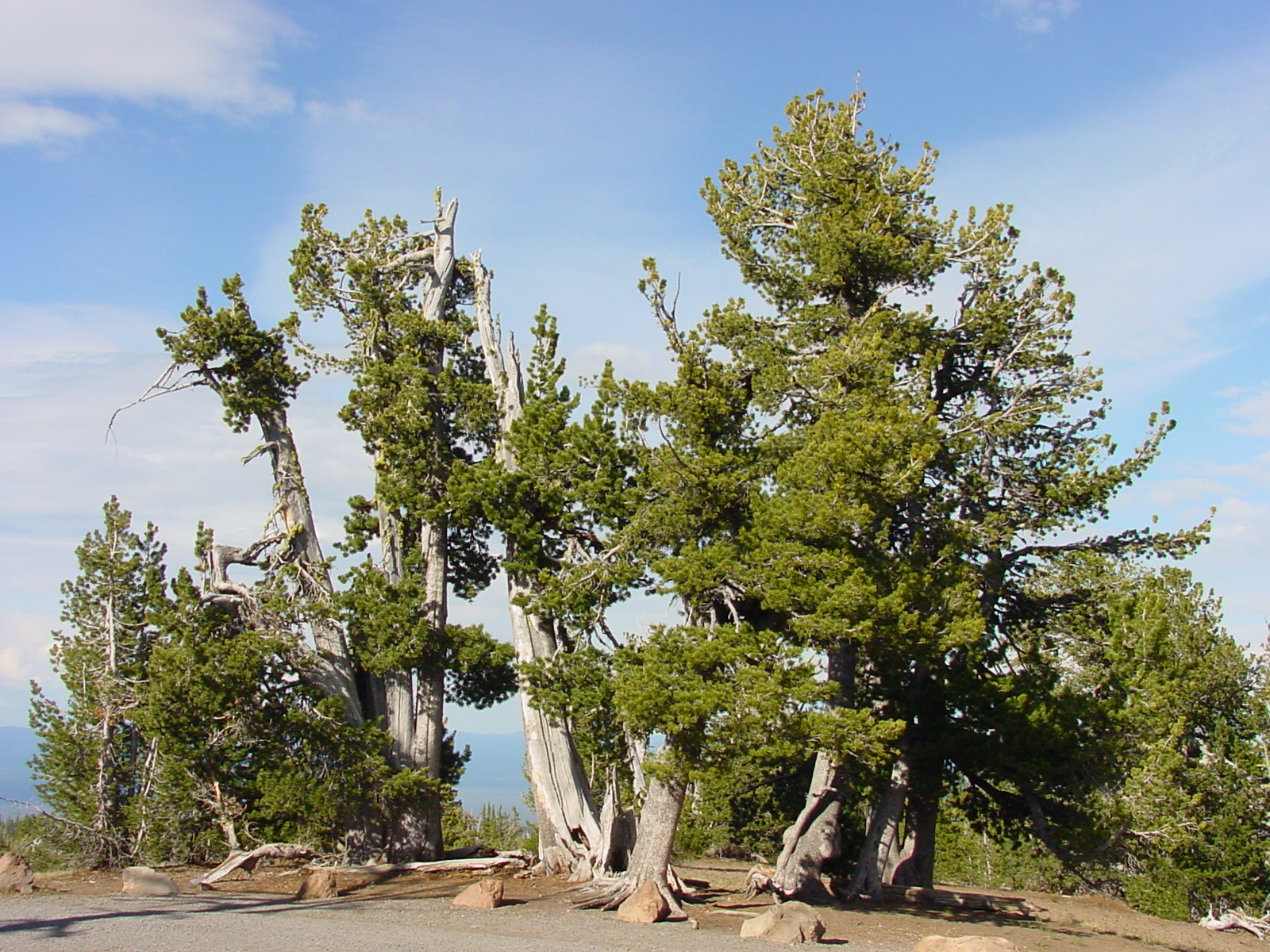
The whitebark pine is typically the highest-elevation pine tree found in these mountain ranges and often marks the tree line. Thus, it is often found as krummholz, trees growing close to the ground that have been dwarfed by exposure. In more favorable conditions, the trees may grow to 29 meters (95 ft) in height.
Whitebark pine is a member of the white pine group, the Pinus subgenus Strobus, and the section Strobus; like all members of this group, the leaves (needles) are in fascicles (bundles) of five with a deciduous sheath. This distinguishes whitebark pine and its relatives from the lodgepole pine (Pinus contorta), with two needles per fascicle, as well as the ponderosa pine (Pinus ponderosa) and Jeffrey pine (Pinus jeffreyi), which both have three needles per fascicle; all three of these species also have a persistent sheath at the base of each fascicle. Whitebark pine owes its name to the light gray bark of its young specimens.
Distinguishing whitebark pine (Pinus albicaulis), from the related limber pine (Pinus flexilis), also a member of the white pine group, is much more difficult, and usually requires seed or pollen cones. In Pinus albicaulis, the seed-bearing female cones are 4–7 centimeters (1+1⁄2–3 in) long, dark purple when immature, and do not open on drying, but the scales easily break when they are removed by the Clark's nutcracker to harvest the seeds; rarely are there intact old cones in the litter beneath the trees. Its pollen cones are scarlet.
In Pinus flexilis, the cones are 6–12 cm (2+1⁄2–4+1⁄2 in) long, green when immature, and open to release the seeds; the scales are not fragile. Their pollen cones are yellow, and there are usually intact old cones found beneath them.
Whitebark pine can also be hard to distinguish from the western white pine (Pinus monticola) in the absence of cones. However, whitebark pine needles are yellow-green and entire (smooth when rubbed gently in either direction), whereas western white pine needles are silvery green and finely serrated (feeling rough when rubbed gently from tip to base). Whitebark pine needles are also usually shorter, 3–7 cm (1–3 in) long, though still overlapping in size with the larger 5–10 cm (2–4 in) needles of the western white pine.
Whitebark pine (Pinus albicaulis) can be found at high elevation in the Rocky Mountains from central British Columbia to western Wyoming. It occurs in the timberline zone of the Cascades and coastal ranges from British Columbia to the Sierra Nevada, as well as most high ranges between the Rockies and Cascades, such as the Blue Mountains. It is also populous in subalpine forests of Montana and Idaho.
The whitebark pine is an important source of food for many granivorous birds and small mammals, including most importantly the Clark's nutcracker (Nucifraga columbiana), the major seed disperser of the pine. Clark's nutcrackers each cache about 30,000 to 100,000 seeds each year in small, widely scattered caches, usually under 2 to 3 cm (3⁄4 to 1+1⁄4 in) of soil or gravelly substrate. Nutcrackers retrieve these seed caches during times of food scarcity and to feed their young. Cache sites selected by nutcrackers are often favorable for germination of seeds and survival of seedlings. Those caches not retrieved by the time the snow melts contribute to forest regeneration. Consequently, whitebark pine often grows in clumps of several trees, originating from a single cache of two to 15 or more seeds.
Hub AI
Pinus albicaulis AI simulator
(@Pinus albicaulis_simulator)
Pinus albicaulis
Pinus albicaulis, known by the common names whitebark pine, white bark pine, white pine, pitch pine, scrub pine, and creeping pine, is a conifer tree native to the mountains of the western United States and Canada, specifically subalpine areas of the Sierra Nevada, Cascade Range, Pacific Coast Ranges, Rocky Mountains, and Ruby Mountains. It shares the common name "creeping pine" with several other plants.
The whitebark pine is typically the highest-elevation pine tree found in these mountain ranges and often marks the tree line. Thus, it is often found as krummholz, trees growing close to the ground that have been dwarfed by exposure. In more favorable conditions, the trees may grow to 29 meters (95 ft) in height.
Whitebark pine is a member of the white pine group, the Pinus subgenus Strobus, and the section Strobus; like all members of this group, the leaves (needles) are in fascicles (bundles) of five with a deciduous sheath. This distinguishes whitebark pine and its relatives from the lodgepole pine (Pinus contorta), with two needles per fascicle, as well as the ponderosa pine (Pinus ponderosa) and Jeffrey pine (Pinus jeffreyi), which both have three needles per fascicle; all three of these species also have a persistent sheath at the base of each fascicle. Whitebark pine owes its name to the light gray bark of its young specimens.
Distinguishing whitebark pine (Pinus albicaulis), from the related limber pine (Pinus flexilis), also a member of the white pine group, is much more difficult, and usually requires seed or pollen cones. In Pinus albicaulis, the seed-bearing female cones are 4–7 centimeters (1+1⁄2–3 in) long, dark purple when immature, and do not open on drying, but the scales easily break when they are removed by the Clark's nutcracker to harvest the seeds; rarely are there intact old cones in the litter beneath the trees. Its pollen cones are scarlet.
In Pinus flexilis, the cones are 6–12 cm (2+1⁄2–4+1⁄2 in) long, green when immature, and open to release the seeds; the scales are not fragile. Their pollen cones are yellow, and there are usually intact old cones found beneath them.
Whitebark pine can also be hard to distinguish from the western white pine (Pinus monticola) in the absence of cones. However, whitebark pine needles are yellow-green and entire (smooth when rubbed gently in either direction), whereas western white pine needles are silvery green and finely serrated (feeling rough when rubbed gently from tip to base). Whitebark pine needles are also usually shorter, 3–7 cm (1–3 in) long, though still overlapping in size with the larger 5–10 cm (2–4 in) needles of the western white pine.
Whitebark pine (Pinus albicaulis) can be found at high elevation in the Rocky Mountains from central British Columbia to western Wyoming. It occurs in the timberline zone of the Cascades and coastal ranges from British Columbia to the Sierra Nevada, as well as most high ranges between the Rockies and Cascades, such as the Blue Mountains. It is also populous in subalpine forests of Montana and Idaho.
The whitebark pine is an important source of food for many granivorous birds and small mammals, including most importantly the Clark's nutcracker (Nucifraga columbiana), the major seed disperser of the pine. Clark's nutcrackers each cache about 30,000 to 100,000 seeds each year in small, widely scattered caches, usually under 2 to 3 cm (3⁄4 to 1+1⁄4 in) of soil or gravelly substrate. Nutcrackers retrieve these seed caches during times of food scarcity and to feed their young. Cache sites selected by nutcrackers are often favorable for germination of seeds and survival of seedlings. Those caches not retrieved by the time the snow melts contribute to forest regeneration. Consequently, whitebark pine often grows in clumps of several trees, originating from a single cache of two to 15 or more seeds.