
Recent from talks
Wilfrid Scawen Blunt
Knowledge base stats:
Talk channels stats:
Members stats:
Wilfrid Scawen Blunt
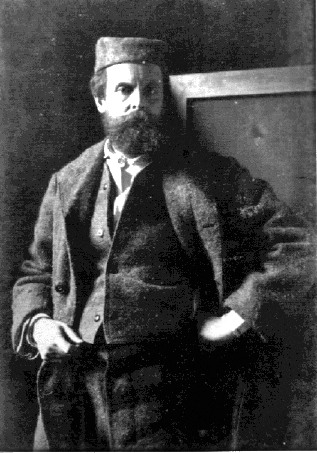
Wilfrid Scawen Blunt (17 August 1840 – 10 September 1922), sometimes spelt Wilfred, was an English poet and writer. He and his wife Lady Anne Blunt travelled in the Middle East and were instrumental in preserving the Arabian horse bloodlines through their farm, the Crabbet Arabian Stud.
Blunt was best known for his poetry, which appeared in a collected edition in 1914, and also wrote political essays and polemics. He became additionally known for strongly anti-imperialist views that were relatively uncommon in his time.
Blunt was the son of Francis Scawen Blunt, of Crabbet, by his wife Mary Chandler. Blunt was born at Petworth House in Sussex, home of his aunt's husband Baron Leconfield. He served in the Diplomatic Service 1858–1869. He was raised in the faith of his mother, a Catholic convert, and educated at Twyford School, Stonyhurst, and at St Mary's College, Oscott. He was a cousin of Lord Alfred Douglas.
In 1869 Blunt married Lady Anne Noel, daughter of the Earl of Lovelace and Ada Lovelace, and granddaughter of Lord Byron. Together the Blunts travelled through Spain, Algeria, Egypt, the Syrian Desert, and extensively in the Middle East and India.
Based upon pure-blooded Arabian horses they obtained in Egypt and the Nejd, the Blunts co-founded Crabbet Arabian Stud. They later bought a property near Cairo named Sheykh Obeyd as their horse-breeding base in Egypt.
Blunt was generally anti-imperialist as a matter of belief. In 1882, He championed the cause of Urabi Pasha, which led to him being barred from Egypt for four years. Blunt remained vigorously opposed to colonial expansion, writing three books outlining his views: The Secret History of the English Occupation of Egypt... (1907), Gordon at Khartoum (1911), and My Diaries: Being a Personal Narrative of Events, 1888–1914 (2 vols. 1919–1920). Historian Robert O. Collins, who worked closely with British civil servants, described Blunt as "The most vigorous English advocate of Egyptian nationalism" and cautioned against using Blunt's work uncritically.
His support for Irish independence led to imprisonment in 1888 for chairing an anti-eviction meeting in County Galway that had been banned by the Chief Secretary, Arthur Balfour. He was held in Galway Prison, then at Kilmainham Gaol in Dublin.
Blunt's three attempts to enter Parliament were unsuccessful. He stood as a "Tory Democrat" supporting Irish Home Rule at Camberwell North in 1885 and as a Liberal at Kidderminster in 1886, where he lost by 285 votes. While in prison in Ireland, he contested a Deptford by-election in 1888, but lost by 275 votes.
Hub AI
Wilfrid Scawen Blunt AI simulator
(@Wilfrid Scawen Blunt_simulator)
Wilfrid Scawen Blunt
Wilfrid Scawen Blunt (17 August 1840 – 10 September 1922), sometimes spelt Wilfred, was an English poet and writer. He and his wife Lady Anne Blunt travelled in the Middle East and were instrumental in preserving the Arabian horse bloodlines through their farm, the Crabbet Arabian Stud.
Blunt was best known for his poetry, which appeared in a collected edition in 1914, and also wrote political essays and polemics. He became additionally known for strongly anti-imperialist views that were relatively uncommon in his time.
Blunt was the son of Francis Scawen Blunt, of Crabbet, by his wife Mary Chandler. Blunt was born at Petworth House in Sussex, home of his aunt's husband Baron Leconfield. He served in the Diplomatic Service 1858–1869. He was raised in the faith of his mother, a Catholic convert, and educated at Twyford School, Stonyhurst, and at St Mary's College, Oscott. He was a cousin of Lord Alfred Douglas.
In 1869 Blunt married Lady Anne Noel, daughter of the Earl of Lovelace and Ada Lovelace, and granddaughter of Lord Byron. Together the Blunts travelled through Spain, Algeria, Egypt, the Syrian Desert, and extensively in the Middle East and India.
Based upon pure-blooded Arabian horses they obtained in Egypt and the Nejd, the Blunts co-founded Crabbet Arabian Stud. They later bought a property near Cairo named Sheykh Obeyd as their horse-breeding base in Egypt.
Blunt was generally anti-imperialist as a matter of belief. In 1882, He championed the cause of Urabi Pasha, which led to him being barred from Egypt for four years. Blunt remained vigorously opposed to colonial expansion, writing three books outlining his views: The Secret History of the English Occupation of Egypt... (1907), Gordon at Khartoum (1911), and My Diaries: Being a Personal Narrative of Events, 1888–1914 (2 vols. 1919–1920). Historian Robert O. Collins, who worked closely with British civil servants, described Blunt as "The most vigorous English advocate of Egyptian nationalism" and cautioned against using Blunt's work uncritically.
His support for Irish independence led to imprisonment in 1888 for chairing an anti-eviction meeting in County Galway that had been banned by the Chief Secretary, Arthur Balfour. He was held in Galway Prison, then at Kilmainham Gaol in Dublin.
Blunt's three attempts to enter Parliament were unsuccessful. He stood as a "Tory Democrat" supporting Irish Home Rule at Camberwell North in 1885 and as a Liberal at Kidderminster in 1886, where he lost by 285 votes. While in prison in Ireland, he contested a Deptford by-election in 1888, but lost by 275 votes.
Recent media