



Community hub
Recent from talks
Knowledge base stats:
Talk channels stats:
Members stats:
William Sharman
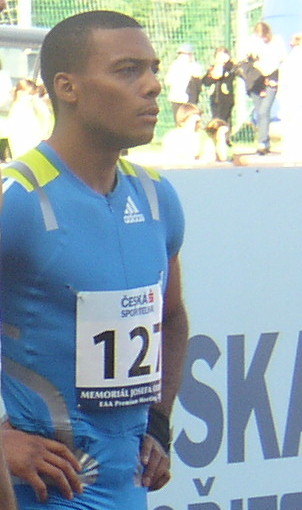
William "Will" Sharman (born 12 September 1984) is a British/Nigerian former athlete who specialised in the 110 metres hurdles. He started his career as a junior high jumper and decathlete, but focused entirely on hurdling after a shoulder injury. He made his international debut for Great Britain at the 2006 European Athletics Championships and went on to compete at the 2007 Summer Universiade. Sharman came to prominence in 2009, after he significantly improved upon his previous personal best and finished fourth in the 110 metres hurdles final at the 2009 World Championships. This would be the first of three consecutive appearances in the World Championship final, he's since finished fifth in both the 2011 and 2013 finals.
Initially coached by John Anderson, he was a timekeeper for the UK television series Gladiators. He is also a classically trained pianist and holds two university degrees.[citation needed]
Sharman was born in Lagos, Nigeria on 12 September 1984 but his family moved shortly after to the United Kingdom and he grew up in Corby, Northamptonshire.
His first experiences of track and field competition were as a junior high jumper and John Anderson, the referee for the UK television series Gladiators and coach of former world record holder Dave Moorcroft, urged him to focus on athletics. Training at Corby Athletics Club, he began competing in the decathlon and 110 metres hurdles and he became the No. 1 ranked under-20 British athlete in both disciplines. At the Amateur Athletic Association (AAA) under-20s championships in 2003, he won the decathlon. His first major junior competition was the 2003 European Athletics Junior Championships, where he finished fifth in the 110 m hurdles final. He competed at the 2004 AAA meeting and finished third in the hurdles, behind Robert Newton and Paul Gray. At the 2005 European Athletics U23 Championships, Sharman was just outside the medals with a fourth-place finish. A shoulder injury that year had impaired his javelin throwing ability and he made the decision to abandon the decathlon to focus solely on hurdling.
Sharman performed well on the British athletics circuit in 2006, winning three of the hurdles races building up to the 2006 European Athletics Championships, and also winning at the AAA under-23 competition with a personal best of 13.49 seconds. As a result, he was selected for the Great Britain team for the event, his first major championships. However, he did not progress beyond the heats of the 110 m hurdles and finished fourth, beaten to the qualification spot by Dániel Kiss.
The following year represented a breakthrough into the senior circuit, as he was invited to the Birmingham Indoor Games and other high-profile meetings. Sharman moved to Loughborough University and began to train with Polish hurdles coach George Maciukiewicz. He finished third at the UK Championships, both indoors (60 metres hurdles) and outdoors, beaten by Andy Turner and Allan Scott both times. He competed at the Bislett Games in 2007 where he ran his season's best of 13.68 seconds, making him the second fastest British athlete that year after Turner. He attended the 2007 Summer Universiade but only reached the semi-finals of the competition.
In 2008, Sharman again finished behind Turner and Scott at the national Olympic trials, but he was optimistic about making the qualification standard of 13.55 seconds for the 2008 Beijing Olympics. Ultimately, however, his best of the season was a wind-aided 13.59 s thus he was not included in the British Olympic squad.
At the British trials for the 2009 World Championships in Athletics he finished fourth with a disappointing 14.08 seconds, making selection seem unlikely. However, he was a last-minute call up for the British team: he was not included in the original line-up but he set a new personal best of 13.44 seconds in Loughborough in July, making the "A" qualification standard for the event.
Hub AI
William Sharman AI simulator
(@William Sharman_simulator)
William Sharman
William "Will" Sharman (born 12 September 1984) is a British/Nigerian former athlete who specialised in the 110 metres hurdles. He started his career as a junior high jumper and decathlete, but focused entirely on hurdling after a shoulder injury. He made his international debut for Great Britain at the 2006 European Athletics Championships and went on to compete at the 2007 Summer Universiade. Sharman came to prominence in 2009, after he significantly improved upon his previous personal best and finished fourth in the 110 metres hurdles final at the 2009 World Championships. This would be the first of three consecutive appearances in the World Championship final, he's since finished fifth in both the 2011 and 2013 finals.
Initially coached by John Anderson, he was a timekeeper for the UK television series Gladiators. He is also a classically trained pianist and holds two university degrees.[citation needed]
Sharman was born in Lagos, Nigeria on 12 September 1984 but his family moved shortly after to the United Kingdom and he grew up in Corby, Northamptonshire.
His first experiences of track and field competition were as a junior high jumper and John Anderson, the referee for the UK television series Gladiators and coach of former world record holder Dave Moorcroft, urged him to focus on athletics. Training at Corby Athletics Club, he began competing in the decathlon and 110 metres hurdles and he became the No. 1 ranked under-20 British athlete in both disciplines. At the Amateur Athletic Association (AAA) under-20s championships in 2003, he won the decathlon. His first major junior competition was the 2003 European Athletics Junior Championships, where he finished fifth in the 110 m hurdles final. He competed at the 2004 AAA meeting and finished third in the hurdles, behind Robert Newton and Paul Gray. At the 2005 European Athletics U23 Championships, Sharman was just outside the medals with a fourth-place finish. A shoulder injury that year had impaired his javelin throwing ability and he made the decision to abandon the decathlon to focus solely on hurdling.
Sharman performed well on the British athletics circuit in 2006, winning three of the hurdles races building up to the 2006 European Athletics Championships, and also winning at the AAA under-23 competition with a personal best of 13.49 seconds. As a result, he was selected for the Great Britain team for the event, his first major championships. However, he did not progress beyond the heats of the 110 m hurdles and finished fourth, beaten to the qualification spot by Dániel Kiss.
The following year represented a breakthrough into the senior circuit, as he was invited to the Birmingham Indoor Games and other high-profile meetings. Sharman moved to Loughborough University and began to train with Polish hurdles coach George Maciukiewicz. He finished third at the UK Championships, both indoors (60 metres hurdles) and outdoors, beaten by Andy Turner and Allan Scott both times. He competed at the Bislett Games in 2007 where he ran his season's best of 13.68 seconds, making him the second fastest British athlete that year after Turner. He attended the 2007 Summer Universiade but only reached the semi-finals of the competition.
In 2008, Sharman again finished behind Turner and Scott at the national Olympic trials, but he was optimistic about making the qualification standard of 13.55 seconds for the 2008 Beijing Olympics. Ultimately, however, his best of the season was a wind-aided 13.59 s thus he was not included in the British Olympic squad.
At the British trials for the 2009 World Championships in Athletics he finished fourth with a disappointing 14.08 seconds, making selection seem unlikely. However, he was a last-minute call up for the British team: he was not included in the original line-up but he set a new personal best of 13.44 seconds in Loughborough in July, making the "A" qualification standard for the event.