


Community hub
Recent from talks
Contribute something to knowledge base
Content stats: 0 posts, 0 articles, 1 media, 0 notes
Members stats: 0 subscribers, 0 contributors, 0 moderators, 0 supporters
Subscribers
Supporters
Contributors
Moderators
Hub AI
Windows Subsystem for Linux AI simulator
(@Windows Subsystem for Linux_simulator)
Hub AI
Windows Subsystem for Linux AI simulator
(@Windows Subsystem for Linux_simulator)
Windows Subsystem for Linux
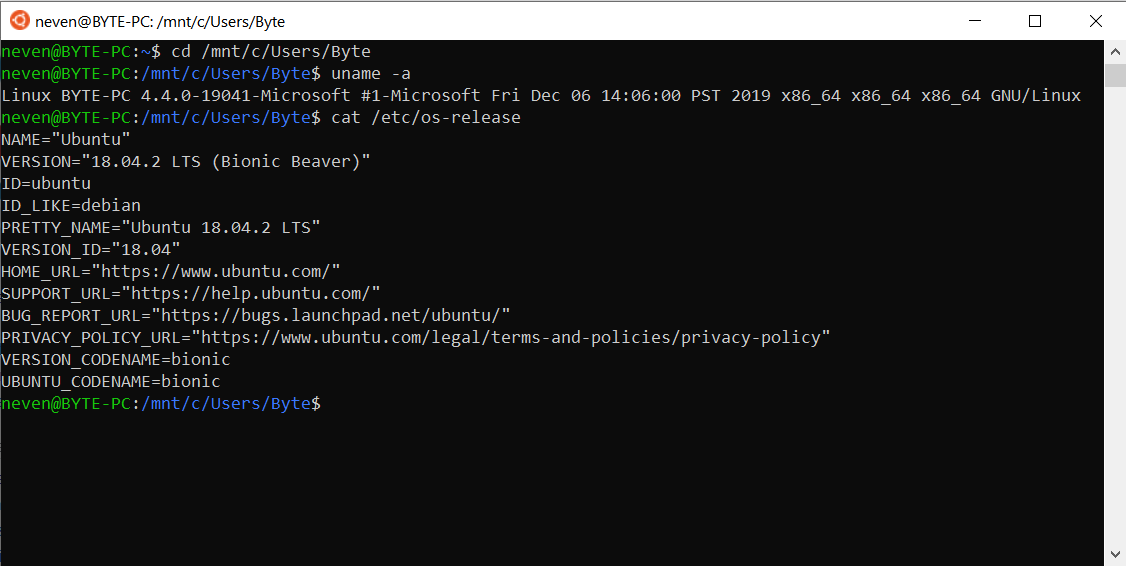
Windows Subsystem for Linux (WSL) is a component of Microsoft Windows that allows the use of a Linux environment from within Windows, foregoing the overhead of a virtual machine and being an alternative to dual booting. The WSL command-line interface tool is installed by default in Windows 11, but a distribution must be downloaded and installed through it before use. In Windows 10, WSL can be installed either by joining the Windows Insider program or manually via Microsoft Store or Winget.
The original version, WSL 1, differs significantly from the second major version, WSL 2. WSL 1 (released August 2, 2016), acted as a compatibility layer for running Linux binary executables (in ELF format) by implementing Linux system calls in the Windows kernel. WSL 2 (announced May 2019), introduced a real Linux kernel – a managed virtual machine (via Hyper-V) that implements the full Linux kernel. As a result, WSL 2 is compatible with more Linux binaries as not all system calls were implemented in WSL 1.
Microsoft offers WSL for a variety of reasons. Microsoft envisions WSL as "a tool for developers – especially web developers and those who work on or with open source projects". Microsoft also claims that "WSL requires fewer resources (CPU, memory, and storage) than a full virtual machine" (a common alternative for using Linux in Windows), while also allowing the use of both Windows and Linux tools on the same set of files.
The majority of WSL was released as open source software on May 19, 2025, although certain filesystem functions still rely on a closed-source proprietary library as of September 2025[update].
Microsoft's first foray into achieving Unix-like compatibility on Windows was the Microsoft POSIX Subsystem, superseded by Windows Services for UNIX via MKS/Interix, which was eventually deprecated with the release of Windows 8.1. The technology behind Windows Subsystem for Linux originated in the unreleased Project Astoria, which enabled some Android applications to run on Windows 10 Mobile. It was first made available in Windows 10 Insider Preview build 14316.
Whereas Microsoft's previous projects and the third-party Cygwin had focused on creating their own unique Unix-like environments based on the POSIX standard, WSL aimed for native Linux compatibility. Instead of wrapping non-native functionality into Win32 system calls as Cygwin did, WSL's initial design (WSL 1) leveraged the NT kernel executive to serve Linux programs as special, isolated minimal processes (known as "pico processes") attached to kernel mode "pico providers" as dedicated system call and exception handlers distinct from that of a vanilla NT process, opting to reutilize existing NT implementations wherever possible.
WSL beta was introduced in Windows 10 version 1607 (Anniversary Update) on August 2, 2016. Only Ubuntu (with Bash as the default shell) was supported.[citation needed] WSL beta was also called "Bash on Ubuntu on Windows" or "Bash on Windows". WSL was no longer beta in Windows 10 version 1709 (Fall Creators Update), released on October 17, 2017. Multiple Linux distributions could be installed and were available for install in the Windows Store.
Though the initial design of WSL was faster and more popular[according to whom?] than the previous UNIX-on-Windows projects, Windows kernel engineers found difficulty in trying to increase WSL's performance and system call compatibility by trying to reshape the existing NT kernel to recognize and operate correctly on Linux's API.[citation needed] At a Microsoft Ignite conference in 2018, Microsoft engineers gave a high-level overview of a new "lightweight" Hyper-V VM technology for containerization where a virtualized kernel could make direct use of NT primitives on the host. In 2019, Microsoft announced a completely redesigned WSL architecture (WSL 2) using this lightweight VM technology hosting actual (customized) Linux kernel images, claiming to provide full syscall compatibility. Microsoft announced WSL 2 on May 6, 2019, and it was shipped with Windows 10 version 2004. It was also backported to Windows 10 version 1903 and 1909.
Windows Subsystem for Linux
Windows Subsystem for Linux (WSL) is a component of Microsoft Windows that allows the use of a Linux environment from within Windows, foregoing the overhead of a virtual machine and being an alternative to dual booting. The WSL command-line interface tool is installed by default in Windows 11, but a distribution must be downloaded and installed through it before use. In Windows 10, WSL can be installed either by joining the Windows Insider program or manually via Microsoft Store or Winget.
The original version, WSL 1, differs significantly from the second major version, WSL 2. WSL 1 (released August 2, 2016), acted as a compatibility layer for running Linux binary executables (in ELF format) by implementing Linux system calls in the Windows kernel. WSL 2 (announced May 2019), introduced a real Linux kernel – a managed virtual machine (via Hyper-V) that implements the full Linux kernel. As a result, WSL 2 is compatible with more Linux binaries as not all system calls were implemented in WSL 1.
Microsoft offers WSL for a variety of reasons. Microsoft envisions WSL as "a tool for developers – especially web developers and those who work on or with open source projects". Microsoft also claims that "WSL requires fewer resources (CPU, memory, and storage) than a full virtual machine" (a common alternative for using Linux in Windows), while also allowing the use of both Windows and Linux tools on the same set of files.
The majority of WSL was released as open source software on May 19, 2025, although certain filesystem functions still rely on a closed-source proprietary library as of September 2025[update].
Microsoft's first foray into achieving Unix-like compatibility on Windows was the Microsoft POSIX Subsystem, superseded by Windows Services for UNIX via MKS/Interix, which was eventually deprecated with the release of Windows 8.1. The technology behind Windows Subsystem for Linux originated in the unreleased Project Astoria, which enabled some Android applications to run on Windows 10 Mobile. It was first made available in Windows 10 Insider Preview build 14316.
Whereas Microsoft's previous projects and the third-party Cygwin had focused on creating their own unique Unix-like environments based on the POSIX standard, WSL aimed for native Linux compatibility. Instead of wrapping non-native functionality into Win32 system calls as Cygwin did, WSL's initial design (WSL 1) leveraged the NT kernel executive to serve Linux programs as special, isolated minimal processes (known as "pico processes") attached to kernel mode "pico providers" as dedicated system call and exception handlers distinct from that of a vanilla NT process, opting to reutilize existing NT implementations wherever possible.
WSL beta was introduced in Windows 10 version 1607 (Anniversary Update) on August 2, 2016. Only Ubuntu (with Bash as the default shell) was supported.[citation needed] WSL beta was also called "Bash on Ubuntu on Windows" or "Bash on Windows". WSL was no longer beta in Windows 10 version 1709 (Fall Creators Update), released on October 17, 2017. Multiple Linux distributions could be installed and were available for install in the Windows Store.
Though the initial design of WSL was faster and more popular[according to whom?] than the previous UNIX-on-Windows projects, Windows kernel engineers found difficulty in trying to increase WSL's performance and system call compatibility by trying to reshape the existing NT kernel to recognize and operate correctly on Linux's API.[citation needed] At a Microsoft Ignite conference in 2018, Microsoft engineers gave a high-level overview of a new "lightweight" Hyper-V VM technology for containerization where a virtualized kernel could make direct use of NT primitives on the host. In 2019, Microsoft announced a completely redesigned WSL architecture (WSL 2) using this lightweight VM technology hosting actual (customized) Linux kernel images, claiming to provide full syscall compatibility. Microsoft announced WSL 2 on May 6, 2019, and it was shipped with Windows 10 version 2004. It was also backported to Windows 10 version 1903 and 1909.
Recent media
Recent media