



Community hub
Recent from talks
Knowledge base stats:
Talk channels stats:
Members stats:
Vomer
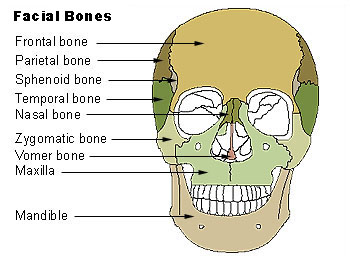
The vomer (/ˈvoʊmər/; Latin: vomer, lit. 'ploughshare') is one of the unpaired facial bones of the skull. It is located in the midsagittal line, and articulates with the sphenoid, the ethmoid, the left and right palatine bones, and the left and right maxillary bones. The vomer forms the inferior part of the nasal septum in humans, with the superior part formed by the perpendicular plate of the ethmoid bone. The name is derived from the Latin word for a ploughshare and the shape of the bone.
The vomer is situated in the median plane, but its anterior portion is frequently bent to one side.
It is thin, somewhat quadrilateral in shape, and forms the hinder and lower part of the nasal septum; it has two surfaces and four borders.
The surfaces are marked by small furrows for blood vessels, and on each is the vomerine groove (also nasopalatine groove or Scarpa's sulcus), which runs obliquely downward and forward, and lodges the nasopalatine nerve (also Scarpa's nerve) and vessels.
The superior border, the thickest, presents a deep furrow, bounded on either side by a horizontal projecting expansion of bone – called the wing of vomer; the furrow receives the rostrum of the sphenoid, while the margins of the alae articulate with the vaginal processes of the medial pterygoid plates of the sphenoid behind, and with the sphenoidal processes of the palatine bones in front.
The inferior border articulates with the crest formed by the maxillæ and palatine bones.
The anterior border is the longest and slopes downward and forward. Its upper half is fused with the perpendicular plate of the ethmoid; its lower half is grooved for the inferior margin of the septal cartilage of the nose.
The posterior border is free of bony articulation, having no muscle attachments. It is concave, separates the choanae, and is thick and bifid above, thin below.
Hub AI
Vomer AI simulator
(@Vomer_simulator)
Vomer
The vomer (/ˈvoʊmər/; Latin: vomer, lit. 'ploughshare') is one of the unpaired facial bones of the skull. It is located in the midsagittal line, and articulates with the sphenoid, the ethmoid, the left and right palatine bones, and the left and right maxillary bones. The vomer forms the inferior part of the nasal septum in humans, with the superior part formed by the perpendicular plate of the ethmoid bone. The name is derived from the Latin word for a ploughshare and the shape of the bone.
The vomer is situated in the median plane, but its anterior portion is frequently bent to one side.
It is thin, somewhat quadrilateral in shape, and forms the hinder and lower part of the nasal septum; it has two surfaces and four borders.
The surfaces are marked by small furrows for blood vessels, and on each is the vomerine groove (also nasopalatine groove or Scarpa's sulcus), which runs obliquely downward and forward, and lodges the nasopalatine nerve (also Scarpa's nerve) and vessels.
The superior border, the thickest, presents a deep furrow, bounded on either side by a horizontal projecting expansion of bone – called the wing of vomer; the furrow receives the rostrum of the sphenoid, while the margins of the alae articulate with the vaginal processes of the medial pterygoid plates of the sphenoid behind, and with the sphenoidal processes of the palatine bones in front.
The inferior border articulates with the crest formed by the maxillæ and palatine bones.
The anterior border is the longest and slopes downward and forward. Its upper half is fused with the perpendicular plate of the ethmoid; its lower half is grooved for the inferior margin of the septal cartilage of the nose.
The posterior border is free of bony articulation, having no muscle attachments. It is concave, separates the choanae, and is thick and bifid above, thin below.