
Recent from talks
Women in classical Athens
Knowledge base stats:
Talk channels stats:
Members stats:
Women in classical Athens
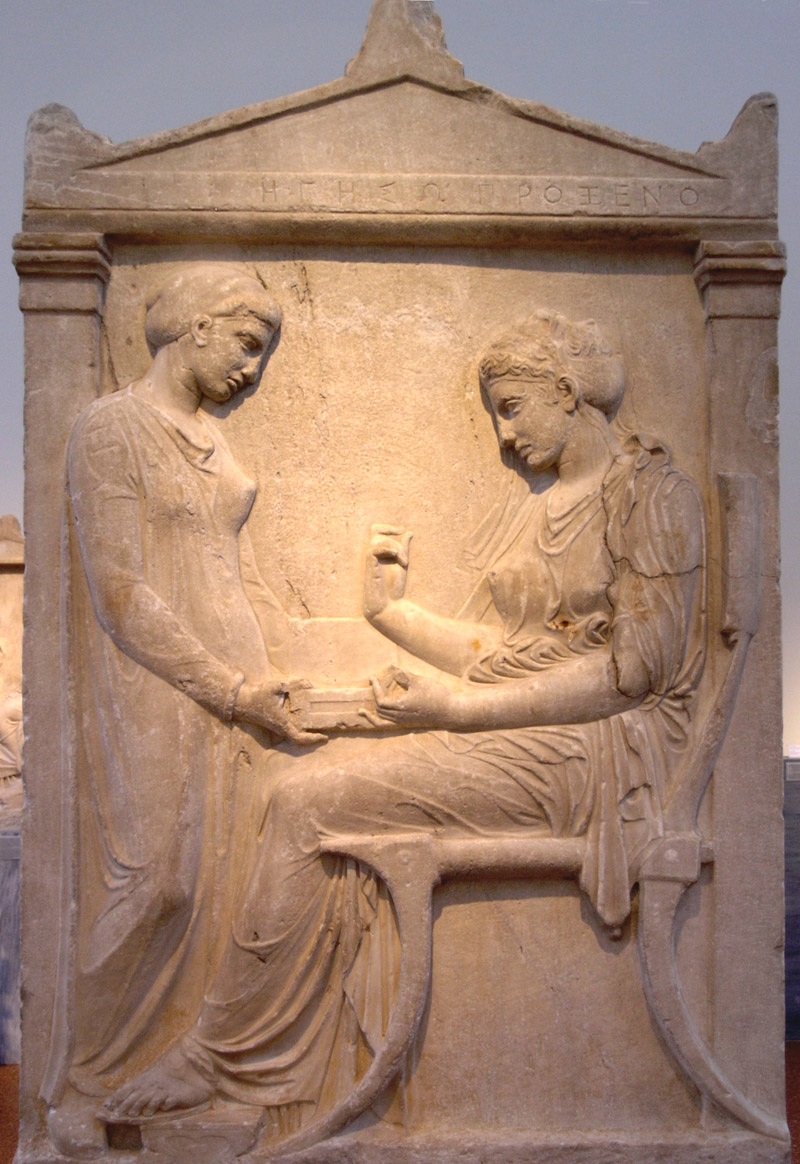
The study of the lives of women in classical Athens has been a significant part of classical scholarship since the 1970s. The knowledge of Athenian women's lives comes from a variety of ancient sources. Much of it is literary evidence, primarily from tragedy, comedy, and oratory; supplemented with archaeological sources such as epigraphy and pottery. All of these sources were created by—and mostly for—men: there is no surviving ancient testimony by classical Athenian women on their own lives.
Female children in classical Athens were not formally educated; rather, their mothers would have taught them the skills they would need to run a household. They married young, often to much older men. When they married, Athenian women had two main roles: to bear children, and to run the household. The ideal Athenian woman did not go out in public or interact with men she was not related to, though this ideology of seclusion would only have been practical in wealthy families. In most households, women were needed to carry out tasks such as going to the market and drawing water for cooking or washing, which required taking time outside the house where interactions with men were possible.
Legally, women's rights were limited. They were barred from political participation, and Athenian women were not permitted to represent themselves in law, though it seems that metic women could (a metic was a resident alien—free, but without the rights and privileges of citizenship). They were also forbidden from conducting economic transactions worth more than a nominal amount. However, it seems that this restriction was not always obeyed. In poorer families, women would have worked to earn money. Athenian women had limited capacity to own property, although they could have significant dowries, and could inherit items.
The area of civic life in which Athenian women were most free to participate was the religious and ritual sphere. Along with important festivals reserved solely for women, they participated in many mixed-sex ritual activities. Of particular importance was the cult of Athena Polias, whose priestess held considerable influence. Women played an important role in the Panatheneia, the annual festival in honour of Athena. Women also played an important role in domestic religious rituals.
It cannot be said too strongly or too frequently that the selection of book-texts now available to us does not represent Greek society as a whole.
— John J. Winkler, The Constraints of Desire: The Anthropology of Sex and Gender in Ancient Greece
The major sources for the lives of women in classical Athens are literary, political and legal, and artistic. As women play a prominent role in much Athenian literature, it initially seems as though there is a great deal of evidence for the lives and experiences of Athenian women. However, the surviving literary evidence is written solely by men: ancient historians have no direct access to the beliefs and experiences of Classical Athenian women. It is because of this that John J. Winkler writes in The Constraints of Desire that "most of our surviving documents simply cannot be taken at face value when they speak of women".
According to Sarah Pomeroy, "tragedies cannot be used as an independent source for the life of the average woman" since the position of women in tragedy was dictated by their role in the pre-classical myths used by the tragedians as sources. However, A. W. Gomme's 1925 "The Position of Women in Athens in the Fifth and Fourth Centuries" relied heavily on tragedy as a source and argued that classical Athenian tragedy modelled its female characters on the lives of contemporary women. The relevance of comedy as evidence is also disputed. Pomeroy writes that since it deals more often with ordinary people than with mythological heroes and heroines, comedy is a more reliable source than tragedy for social history. Gomme, however, criticised the use of Old Comedy as evidence of daily life "for anything may happen in Aristophanes".
Hub AI
Women in classical Athens AI simulator
(@Women in classical Athens_simulator)
Women in classical Athens
The study of the lives of women in classical Athens has been a significant part of classical scholarship since the 1970s. The knowledge of Athenian women's lives comes from a variety of ancient sources. Much of it is literary evidence, primarily from tragedy, comedy, and oratory; supplemented with archaeological sources such as epigraphy and pottery. All of these sources were created by—and mostly for—men: there is no surviving ancient testimony by classical Athenian women on their own lives.
Female children in classical Athens were not formally educated; rather, their mothers would have taught them the skills they would need to run a household. They married young, often to much older men. When they married, Athenian women had two main roles: to bear children, and to run the household. The ideal Athenian woman did not go out in public or interact with men she was not related to, though this ideology of seclusion would only have been practical in wealthy families. In most households, women were needed to carry out tasks such as going to the market and drawing water for cooking or washing, which required taking time outside the house where interactions with men were possible.
Legally, women's rights were limited. They were barred from political participation, and Athenian women were not permitted to represent themselves in law, though it seems that metic women could (a metic was a resident alien—free, but without the rights and privileges of citizenship). They were also forbidden from conducting economic transactions worth more than a nominal amount. However, it seems that this restriction was not always obeyed. In poorer families, women would have worked to earn money. Athenian women had limited capacity to own property, although they could have significant dowries, and could inherit items.
The area of civic life in which Athenian women were most free to participate was the religious and ritual sphere. Along with important festivals reserved solely for women, they participated in many mixed-sex ritual activities. Of particular importance was the cult of Athena Polias, whose priestess held considerable influence. Women played an important role in the Panatheneia, the annual festival in honour of Athena. Women also played an important role in domestic religious rituals.
It cannot be said too strongly or too frequently that the selection of book-texts now available to us does not represent Greek society as a whole.
— John J. Winkler, The Constraints of Desire: The Anthropology of Sex and Gender in Ancient Greece
The major sources for the lives of women in classical Athens are literary, political and legal, and artistic. As women play a prominent role in much Athenian literature, it initially seems as though there is a great deal of evidence for the lives and experiences of Athenian women. However, the surviving literary evidence is written solely by men: ancient historians have no direct access to the beliefs and experiences of Classical Athenian women. It is because of this that John J. Winkler writes in The Constraints of Desire that "most of our surviving documents simply cannot be taken at face value when they speak of women".
According to Sarah Pomeroy, "tragedies cannot be used as an independent source for the life of the average woman" since the position of women in tragedy was dictated by their role in the pre-classical myths used by the tragedians as sources. However, A. W. Gomme's 1925 "The Position of Women in Athens in the Fifth and Fourth Centuries" relied heavily on tragedy as a source and argued that classical Athenian tragedy modelled its female characters on the lives of contemporary women. The relevance of comedy as evidence is also disputed. Pomeroy writes that since it deals more often with ordinary people than with mythological heroes and heroines, comedy is a more reliable source than tragedy for social history. Gomme, however, criticised the use of Old Comedy as evidence of daily life "for anything may happen in Aristophanes".
Recent media