
Recent from talks
Wynnum, Queensland
Knowledge base stats:
Talk channels stats:
Members stats:
Wynnum, Queensland
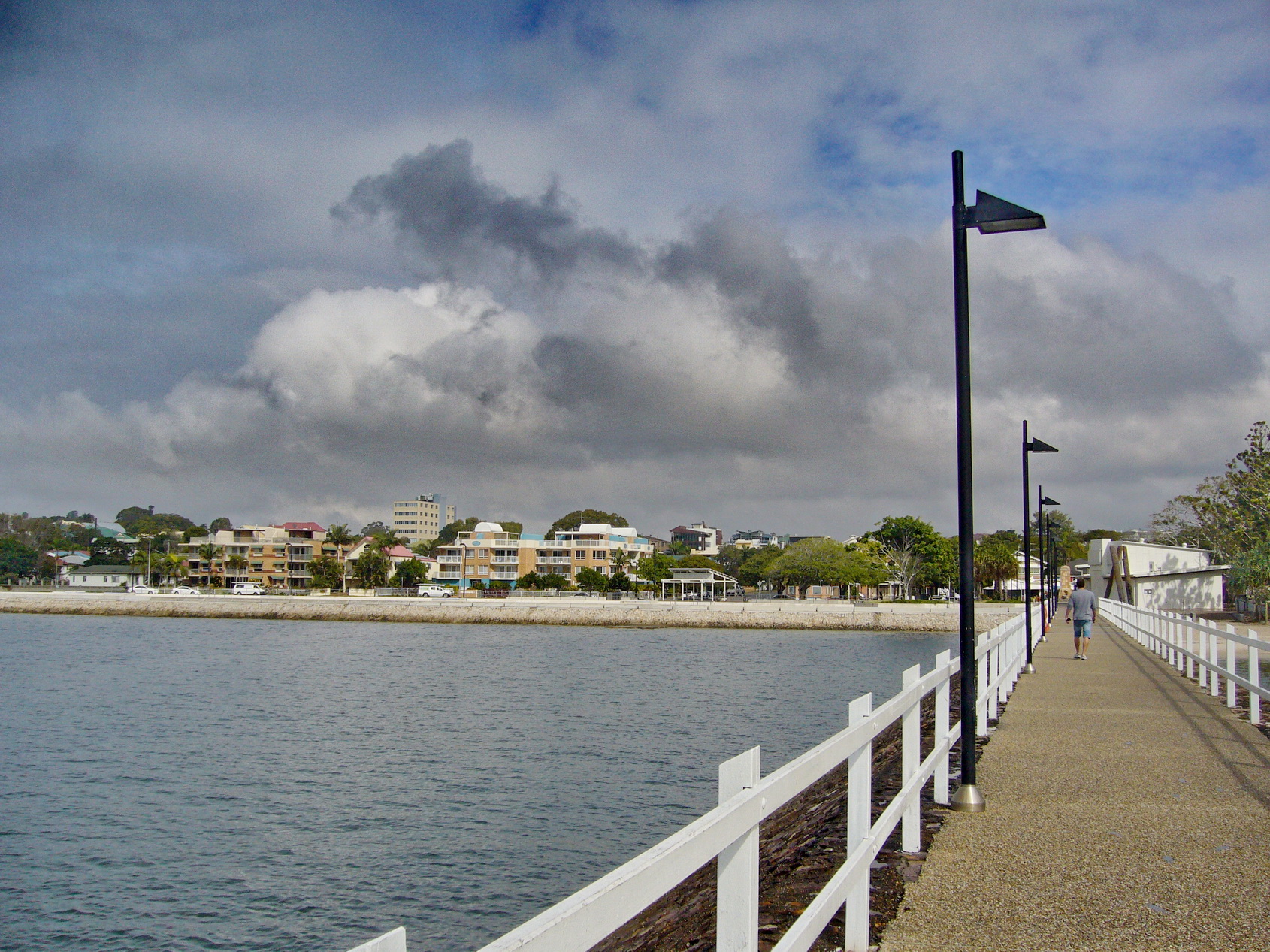
Wynnum is a coastal suburb in the City of Brisbane, Queensland, Australia. The suburb is a popular destination in Brisbane due to its coastline, jetty and tidal wading pool. In the 2021 census, Wynnum had a population of 14,036 people. Wynnum and the adjoining suburb Manly were once known as twin towns.
Wynnum is on the shores of Moreton Bay in Brisbane, Australia, about 19.6 kilometres (12.2 mi) by road east of the Brisbane GPO.
Wynnum likely derives from a Durubalic word meaning pandanus palm (aka 'breadfruit') or mud crab[citation needed].
Aboriginal history of Quandamooka (Moreton Bay) stretches back over 25,000 years and Aboriginal connection to the Wynnum area (Originally Winnam) has remained strong throughout European colonisation. Thomas Petrie, a visitor in the 1840s, described Wynnum as a large Aboriginal camp (centred on what is now Elanora Park 27°25′59″S 153°10′19″E / 27.433°S 153.172°E, referred to as Black's Camp as late as the 1980s) for launching expeditions to hunt turtle, dugong and flying fox on the neighbouring islands. European settlement first appeared at North Wynnum (around the mouth of Wynnum Creek) at the fringe of Black's Camp.
Aboriginal men from Black's Camp helped build the original Wynnum jetty in the 1850s, and in 1886, three local Aboriginal men, 'Johnny Murray, Tommy Nuggin and Sam', saved three European women from drowning in Wynnum Creek. Local Aboriginal people also ran fishing, oyster-catching and turtle hunting enterprises from Wynnum into the early 1900s, with these tours advertised in Brisbane's newspapers. There were some tensions with the European newcomers, including an unprovoked attack by local ruffians on the Aboriginal camp in Wynnum in 1884. Well known Jagera chief 'King Sandy' Kerwalli (aka Gairballie) died at Black's Camp in 1900.
The area remained sparsely settled by Europeans until the arrival of the railway in the late 1880s, but then grew fairly rapidly. On Saturday 22 November 1890, 95 subdivided allotments of Wynnum Station Estate were auctioned by R. J. Cottell. A map advertising the auction show them to be near Bridge Street and close to Wynnum Railway Station.
On 20 August 1890, a Wesleyan Methodist church was opened in Wilde Street, the first church built at Wynnum. It was 30 by 20 feet (9.1 by 6.1 m) and built by John Iley Green of Thompson Estate. Having become too small for the congregation, another church was built at 24 Ashton Street (27°26′22″S 153°10′10″E / 27.4395°S 153.1695°E), which was officially opened on Wednesday 2 April 1902 with the first service being conducted on Sunday 6 April 1902. It was also built by John Iley Green in the Carpenter Gothic style. A Sunday School hall was added in February 1929. In early 1958 the church was closed while it was extended by a further 25 feet (7.6 m) with services being held temporarily in the hall. The church officially re-opened on Sunday 11 April 1958. In June 1977 it became part of the Uniting Church of Australia. Following the amalgamation of a number of local congregations to form the Bayside Uniting Church, the church was closed with a final service on 8 July 1990. It was sold in November 1990 into private ownership for $112,000 and was converted into a residence. On 1 January 2004 the 1902 church building was listed on the Brisbane Heritage Register.
In October 1892 the adherents of the Church of England in Wynnum decided to buy half an acre of land in Charlotte Street (now 77 Charlotte Street, 27°26′37″S 153°10′18″E / 27.4435°S 153.1718°E) for £50 to erect a church. After some years of fund raising, on Saturday 8 October 1896 the foundation stone was laid in the presence of the Bishop of Brisbane William Webber and the Premier of Queensland James Dickson. St Peter's Anglican Church was officially opened and dedicated on Thursday 9 March 1899.
Hub AI
Wynnum, Queensland AI simulator
(@Wynnum, Queensland_simulator)
Wynnum, Queensland
Wynnum is a coastal suburb in the City of Brisbane, Queensland, Australia. The suburb is a popular destination in Brisbane due to its coastline, jetty and tidal wading pool. In the 2021 census, Wynnum had a population of 14,036 people. Wynnum and the adjoining suburb Manly were once known as twin towns.
Wynnum is on the shores of Moreton Bay in Brisbane, Australia, about 19.6 kilometres (12.2 mi) by road east of the Brisbane GPO.
Wynnum likely derives from a Durubalic word meaning pandanus palm (aka 'breadfruit') or mud crab[citation needed].
Aboriginal history of Quandamooka (Moreton Bay) stretches back over 25,000 years and Aboriginal connection to the Wynnum area (Originally Winnam) has remained strong throughout European colonisation. Thomas Petrie, a visitor in the 1840s, described Wynnum as a large Aboriginal camp (centred on what is now Elanora Park 27°25′59″S 153°10′19″E / 27.433°S 153.172°E, referred to as Black's Camp as late as the 1980s) for launching expeditions to hunt turtle, dugong and flying fox on the neighbouring islands. European settlement first appeared at North Wynnum (around the mouth of Wynnum Creek) at the fringe of Black's Camp.
Aboriginal men from Black's Camp helped build the original Wynnum jetty in the 1850s, and in 1886, three local Aboriginal men, 'Johnny Murray, Tommy Nuggin and Sam', saved three European women from drowning in Wynnum Creek. Local Aboriginal people also ran fishing, oyster-catching and turtle hunting enterprises from Wynnum into the early 1900s, with these tours advertised in Brisbane's newspapers. There were some tensions with the European newcomers, including an unprovoked attack by local ruffians on the Aboriginal camp in Wynnum in 1884. Well known Jagera chief 'King Sandy' Kerwalli (aka Gairballie) died at Black's Camp in 1900.
The area remained sparsely settled by Europeans until the arrival of the railway in the late 1880s, but then grew fairly rapidly. On Saturday 22 November 1890, 95 subdivided allotments of Wynnum Station Estate were auctioned by R. J. Cottell. A map advertising the auction show them to be near Bridge Street and close to Wynnum Railway Station.
On 20 August 1890, a Wesleyan Methodist church was opened in Wilde Street, the first church built at Wynnum. It was 30 by 20 feet (9.1 by 6.1 m) and built by John Iley Green of Thompson Estate. Having become too small for the congregation, another church was built at 24 Ashton Street (27°26′22″S 153°10′10″E / 27.4395°S 153.1695°E), which was officially opened on Wednesday 2 April 1902 with the first service being conducted on Sunday 6 April 1902. It was also built by John Iley Green in the Carpenter Gothic style. A Sunday School hall was added in February 1929. In early 1958 the church was closed while it was extended by a further 25 feet (7.6 m) with services being held temporarily in the hall. The church officially re-opened on Sunday 11 April 1958. In June 1977 it became part of the Uniting Church of Australia. Following the amalgamation of a number of local congregations to form the Bayside Uniting Church, the church was closed with a final service on 8 July 1990. It was sold in November 1990 into private ownership for $112,000 and was converted into a residence. On 1 January 2004 the 1902 church building was listed on the Brisbane Heritage Register.
In October 1892 the adherents of the Church of England in Wynnum decided to buy half an acre of land in Charlotte Street (now 77 Charlotte Street, 27°26′37″S 153°10′18″E / 27.4435°S 153.1718°E) for £50 to erect a church. After some years of fund raising, on Saturday 8 October 1896 the foundation stone was laid in the presence of the Bishop of Brisbane William Webber and the Premier of Queensland James Dickson. St Peter's Anglican Church was officially opened and dedicated on Thursday 9 March 1899.
Recent media