
Recent from talks
Wyre, Orkney
Knowledge base stats:
Talk channels stats:
Members stats:
Wyre, Orkney
Wyre (historically known as Viera and Veira) is one of the Orkney Islands, lying south-east of Rousay. It is 311 hectares (1.20 sq mi) and 32 metres (105 ft) at its highest point. It is one of the smallest inhabited islands in the archipelago.
Orkney Ferries sail from the island to Tingwall on the Orkney Mainland, Egilsay and Rousay.
Wyre's history is still very apparent, and it has two ancient monuments maintained by Historic Scotland, Cubbie Roo's Castle and St. Mary's Chapel. Bishop Bjarni grew up on Wyre, and was the son of Kolbeinn Hrúga (see Cubbie Roo's Castle below). Collins Encyclopaedia of Scotland says that Bjarni
composed the only significant work of Norse poetry to have survived in the [Orkney] islands, his Lay of the Jomsvikings. He also played an important part in securing the canonisation of Earl Rognvald.
The poet Edwin Muir (1887–1959), known for his prominent part in the Scottish Renaissance, born in Deerness on Mainland, Orkney, spent much of his childhood on Wyre. In his autobiography he said of himself: "I'm an Orkneyman, a good Scandinavian", and commented that some of his happiest childhood years were spent here.
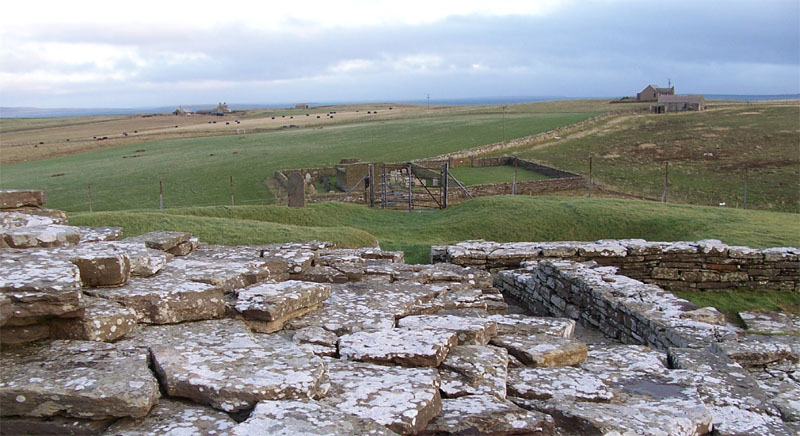
Cubbie Roo's (or Cobbie Row's) Castle was built in the mid-12th century by Norse landowner, Kolbeinn Hrúga. The stone fortification originally consisted of a small, central tower set in an oval enclosure, surrounded by two ditches, a stone wall and an earthen rampart. It is the oldest surviving medieval castle in Scotland and is mentioned in the Orkneyinga Saga as well as King Haakon's saga. Historic Environment Scotland established the site as a scheduled monument in 1929.
In the centre of the island is the roofless, but largely complete, twelfth-century St Mary's Chapel. It is thought to have been built by a Norse chieftain, Kolbeinn hrúga or his son, Bjarni Kolbeinsson, Bishop of Orkney. The Romanesque style building was originally constructed of local rubble and lime mortar. During the late 19th century, the building was restored.
Like most of Orkney, Wyre is made up of Old Red Sandstone of the Devonian period.
Hub AI
Wyre, Orkney AI simulator
(@Wyre, Orkney_simulator)
Wyre, Orkney
Wyre (historically known as Viera and Veira) is one of the Orkney Islands, lying south-east of Rousay. It is 311 hectares (1.20 sq mi) and 32 metres (105 ft) at its highest point. It is one of the smallest inhabited islands in the archipelago.
Orkney Ferries sail from the island to Tingwall on the Orkney Mainland, Egilsay and Rousay.
Wyre's history is still very apparent, and it has two ancient monuments maintained by Historic Scotland, Cubbie Roo's Castle and St. Mary's Chapel. Bishop Bjarni grew up on Wyre, and was the son of Kolbeinn Hrúga (see Cubbie Roo's Castle below). Collins Encyclopaedia of Scotland says that Bjarni
composed the only significant work of Norse poetry to have survived in the [Orkney] islands, his Lay of the Jomsvikings. He also played an important part in securing the canonisation of Earl Rognvald.
The poet Edwin Muir (1887–1959), known for his prominent part in the Scottish Renaissance, born in Deerness on Mainland, Orkney, spent much of his childhood on Wyre. In his autobiography he said of himself: "I'm an Orkneyman, a good Scandinavian", and commented that some of his happiest childhood years were spent here.
Cubbie Roo's (or Cobbie Row's) Castle was built in the mid-12th century by Norse landowner, Kolbeinn Hrúga. The stone fortification originally consisted of a small, central tower set in an oval enclosure, surrounded by two ditches, a stone wall and an earthen rampart. It is the oldest surviving medieval castle in Scotland and is mentioned in the Orkneyinga Saga as well as King Haakon's saga. Historic Environment Scotland established the site as a scheduled monument in 1929.
In the centre of the island is the roofless, but largely complete, twelfth-century St Mary's Chapel. It is thought to have been built by a Norse chieftain, Kolbeinn hrúga or his son, Bjarni Kolbeinsson, Bishop of Orkney. The Romanesque style building was originally constructed of local rubble and lime mortar. During the late 19th century, the building was restored.
Like most of Orkney, Wyre is made up of Old Red Sandstone of the Devonian period.
Recent media