
Recent from talks
Yola dialect
Knowledge base stats:
Talk channels stats:
Members stats:
Yola dialect
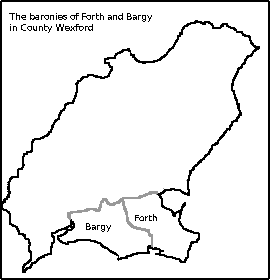
Yola, more commonly and historically the Forth and Bargy dialect, is an extinct dialect of the Middle English language once spoken in the baronies of Forth and Bargy in County Wexford, Ireland. As such, it was probably similar to the Fingallian dialect of the Fingal area. Both became functionally extinct in the 19th century when they were replaced by modern Hiberno-English. The word yola means 'old' in the dialect. In modern times, there have been efforts to revive the dialect.
The dialect was spoken in County Wexford, particularly in the baronies of Forth and Bargy. This was the first area English speakers came to in the Norman invasion of Ireland, supporting the theory that it evolved from the Middle English introduced in that period. As such it is thought to have been similar to Fingallian, which was spoken in the Fingal region north of Dublin. Middle English, the mother tongue of the "Old English" community, was widespread throughout southeastern Ireland until the 14th century; as the Old English were increasingly assimilated into Irish culture, their original language was gradually displaced through Gaelicisation. After this point, Yola and Fingallian were the only attested relicts of this original form of English.
Modern English was widely introduced by British colonists during and after the 17th century, forming the basis for the modern Hiberno-English of Ireland. The new varieties were notably distinct from the surviving relict dialects. As English continued to spread, both Yola and Fingallian died out in the 19th century, though Yola continued to be used as a liturgical language by the churches of Wexford well into the 20th century. To this day the Kilmore Choir sings what were once Yola tunes, now adapted to Standard English.
The speech of Forth and Bargy was the only kind in Ireland included in Alexander John Ellis's work On Early English Pronunciation Volume V, which was the earliest survey of dialects of English. The phonetics of the dialect were taken from a local reverend.
Though the Forth and Bargy dialect ceased to be used as a means of daily communication after the mid-19th century, it continued to see significant usage as a liturgical language, and some personal usage within the linguist community of Ireland, such as Kathleen Browne's letter to Ireland dated to 10 April 1893. Browne was a fluent Yola speaker and wrote a number of articles including "The Ancient Dialect of the Baronies of Forth and Bargy" in 1927. In 1952 N.A. Hudlestone observed that inhabitants of the area still used some of Yola vocabulary and phrases.
County Wexford native Paddy Berry is noted for his condensed performances of the piece "A Yola Zong", which he has performed for various recordings, the latest of which was in 2017. Various Yola rhymes, passed down from generation to generation, can be heard spoken by a Wexford woman in a documentary recorded in 1969 on the present usage and rememberers of Yola in the former baronies of Forth and Bargy.
Yola Farmstead, a community-operated reenactment of a Forth and Bargy village as it would have been during the 18th century, delivered a speech and performance of a song in Yola at their opening ceremony, featured Yola phrases in their advertisements, and hosted events where participants could learn some of the dialect from linguists and other experts on it.[citation needed] The Yola Farmstead also hosted a memorial event dedicated to Jack Devereux of the Kilmore Choir, which once used Yola extensively in their Christmas services. Devereux was a preservationist of, and well-versed in, Yola; locals considered him to be an expert on the dialect, and a rendition of the Lord's Prayer translated into Yola was read at his memorial.
The Yola Farm has since closed down but since 2021 there have been efforts to reopen it. Wikitongues also has a section dedicated to Yola on its website which hosts language documentation and revitalization resources.
Hub AI
Yola dialect AI simulator
(@Yola dialect_simulator)
Yola dialect
Yola, more commonly and historically the Forth and Bargy dialect, is an extinct dialect of the Middle English language once spoken in the baronies of Forth and Bargy in County Wexford, Ireland. As such, it was probably similar to the Fingallian dialect of the Fingal area. Both became functionally extinct in the 19th century when they were replaced by modern Hiberno-English. The word yola means 'old' in the dialect. In modern times, there have been efforts to revive the dialect.
The dialect was spoken in County Wexford, particularly in the baronies of Forth and Bargy. This was the first area English speakers came to in the Norman invasion of Ireland, supporting the theory that it evolved from the Middle English introduced in that period. As such it is thought to have been similar to Fingallian, which was spoken in the Fingal region north of Dublin. Middle English, the mother tongue of the "Old English" community, was widespread throughout southeastern Ireland until the 14th century; as the Old English were increasingly assimilated into Irish culture, their original language was gradually displaced through Gaelicisation. After this point, Yola and Fingallian were the only attested relicts of this original form of English.
Modern English was widely introduced by British colonists during and after the 17th century, forming the basis for the modern Hiberno-English of Ireland. The new varieties were notably distinct from the surviving relict dialects. As English continued to spread, both Yola and Fingallian died out in the 19th century, though Yola continued to be used as a liturgical language by the churches of Wexford well into the 20th century. To this day the Kilmore Choir sings what were once Yola tunes, now adapted to Standard English.
The speech of Forth and Bargy was the only kind in Ireland included in Alexander John Ellis's work On Early English Pronunciation Volume V, which was the earliest survey of dialects of English. The phonetics of the dialect were taken from a local reverend.
Though the Forth and Bargy dialect ceased to be used as a means of daily communication after the mid-19th century, it continued to see significant usage as a liturgical language, and some personal usage within the linguist community of Ireland, such as Kathleen Browne's letter to Ireland dated to 10 April 1893. Browne was a fluent Yola speaker and wrote a number of articles including "The Ancient Dialect of the Baronies of Forth and Bargy" in 1927. In 1952 N.A. Hudlestone observed that inhabitants of the area still used some of Yola vocabulary and phrases.
County Wexford native Paddy Berry is noted for his condensed performances of the piece "A Yola Zong", which he has performed for various recordings, the latest of which was in 2017. Various Yola rhymes, passed down from generation to generation, can be heard spoken by a Wexford woman in a documentary recorded in 1969 on the present usage and rememberers of Yola in the former baronies of Forth and Bargy.
Yola Farmstead, a community-operated reenactment of a Forth and Bargy village as it would have been during the 18th century, delivered a speech and performance of a song in Yola at their opening ceremony, featured Yola phrases in their advertisements, and hosted events where participants could learn some of the dialect from linguists and other experts on it.[citation needed] The Yola Farmstead also hosted a memorial event dedicated to Jack Devereux of the Kilmore Choir, which once used Yola extensively in their Christmas services. Devereux was a preservationist of, and well-versed in, Yola; locals considered him to be an expert on the dialect, and a rendition of the Lord's Prayer translated into Yola was read at his memorial.
The Yola Farm has since closed down but since 2021 there have been efforts to reopen it. Wikitongues also has a section dedicated to Yola on its website which hosts language documentation and revitalization resources.
Recent media