Hubbry Logo
Yuji NakaYuji NakaMain
Open search
Yuji Naka
Community hub
Yuji Naka
logo
24 pages, 0 posts
0 subscribers
Be the first to start a discussion here.
Yuji Naka
Yuji Naka
from Wikipedia

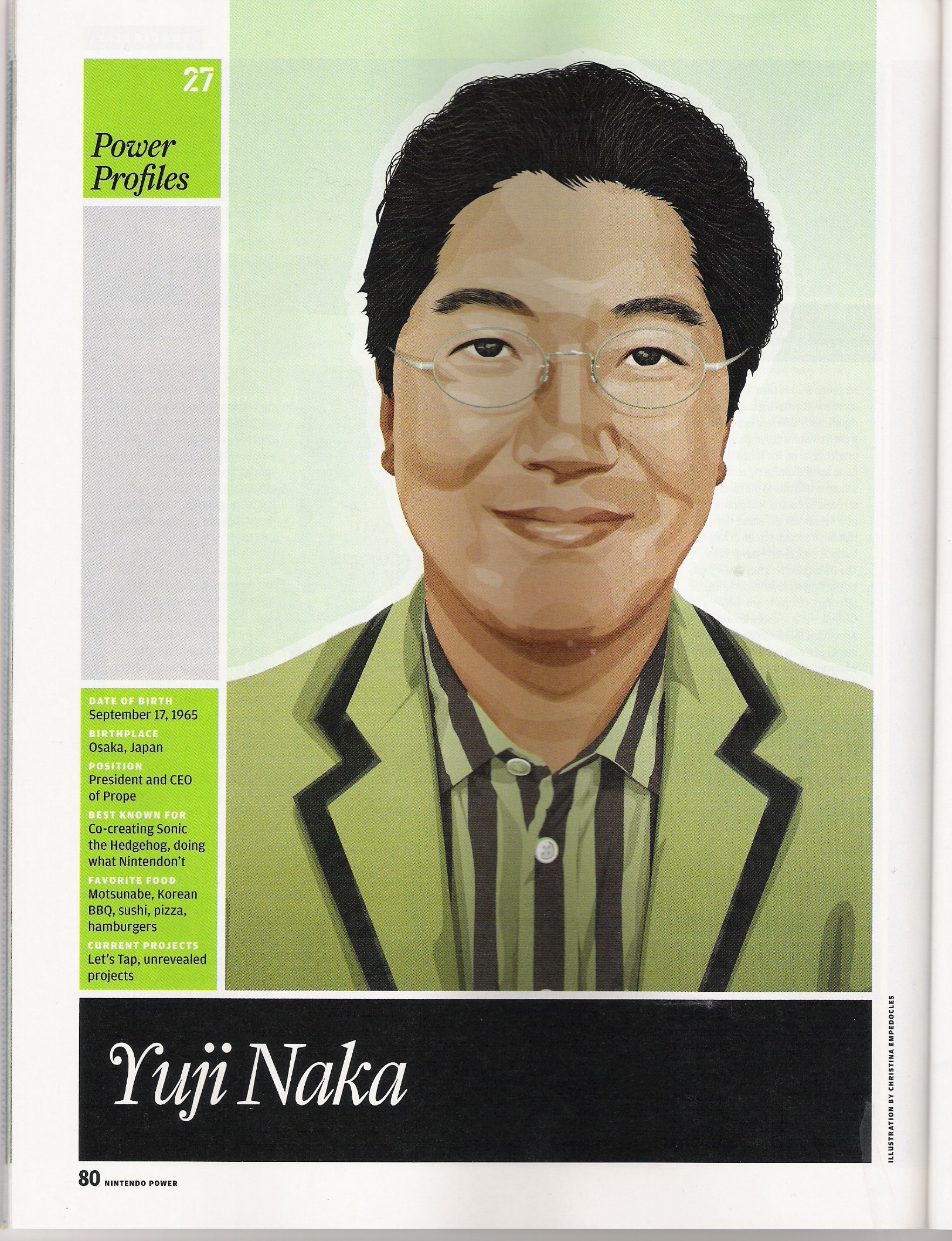
Yuji Naka (中 裕司, Naka Yūji; born September 17, 1965), sometimes credited as YU2, is a Japanese video game designer and programmer. He is the co-creator of the Sonic the Hedgehog series and was the president of Sonic Team at Sega until his departure in 2006.

Key Information

Naka joined Sega in 1984 and worked on games including Girl's Garden (1985) and Phantasy Star II (1989). He was the lead programmer of the original Sonic games on the Mega Drive in the early 1990s, which greatly increased Sega's market share. After developing Sonic the Hedgehog (1991) in Japan, Naka moved to California to develop Sonic the Hedgehog 2 (1992), Sonic the Hedgehog 3 (1994) and Sonic & Knuckles (1994) with Sega Technical Institute.

Naka returned to Japan to lead development on Sonic Team games including Nights into Dreams (1996), Burning Rangers (1998), Sonic Adventure (1998) and Phantasy Star Online (2000). After Sega left the console market in 2001, Naka remained as an executive officer and oversaw its output for the next five years.

In 2006, Naka left Sega and founded the independent game company Prope. He joined Square Enix to direct the platform game Balan Wonderworld (2021), which reunited him with the Sonic co-creator Naoto Ohshima. Naka said he was removed from the project six months before Balan Wonderworld was released, and it underperformed critically and commercially. He left Square Enix in April 2021. In 2023, Naka was found guilty of insider trading at Square Enix.

Early life

[edit]

Naka was born on September 17, 1965, in Hirakata, Osaka.[2] He learned to program by replicating and debugging video game code printed in magazines. The experience prompted him to study assemblers and practice writing code during his school classes.[3] After graduating, he decided to stay in Osaka rather than enroll in university.[4]

Career

[edit]

1983–1989: Beginnings at Sega

[edit]

Around 1983, Naka saw that the video game company Sega was looking for programming assistants and applied.[5] Following a brief interview,[5] he began working for Sega in April 1984.[6] His first task was designing maps and checking floppy disks for Lode Runner for the SG-1000; he could not recall if the game was released.[6] His first major project was Girl's Garden (1985), which he and the composer Hiroshi Kawaguchi created as part of their training process.[5] Their boss was impressed and decided to publish the game, and it earned them notice among their peers and Japanese gamers.[3] Naka felt embarrassed about his code, and did not want to release the game. He developed games going with the flow, and did not do task management at all. The pace of game development was 1 game every one or two months, and he was essentially living at the company; he recalled bragging with Yu Suzuki on who worked more overtime.[7]

During the Master System era, Naka wanted to develop games that were not possible on Nintendo's Famicom. Examples of this include the 3D dungeons of Phantasy Star and ports of Space Harrier and OutRun, which ran on powerful arcade hardware. The Mega Drive was introduced suddenly, much like the Master System. It was only around the 32X's release in 1994 that Sega gave Naka information about hardware beforehand.[7] Super Thunder Blade was the first game he programmed for the Mega Drive. He requested that sprite-scaling be implemented in future models of the console.[7] However, he was told that it was not possible at the time. He also requested a 6Mbit cartridge for Phantasy Star II, which was approved.[7] The Mega Drive was Naka's favourite hardware, and he said that he could have kept working on it forever just by making the clock speed faster.[7]

During a visit to the 1988 Amusement Machines Show, Naka was impressed by the ability to move diagonally on slopes in a demonstration of Capcom's game Ghouls 'n Ghosts. Hoping to recreate it, he asked his supervisors at Sega to allow him to port the game to the Mega Drive. Capcom provided him with the source code and ROM data. As he was developing the port, he experimented with aspects such as the speed of the main character to understand how they interacted with the environment. He also altered the slopes and was able to create a functioning 360-degree loop.[8] Sprite-scaling was still a technique that Naka wanted to improve his skill on with a game called Metal Lancer, but it was cancelled halfway through development.[7]

1989–1991: Sonic the Hedgehog

[edit]

Sega's president Hayao Nakayama decided that Sega needed a flagship series and mascot to compete with Nintendo's Mario franchise.[9] Of Naka's numerous development plans, "a game to beat Super Mario", caught a superior's attention. Naka created a prototype platform game that involved a fast-moving character rolling in a ball through a long winding tube.[10] The idea for a hedgehog that could roll into a ball by jumping and attacking enemies came from his high school notebook, and he was unsure whether to use it. This concept was expanded out with character design by Naoto Ohshima and levels conceived by Hirokazu Yasuhara.[11] Naka hoped to showcase the Mega Drive's processing speed through fast and exhilarating gameplay. Part of his approach was based on his experience playing through the original Super Mario Bros (1985); he wondered why he could not complete each level faster the better he became at playing the game.[12] The development took longer than any game Naka worked on before, and he worked only on this game for approximately a year and a half.[7]

Sonic the Hedgehog was released in 1991 and received acclaim;[13][14] it greatly increased the popularity of the Sega Genesis in North America,[15] and is credited with helping Sega gain 65% of the market share against Nintendo.[16] Naka was dissatisfied at Sega, feeling he received little credit for the success, and quit.[15][17]

1991–1994: Sonic sequels and time in California

[edit]

Naka rejoined Sega when he was hired by Mark Cerny to work at Sega Technical Institute (STI) in California, with a higher salary and more creative freedom.[17][15] At STI, Naka led development on Sonic the Hedgehog 2, released in 1992. It was another major success, but its development suffered from the language barrier and cultural differences between the Japanese and American developers.[18] The artist Craig Stitt described Naka as "an arrogant pain in the ass" who was not interested in working with Americans.[19] Another artist, Tim Skelly, said that Naka would have been happier working with an all-Japanese team.[20] As Naka refused to develop another Sonic game with the American staff, he formed a Japanese-only team at STI and developed Sonic the Hedgehog 3 and Sonic & Knuckles, both released in 1994.[21][20]

1994–1998: Return to Japan and Sega Saturn

[edit]

Following the release of Sonic & Knuckles, Naka returned to Japan, having been offered a role as a producer.[22] As managing director Hisashi Suzuki brought in videotapes of Virtua Racing and Virtua Fighter, Naka was so impressed that it partly contributed to him going back to Japan.[7] With Naka's return, Sonic Team was officially formed as a brand,[23][24] and began work on a new intellectual property,[22] Nights into Dreams (1996), for Sega's 32-bit Saturn console.[25] Naka did not have any desire to develop for the 32X, and was disappointed that the Saturn was not true 3D. Observing the development environment he did not want to make a Sonic game right away, and instead created Nights. He persuaded his superiors that Nights would only take one year and that he would work on a 3D Sonic in 1997. However, the development took longer than expected.[7] Naka regretted that he was not able to deliver a Sonic game for the Saturn, as this was often cited as a reason for the console's failure.[26]

Meanwhile, in America, STI worked on Sonic X-treme, a 3D Sonic game. Development was hindered by numerous setbacks, culminating in its cancellation in 1996. Reportedly, Naka contributed to the cancellation by refusing to let STI use the Nights game engine and threatening to quit.[27][28] The X-treme developer Chris Senn dismissed the story as speculation but said that, if true, he understood Naka's interest in maintaining control over the Sonic Team technology and the Sonic franchise.[29][30] Sonic Team was developing its own 3D Sonic game using the Nights engine, which could have motivated Naka's threat.[31] In July 2022, Naka denied that he had anything to do with X-treme's use of the Nights engine and said it would have been useless because Nights was coded in assembly and X-treme was in C. He suggested that the developers invented the story to rationalize their failure to finish X-treme.[29]

1998–2001: Dreamcast

[edit]

While Sonic Adventure was in development for the Saturn, Naka was involved with planning Sega's next console, the Dreamcast, as early as 1996. Sonic Team proposed the name "G-Cube". Naka also proposed a multimedia concept that involved talking to a built in microphone to switch TV channels, a mode of communication later used in the Dreamcast game Seaman.[7]

In 1998, prior to the launch of Dreamcast, Naka and his team visited Sega of America to tour their development offices and observe their work on the game Geist Force, a rail shooter for Dreamcast. According to the producer Mark Subotnick, Naka told his team in Japanese which parts they would take to incorporate in Sonic games and suggested firing all but one of the engineers. Unbeknownst to Naka, several of the Geist Force developers understood Japanese and quit, contributing to the project's cancellation.[32]

Shortly after the Japanese launch of the Dreamcast and Sonic Adventure, Naka was asked by the Sega chairman, Isao Okawa, to develop a flagship online game for the Dreamcast.[33] Originally, Naka was unenthusiastic about the idea given his team's inexperience with creating online games. However, the other Sega development studios were preoccupied with their own projects, such as the Sakura Wars series and Jet Set Radio (2000). Naka and his team saw the creation of an online game for Japan, a nation of console gamers, as a serious challenge, akin to creating a new genre. This was further complicated by the perception of online games in the late 1990s having boring visuals and the per-minute fee for dial-up internet in Japan.[33]

Naka split his team into three groups, all serving different purposes, before rejoining to develop Phantasy Star Online (2001). Two groups were focused on discovering the limits of the Dreamcast's capabilities, specifically in terms of graphical fidelity and the possibilities of online play on the system.[33] The other group would work on various projects under Naka's supervision that would lead them closer to their goal. This would culminate with the release of Sonic Team's Chu Chu Rocket (1999), an action-puzzle game and the first game for the system to support online console gaming.[33] Additionally, it was the only game directed by Naka at Sega as he would move on to become a producer, overseeing output from Sonic Team. Following Chu Chu Rocket's release, all three teams collaborated on the development of Phantasy Star Online. It is reported that after Okawa became ill in 2000, Naka would send reports to the hospital, updating him on the team's progress.[33]

In 2000, Sega began to restructure its development operations as part of the dissolution of Sega Enterprises, transforming its arcade and console studios into semi-autonomous subsidiary companies. While each studio was given an unprecedented amount of creative freedom, Naka felt it important to preserve the Sonic Team brand name, and therefore the legal name of the company was SONICTEAM, Ltd. Naka was installed as the CEO of the new company.[34]

2001–2006: Final years at Sega

[edit]

In March 2001, Sega discontinued the Dreamcast and left the video game hardware market.[35] Sega's semiautonomous entities were reabsorbed, including Sonic Team. Naka remained as an executive officer, overseeing all of Sega's output until his departure in 2006.[36][37] According to the former Sega producer Takashi Yuda, senior Sega figures including Toshihiro Nagoshi and Yu Suzuki were reporting to Naka.[38] In late 2001 or early 2002, Peter Moore, the president of Sega of America, arranged focus groups with teenagers and found that Sega's reputation was declining. According to Moore, Naka responded angrily and accused Moore of having falsified the findings.[39]

After Sega left the hardware market, Sonic Team began developing for consoles by other manufacturers;[40] Naka became fond of the Nintendo GameCube. He regretted that he did not bring Phantasy Star Online to the PlayStation 2, as Monster Hunter came out in 2004 and became popular.[7]

2006–2016: Prope

[edit]
Naka during the 2008 Tokyo Game Show

On March 16, 2006, Naka announced that he would leave Sega to create his own game studio, Prope.[41] He said he considered it a benefit to be able to create games other than Sonic the Hedgehog games.[42] Naka also explained that the video game industry was young, leading to quick promotions; he felt his senior position had given him less time to be close to development.[43] The last Sonic game Naka was involved was Sonic the Hedgehog (2006). He regretted leaving Sega during the middle of its development as it was poorly received.[26]

Naka and Prope developed small games for the Wii and mobile devices, such as Wii Play: Motion and Ivy The Kiwi?. This included a reunion with Sega as they published Let's Tap and Let's Catch for the Wii. Naka explained that while it was uncommon in the west, he always maintained a strong relationship with the company despite his departure.[44] During this time, Naka also voiced a fictionalized version of himself in the Sega-themed anime series Hi-sCoool! SeHa Girls, though his identity was concealed under the alias "Center-sensei" until the final episode.[45]

The games helped finance their first large-scale production, Rodea the Sky Soldier, which finished development in 2011 but was not released until 2015.[46] According to Naka, the publisher, Kadokawa Games, would not release the game until they developed a version for the Nintendo 3DS.[46][47] Following the launch of the Nintendo Wii U in 2012, Kadakowa opted to create a Wii U version based on the 3DS version, delaying it until 2015.[48][49] In November 2015, Kadokawa Games released Rodea the Sky Soldier on the 3DS and Wii U, while packaging Naka and Prope's Wii version as bonus bundled with the initial print of the Wii U version.[48] In response, Naka used his social media following to request people prioritize playing the Wii version.[50][51] Naka was awarded with the Bizkaia Award at the Fun & Serious Game Festival in 2016.[52]

2016–2022: Square Enix and Balan Wonderworld

[edit]

In 2018, Naka joined Square Enix to form the subsidiary developer Balan Company, which aimed to facilitate collaboration between internal and external staff. Naka described Balan Company as a collective of designers and artists focusing on genres outside the norms of Square Enix. Prope remained in business, but with Naka its only employee.[53]

Balan Company's first game, Balan Wonderworld, was co-developed by Arzest, a company which had previously co-developed multiple projects for Nintendo and Mistwalker. A key staff member at Arzest was Naoto Ohshima, a former Sega artist who created the designs for Sonic the Hedgehog and Doctor Eggman. When Naka joined Square Enix in January 2018, he considered making social mobile games, but was encouraged by Shinji Hashimoto to make action games for the new market, which was seeing a resurgence in classic action and platform games. Naka approached Ohshima about a collaboration, their first since Sonic Adventure in 1998.[54]

Following disagreements with staff, Naka was removed from the project approximately six months before Balan Wonderworld was released. It received generally negative reviews and underperformed commercially. Naka left Square Enix in April 2021.[55][56] On December 22, 2021, Naka released a free mobile game, Shot2048, similar to the games 2048 and Chain Cube.[57]

In April 2022, Naka announced that he had sued Square Enix. He said he had attempted to negotiate to address problems with Balan Wonderworld, but was ignored, and said Square Enix and Arzest did not "value games or game fans".[58] In July, Naka tweeted a photo of the Nights team with Ohshima's face blacked out, and expressed his anger over Balan Wonderworld.[59]

Insider trading charges

[edit]

On November 17, 2022, Naka was arrested by the Tokyo District Public Prosecutors Office and charged with violating the Financial Instruments and Exchange Act of 2006.[60][61][62] The Public Prosecutors Office accused him of insider trading; Naka bought 10,000 shares of the developer Aiming before its game Dragon Quest Tact was announced to the public. Two other former Square Enix employees were also arrested, alleged to have bought 162,000 shares between December 2019 and February 2020 for approximately 47.2 million yen.[62][60][61]

On December 7, Naka was arrested again, accused of having purchased 144.7 million yen of shares of the developer ATeam before their game Final Fantasy VII: The First Soldier was announced.[63] He was later indicted on insider trading charges by the Tokyo District Public Prosecutors Office.[64] Naka admitted his guilt in March 2023.[65] On June 1, prosecutors asked for a sentence of two and a half years in prison and a combined fine of 172.5 million yen.[65] On July 7, a Tokyo District Court judge gave Naka a sentence of two years and six months in prison, suspended for four years. The judge ordered Naka to forfeit 171 million yen and pay a fine of two million yen.[66]

Following the charges, Naka made no public statements for 16 months. In April 2024, he ended his social media hiatus to respond to the news that Yu Miyake, Dragon Quest's executive producer, was being reassigned to Square Enix's mobile division by accusing him of lying during the trial. Miyake was credited as executive officer on Balan Wonderworld.[67]

Personal life

[edit]

Naka is a racer and car enthusiast, having mentioned his Ferrari 360 Spider in multiple interviews.[68][36] In November 2004, he competed in round six of the Kumho Tyres Lotus Championship in Tasmania.[69] In April 2022, Naka participated in the first round of the Elise Super Tech competition at the Mobility Resort Motegi circuit, finishing seventh place.[70]

Works

[edit]
Year Game Role
1985 Girl's Garden Game designer, programmer
Great Baseball Programmer[7][71][72]
F-16 Fighting Falcon (Master System ver.)
1986 Black Belt
Spy vs. Spy (Master System ver.)
Space Harrier (Master System ver.)
1987 OutRun (Master System ver.)
Phantasy Star Lead programmer
1989 Phantasy Star II Producer, lead programmer
Ghouls 'n Ghosts (Genesis ver.) Programmer
1991 Sonic the Hedgehog
1992 Sonic the Hedgehog 2 Chief programmer
1994 Sonic the Hedgehog 3 Producer, lead programmer
Sonic & Knuckles
1996 Nights into Dreams
Sonic 3D Blast Advisor
1997 Sonic Jam Producer
Sonic R
1998 Burning Rangers
Sonic Adventure
1999 ChuChu Rocket! Director, producer
Sonic Pocket Adventure Supervisor
2000 Samba de Amigo Producer
Phantasy Star Online
2001 Sonic Adventure 2
Puyo Pop
Sonic Advance
2002 Sonic Mega Collection
Sonic Advance 2
2003 Sonic Pinball Party
Billy Hatcher and the Giant Egg
Phantasy Star Online Episode III
Sonic Battle
Sonic Heroes
2004 Puyo Pop Fever
Astro Boy Chief producer
Sonic Advance 3 Producer
Sega Superstars Chief producer
Feel the Magic XX/YY
2005 Sakura Wars: So Long, My Love
Bleach Advance: Kurenai ni Somaru Soul Society
Sonic Gems Collection
The Rub Rabbits!
Shadow the Hedgehog Producer
Sonic Rush
Puyo Puyo Fever 2 Chief producer
Bleach GC: Tasogare ni Mamieru Shinigami
2006 Bleach: The Blade of Fate
Doraemon: Nobita no Kyouryuu 2006 DS
Sonic Riders Executive producer
Phantasy Star Universe
2008 Let's Tap Producer
2009 Let's Catch
Ivy the Kiwi?
2011 Wii Play: Motion
Fishing Resort
2013 Digimon Adventure
StreetPass Mansion / Monster Manor
2014 Digimon All-Star Rumble
Hi-sCoool! SeHa Girls Voice acting ("Center-sensei")
2015 Rodea the Sky Soldier (Wii ver.) Producer
StreetPass Fishing / Ultimate Angler
2016 StreetPass Chef / Feed Mii
2017 Legend of Coin Programmer[73]
2021 Balan Wonderworld Director[74]
Shot2048[75] Game designer, programmer

References

[edit]
[edit]
Revisions and contributorsEdit on WikipediaRead on Wikipedia
from Grokipedia
Yuji Naka (中 裕司, Naka Yūji; born September 17, 1965) is a Japanese video game programmer, designer, and producer best known for co-creating the Sonic the Hedgehog series, serving as the lead programmer for the original 1991 title on the Sega Genesis/Mega Drive, and heading Sega's Sonic Team development group. Born in Hirakata, Osaka Prefecture, Naka developed an early interest in programming by studying code from video game magazines during his teenage years. At age 18, he joined Sega in 1984 after being rejected by Namco, initially contributing to projects such as map design for the 1984 Sega SF-7000 project Road Runner and programming for Phantasy Star II (1989). His breakthrough came with Sonic the Hedgehog (1991), where he collaborated with artist Naoto Ohshima and designer Hirokazu Yasuhara to create a fast-paced platformer that became a flagship title for Sega, rivaling Nintendo's Mario franchise and helping define the 16-bit era of gaming. As co-head of Sonic Team, Naka oversaw the development of numerous sequels and spin-offs, including Sonic the Hedgehog 2 (1992), Sonic CD (1993), and Sonic & Knuckles (1994), innovating features like 360-degree level looping and lock-on technology. He also produced acclaimed non-Sonic titles such as the 3D adventure NiGHTS into Dreams... (1996) and the firefighting simulator Burning Rangers (1998), both showcasing his emphasis on fluid motion and innovative gameplay mechanics. In 1999, Naka led the creation of the puzzle game ChuChu Rocket!, Sega's first title for Dreamcast, which highlighted his versatility in genre experimentation. In 2006, after contributing to (2007), Naka left to establish his independent studio, , with a focus on creative, low-budget games that prioritized fun over commercial success. Under , he developed titles like the motion-controlled Let's Tap (2008) and the Ivy the Kiwi? (2009), though the studio faced challenges sustaining operations. In 2018, Naka joined as a senior producer, where he worked on the (2021), a to NiGHTS, but the project received mixed reviews and underperformed commercially, and left the company in April 2021. Naka faced legal troubles in late 2022 when he was arrested on suspicion of during his time at ; he allegedly purchased shares in Aiming Inc. using non-public information about a collaboration and in ATeam Inc. based on details from an unannounced project. In July 2023, a court sentenced him to a suspended term of two years and six months, with four years of , and fined him 172.5 million yen (approximately $1.2 million USD at the time). Following the resolution of the case, Naka returned to game development in February 2025 by announcing an update to Pirates of Coin, an eight-year-old mobile coin-pusher game originally released by in 2017.

Biography

Early life

Yuji Naka was born on September 17, 1965, in , , . As a child, Naka became fascinated with arcade games and gained early exposure to computers, partly influenced by the electronic music of , which sparked his interest in synthesized sounds and technology. At age 17, during high school, Naka taught himself programming by replicating and debugging code published in magazines, including listings for titles. He supplemented this self-education with part-time work at Nihon Microcomputer Academy, where he ported games between different platforms. Upon graduating high school in 1983, Naka decided to pursue a career in game development but was rejected by due to his lack of formal higher education. He subsequently moved from to to seek opportunities in the industry.

Personal life

Naka has largely kept his family life out of the public eye, with few details disclosed about his personal relationships. A prominent hobby of Naka's is his passion for automobiles and motorsports, which he has pursued alongside his professional career. He owns a Ferrari 360 Spider, which he has referenced in interviews as a favorite vehicle, and has also mentioned possessing a . In 2004, Naka demonstrated his interest by competing as a celebrity participant in round six of the Kumho Tyres Lotus Championship at Symmons Plains Raceway in , . Following career transitions, Naka has continued to reside in , maintaining a low profile on non-professional matters.

Career

Beginnings at Sega (1984–1989)

Yuji Naka joined Enterprises in April 1984 as a junior programmer, responding to a advertisement for programming assistants despite not having a university degree. Having taught himself programming through trial-and-error experimentation with computer magazines and early home computers, Naka quickly adapted to 's environment, starting with entry-level tasks on the company's nascent home console division. At the time, was transitioning from arcade dominance to competing against Nintendo's Famicom in the market, which demanded efficient coding within hardware limitations like the and Mark III systems. Naka's initial assignments involved developing original titles and porting arcade games to home consoles, including his debut project: (1985) for the , a maze-like adventure where players control a girl collecting flowers while avoiding enemies, which he co-developed with Kawaguchi as a exercise that became a full release and surprise hit. He progressed to more creative roles, porting arcade titles to the , including (1986) and (1987), honing his skills in adapting complex graphics and mechanics to 8-bit hardware, often requiring innovative compression techniques to fit data onto limited cartridges. By 1987, Naka had earned a lead programmer position on Phantasy Star, Sega's ambitious role-playing game for the Master System, where he implemented core mechanics such as the first-person dungeon exploration and party-based combat systems. Collaborating with designer Kotaro Hayashida and artist Rieko Kodama, Naka addressed technical challenges like rendering pseudo-3D environments on the system's Z80 processor, contributing to the game's reputation as a pioneering RPG that rivaled Nintendo's offerings. This project marked his transition to more sophisticated developments, building expertise in genre-blending and real-time elements while Sega intensified its push for market share through innovative titles.

Development of Sonic the Hedgehog (1989–1991)

In late 1989, following his successful port of Capcom's Ghouls 'n Ghosts to the Sega Genesis, Yuji Naka was tasked by Sega executives with leading a new project to create a flagship character and game that could rival Nintendo's Mario franchise. Dissatisfied with the deliberate, slow-paced platforming of games like Super Mario Bros., Naka aimed to emphasize high-speed gameplay to showcase the Genesis hardware's capabilities, drawing on his prior experience optimizing arcade ports for the console. He collaborated closely with artist Naoto Ohshima, who designed the anthropomorphic hedgehog protagonist, and designer Hirokazu Yasuhara, who crafted the levels, forming the core trio that would evolve into Sonic Team by 1990. This early Sega tenure, including work on titles like Alex Kidd in Miracle World, had equipped Naka with essential programming skills for handling complex scrolling and animations. As , Naka focused on technical innovations to deliver fluid, responsive movement, optimizing the engine for seamless horizontal scrolling and character animations at 60 frames per second on the Genesis. His code enabled Sonic to accelerate rapidly and navigate dynamic environments without slowdowns, a departure from the more measured physics in contemporary platformers. Naka later reflected, "I didn’t like the slow movement in , so for Sonic, I wanted to find a way to raise the speed." Development faced key challenges in balancing risk and accessibility, particularly with mechanics like the rings and loop-de-loops. During playtesting, Naka observed players struggling with instant deaths from enemies or pitfalls, prompting him to implement the —where collecting golden rings grants temporary protection, with loss upon damage but no permanent setback if rings remain—as a late adjustment to reduce frustration while maintaining tension. Yasuhara's level designs incorporated loop-de-loops to highlight the speed theme, requiring Naka to refine the so Sonic could maintain momentum and adhere to curved paths via calculated centripetal forces, ensuring the hedgehog wouldn't fall off at sufficient velocity. Sonic the Hedgehog launched on June 23, 1991, in , bundled with many Genesis consoles, and quickly became a commercial phenomenon, selling over 15 million copies worldwide and propelling to a 65% share of the European market that year. The game's emphasis on velocity and attitude solidified Sonic as 's enduring mascot, transforming the company's image in the console wars.

Sonic sequels and U.S. assignment (1991–1994)

Following the massive success of the original , which helped capture significant market share against , Yuji Naka relocated to Sega of America's (STI) in in 1991 to oversee the development of its sequel. As lead programmer, Naka collaborated with a multicultural team that included Japanese developers like Hirokazu Yasuhara and American staff under , marking one of 's early efforts to blend Eastern and Western design philosophies for broader appeal. This assignment lasted until 1994, during which Naka focused on enhancing the Genesis hardware's capabilities while adapting to U.S. localization needs and hardware testing protocols. Naka's primary contributions to Sonic the Hedgehog 2 (1992) centered on core gameplay innovations that built on the original's speed-based platforming. He insisted on implementing a two-player cooperative mode, a feature he had envisioned for the first game but deemed technically unfeasible at the time due to synchronization challenges with high-speed movement. This mode allowed a second player to control Tails alongside Sonic, enabling tandem progression through levels and accommodating players of varying skill levels. Additionally, Naka programmed the spin dash technique, which addressed a limitation in the original by letting Sonic curl into a ball and build momentum from a standstill, eliminating the need for a running start before rolling. These additions not only refined the fluid controls but also contributed to the game's commercial triumph, with over 5 million units sold worldwide. While Naka's team at STI concentrated on , the core members remaining in independently developed (1993) for the add-on, incorporating ambitious features like mechanics that had been prototyped but ultimately cut from the Sonic 2 project under Naka's earlier oversight. As head of , Naka provided high-level guidance on integrating the game's acclaimed soundtrack—featuring dual Japanese and Western compositions by artists like and Spencer Nilsen—directly into branching level designs, where music cues enhanced the temporal shifts between past, present, and future stages. The limited cross-continental communication, absent modern tools like , resulted in 's distinct experimental tone compared to the STI-led sequels. Throughout his U.S. tenure, Naka managed a diverse team of about 20 developers, fostering collaboration amid cultural differences and emphasizing performance optimization for the Genesis console. This period exposed him to Western influences, such as more narrative-driven elements and hardware-specific testing, which subtly shaped his approach to future projects. By 1994, after wrapping contributions to the Genesis-era Sonic titles—including oversight on Sonic the Hedgehog 3 (1994)—Naka returned to Sega's Japan headquarters to lead broader initiatives.

Sega Saturn projects (1994–1998)

Upon returning to Sega's Japan headquarters in August 1994, shortly before the Sega Saturn's launch, Yuji Naka reassumed leadership of the development team, which he reorganized as Sonic Team to tackle the console's advanced hardware capabilities following the 2D-focused Sega Genesis era. Naka directed early efforts toward adapting Sonic the Hedgehog to 3D environments on the Saturn, overseeing the development of Sonic X-treme as a flagship title intended to showcase the platform's polygonal graphics and demonstrate Sonic Team's transition from sprite-based gameplay. However, the project faced significant technical hurdles due to the Saturn's complex dual-CPU architecture, which complicated 3D rendering and level design; it was ultimately canceled in late 1996 amid internal delays and Sega's decision to reallocate resources, depriving the console of a major Sonic launch title. Shifting focus, Naka led in creating NiGHTS into Dreams... (1996), a groundbreaking title that emphasized innovative flying mechanics where players controlled the androgynous NiGHTS in fluid, aerial "dream flights" through surreal, score-based dream worlds, leveraging the Saturn's 3D polygon capabilities to blend 2D scoring loops with full 3D navigation for a sense of boundless movement. The game's development highlighted Naka's vision for non-linear, joyful inspired by childhood dreams, though it required custom engine work in to optimize the Saturn's hardware, resulting in a specialized system not easily adaptable to other projects. In 1998, Naka produced Burning Rangers, an where players embodied futuristic firefighters rescuing civilians amid explosive disasters, introducing real-time voice-acted navigation from AI teammates to heighten tension and immersion without traditional UI elements like maps. The title exploited the Saturn's 3D analog controller for precise movement and advanced lighting effects to simulate dynamic fire propagation, aiming to deliver cinematic drama and broad appeal beyond Sonic's speed-focused formula. Throughout this period, grappled with the Saturn's market underperformance, as the console sold only about 9.26 million units worldwide compared to competitors like the PlayStation's 102 million, exacerbated by the lack of a strong Sonic entry and 's premature U.S. launch strategy that strained developer resources. Internal restructuring at , including cost-cutting and hardware transition pressures, intensified challenges for Naka's team, yet his leadership elevated 's reputation for technical innovation despite commercial setbacks. By the late , Naka's successes with and —both critically acclaimed for pushing Saturn boundaries—solidified his promotion to co-head of alongside Takashi Iizuka, positioning the studio for future platforms.

Dreamcast developments (1998–2001)

During the late 1990s, Yuji Naka shifted his focus to Sega's new console, the , leveraging his prior experience with 3D graphics from Saturn projects to push innovative and online capabilities. As producer of (1998), Naka oversaw the transition of the Sonic franchise to full 3D environments, introducing fast-paced platforming across six playable characters including Sonic, Tails, and Knuckles, each with unique abilities and story arcs. The game marked a with its implementation of full for characters, enhancing narrative depth through cutscenes and dialogue, a feature Naka championed to make the experience more cinematic. In 1999, Naka produced ChuChu Rocket!, a fast-paced puzzle game centered on guiding mice to rockets while avoiding cats, emphasizing chaotic multiplayer sessions for up to four players on a single screen. Developed in just four and a half months by a small team of about ten, the title served as a testing ground for Dreamcast's infrastructure, enabling real-time four-player matches over the with low latency of 0.3 to 0.4 seconds, even across international connections like Japan to the U.S. Naka noted that the project aimed to explore "how many people could play and how to work around connection issues," pioneering console-based netplay without dedicated servers. Naka's production of (2000) represented a bold experiment in console gaming, introducing massively multiplayer online role-playing elements with real-time cooperative quests against enemies in shared worlds. As a key developer, Naka conducted extensive networking research beforehand, addressing challenges like stable connections for up to four players in persistent environments, which he described as a "serious challenge" akin to inventing a new genre for Japan's console audience. The game supported cross-region play via Dreamcast's , allowing seamless team-based exploration and combat in sci-fi settings. Building on the series' momentum, Naka produced Sonic Adventure 2 (2001), which expanded the formula with a darker narrative involving government conspiracies and anti-hero Shadow the Hedgehog alongside Sonic's traditional speed-based levels. The title introduced the Chao Garden, a virtual pet-raising mini-game where players nurtured AI-driven creatures that evolved based on interactions, a concept attributed to Naka's vision for promoting Dreamcast's Visual Memory Unit as a portable Tamagotchi-like device. The Dreamcast's market performance began to falter by 2000 amid competition from the , leading Sega to discontinue hardware production in early and limit support for new titles, which constrained the scope of ongoing projects like to fit accelerated release timelines. This decline forced reallocations, with Naka's team prioritizing ports and completions over expansive expansions, ultimately contributing to 's exit from the console market.

Later Sega roles (2001–2006)

Following the successes of the Dreamcast era, Yuji Naka was appointed president of on July 1, 2000, a role that positioned him as the executive head overseeing the studio's projects across multiple platforms. In this capacity, Naka provided high-level direction for key developments, including the 2003 title , where he collaborated with director Takashi Iizuka to ensure consistent gameplay mechanics and content uniformity across , , and versions, rejecting platform-specific variations. The game introduced innovative multi-character team mechanics, allowing players to switch between three characters per team—such as Sonic, Tails, and Knuckles—with distinct roles (speed, flight, and power) that combined for puzzle-solving and combat sequences, expanding the series' formula beyond solo hedgehog runs. Under Naka's production leadership, Sonic Team released and the Giant Egg in 2003 for the , marking the studio's first major non-Sonic platformer since the days. Naka conceived the core concept as an evolution from an initial four-player prototype, shifting to a single-player adventure centered on rolling oversized eggs as the primary mechanic for traversal, combat, and environmental interaction—such as hatching items from eggs to gain abilities like shields or bombs. This whimsical, egg-rolling gameplay emphasized creative problem-solving in vibrant, fairy-tale worlds, diverging from Sonic's high-speed focus while retaining Sonic Team's signature polish in level design and character animation. Naka continued his oversight as producer for in 2005, a spin-off that spotlighted the anti-hero character due to his strong fan appeal as Sonic's rival. The game introduced gunplay as a core element, enabling high-speed shooting action integrated with Shadow's chaos-powered dashes and vehicles, a departure from prior Sonic titles' limited firearm use in cutscenes or side segments. This edgier tone was reinforced by a branching narrative with moral alignment choices—hero, neutral, or dark paths—affecting story outcomes and unlockable content, exploring Shadow's internal conflict and quest for identity amid alien invasions and G.U.N. pursuits. As Sega merged with Sammy Corporation in 2004 to form Sega Sammy Holdings, Naka expressed growing dissatisfaction with the shifting corporate priorities, which increasingly emphasized managerial duties over hands-on creativity. This frustration culminated in his departure from Sega on May 31, 2006, amid the ongoing development of Sonic the Hedgehog for Xbox 360 and PlayStation 3, as he sought to return to direct game development through independent ventures.

Prope studio era (2006–2016)

In 2006, Yuji Naka departed from Sega to establish Prope Ltd., an independent game development studio based in Tokyo, Japan. The company was founded with an initial capital of 10 million yen, of which Sega provided 10% as part of its support program for independent creators, allowing Naka to maintain creative autonomy while leveraging his prior experience at the publisher. The name "Prope," derived from the Latin word meaning "near" or "beside," symbolized Naka's aim to innovate in the "near future" by producing joyful, experimental games through small, agile teams focused on core fun elements unbound by large-scale commercial pressures. Prope's early output emphasized innovative hardware interactions, beginning with two Wii titles released in 2008 under Sega's publishing. Let's Tap introduced a novel mechanic where players tap on a flat surface like a placed over the sensor bar, enabling up to four participants to synchronize beats without directly handling controllers, highlighting Naka's interest in accessible, shared play experiences. Similarly, Let's Catch utilized motion controls for a casual sports simulation centered on playing catch with virtual partners, incorporating gestures to mimic throwing and catching balls in various scenarios, though it received mixed reception for its simplicity. These projects exemplified Prope's philosophy of small-team development, with each game crafted by around 20-30 staff to prioritize unique ideas over blockbuster scope. The studio expanded into puzzle-platforming with Ivy the Kiwi? in 2009, a Wii title where players manipulate the environment to guide a flightless kiwi bird through levels, blending touch-like controls via Wii Remote pointing with narrative-driven challenges that emphasized empathy and problem-solving. Prope continued releasing niche Wii and iOS games through the early 2010s, including the rhythm-boxing app 10 Count Boxer (2009) and photo-manipulation tool Past Camera (2011), which allowed users to apply retro filters to images using device tilt mechanics. These efforts showcased a diversification into mobile platforms, capitalizing on touch and accelerometer features for quick, inventive sessions amid the rising smartphone market. A notable later project was Rodea the Sky Soldier (2015), a 3D featuring aerial combat and exploration, where the robotic protagonist uses magnetic boots for flight and puzzle-solving across floating islands. Originally conceived for in 2009 with assistance from , development shifted to , , , and PC due to hardware transitions and funding constraints, resulting in a delayed release and version inconsistencies that impacted its critical reception. By the mid-2010s, increasingly pivoted to mobile development, exemplified by casual titles like Feed Mii (2016), a 3DS StreetPass game involving feeding virtual characters, reflecting the studio's adaptation to and smaller-scale projects amid industry shifts toward models. This period marked Prope's commitment to experimental, joy-focused design, though ongoing funding reliance on publishers like and Kadokawa Games highlighted the challenges of independent operations.

Square Enix period and Balan Wonderworld (2016–2023)

In January 2018, Yuji Naka joined as a game developer and producer, aiming to create enjoyable action games drawing from his platforming expertise. He emphasized his desire to focus on platformers rather than RPGs, aligning with 's diverse portfolio while leveraging his Sonic legacy. In July 2020, formed Balan Company, a dedicated co-founded by Naka and longtime collaborator , to produce original action platformers. The studio's debut title, , was revealed shortly after as an original 3D platformer directed by Naka. Inspired by theatrical performances, the game casts players as protagonists Leo or Emma, who enter the magical Wonderworld theater to confront personal dilemmas through 12 emotion-themed chapters. Core revolves around collecting over 80 costumes, each providing distinct abilities—like flight, strength, or elemental attacks—to navigate surreal environments, solve puzzles, and battle foes. Naka envisioned it as a heartfelt return to accessible, whimsical platforming free from complex RPG mechanics. Balan Wonderworld launched on March 26, 2021, across , , , Xbox Series X/S, , and PC platforms. Despite vibrant visuals and imaginative costume designs, it faced widespread criticism for clunky controls, repetitive level structures, absent checkpoints, and technical issues, earning a aggregate of 51/100 from 30 reviews. Commercially, the title struggled, with physical sales in under 2,100 units in its debut week and no significant global breakout. Development was fraught with internal challenges, including major staff shifts and creative clashes that led to Naka's removal as director roughly six months prior to release. Key disputes involved decisions like scrapping a planned battle system and using external influencers for promotion, which Naka opposed as detrimental to quality. These issues contributed to the game's perceived lack of polish. Naka resigned from on April 30, 2021, shortly after launch, citing personal reasons at the time but later expressing deep regret over the project's outcome. In April 2022, following the resolution of related legal proceedings, Naka publicly detailed his ousting and blamed company priorities for compromising the game's vision, apologizing to fans for its unfinished state. This marked the effective close of his era, with no further credited projects, though echoes of Balan Wonderworld's troubles lingered into 2023 amid ongoing industry discussions of its development pitfalls.

Independent work (2023–present)

Following the resolution of his case with a in July 2023, Yuji Naka resumed low-profile game development independently, without establishing a new studio. Naka's solo efforts trace continuity from his earlier work, including the free mobile puzzle game Shot2048, which he developed and released in December 2021 using Unity as his first entirely self-made project in 37 years of game creation. In this hyper-casual shooter, players aim and merge numbered blocks to reach 2048, blending puzzle mechanics with fast-paced shooting. In February 2025, Naka announced an update to Pirates of Coin, a 2016 mobile title he originally built in Unity 5, marking his first public project in nearly two years. The update modernized the engine for compatibility with the latest Unity version and added new stages and characters to the pirate-themed coin-pusher gameplay, where players collect coins and treasures across themed levels. Naka's post-2023 activities remain limited to such personal, small-scale updates, reflecting his preference for enjoyable, bite-sized development free from corporate constraints, as evidenced by his hands-on approach to these Unity-based mobile projects.

Insider trading investigation (2022–2023)

Yuji Naka was arrested on November 17, 2022, by the District Public Prosecutors' Office on suspicion of , in violation of Japan's Financial Instruments and Exchange Act. The charges arose from his employment at , where he worked as a from 2018 to 2022 and had access to confidential information about company partnerships and projects. The initial allegation involved Naka purchasing approximately 10,000 shares of Aiming Inc. in September 2020 for ¥2.8 million, after learning through internal discussions that the company would partner with to develop the Dragon Quest Tact. He sold the shares following the project's public announcement in May 2021, realizing a profit of about ¥20.6 million. In December 2022, Naka faced additional charges following two re-arrests. Prosecutors alleged that in July 2021, he bought around 120,000 shares of Ateam Inc. for ¥144.7 million, using non-public knowledge from his producer role about 's impending investment in the company for a new titled . A second set of charges involved trading based on insider information regarding the planned cancellation of 's Final Fantasy VII: The First Soldier , developed by Aiming Inc., which contributed to overall profits estimated at approximately ¥340 million across the cases. Naka initially denied any criminal intent during the investigation, claiming his trades were coincidental. However, in March 2023, at the opening of his trial in , he admitted guilt to all charges, stating there was "no doubt" he had used the non-public information to trade and violated the law.

Trial and sentencing (2023)

On June 1, 2023, during proceedings at the , prosecutors requested that Yuji Naka receive a two-year and six-month prison sentence, a ¥2.5 million fine, and a supplementary penalty of ¥170 million for his violations, amounting to a total financial penalty of approximately ¥172.5 million. The court delivered its verdict on July 7, 2023, finding Naka guilty under Japan's Financial Instruments and Exchange Act. Judge Madoka Hiruta imposed a two-year and six-month prison sentence, suspended for four years under probation, along with two fines totaling ¥173 million (roughly $1.2 million USD at the time). The judge highlighted Naka's demonstrated attitude of and absence of prior criminal history as key factors in suspending the . In , Naka conveyed for his actions while affirming his ongoing commitment to development. The sentencing triggered immediate professional repercussions, including the termination of his contract with . In a related aftermath, Naka publicly accused a in 2024 of providing false testimony during .

Works

Programming contributions

Yuji Naka began his programming career at in 1984, contributing to map design for the title Road Runner (1984) and later programming for II: The Tears of Opa-Opa (1989) on the . His debut as the primary programmer was on (1985), an for the console that involved navigating mazes to collect items while avoiding enemies. He contributed as a programmer to (1986), a for the that featured side-scrolling levels with puzzle elements and power-ups. Naka served as the lead programmer for (1987), an RPG for the , where he handled the core programming to integrate real-time , exploration, and a sci-fi narrative across multiple planets. He also programmed (1989). As lead programmer for the series on the , Naka developed the engine for (1991), emphasizing high-speed platforming mechanics that pushed the console's 16-bit capabilities to achieve fluid motion at up to 60 frames per second. His optimizations focused on efficient sprite handling and to enable Sonic's rapid acceleration and looping movements without performance drops. For (1992) and (1994), Naka continued as , refining the engine to support larger levels, multi-character interactions, and advanced physics simulations for momentum-based , including spin dashes and variable gravity effects. In (1996) for the , Naka coded the flying mechanics as , implementing a hybrid system with "invisible 2D tracks" to simulate free-flight while maintaining stable frame rates on the console's 3D hardware. Naka led the networking programming for (2000), pioneering home console online synchronization through custom protocols that enabled seamless multiplayer lobbies and real-time combat across dial-up connections, earning him the Best Programmer award from the Association of Media in Digital for these innovations.

Production and design credits

Following his foundational work as a programmer on early Sonic titles, Yuji Naka transitioned to higher-level production and design roles in the late 1990s, leveraging his technical expertise to guide creative direction and team oversight. Naka served as producer and director for Sonic Adventure (1998), where he oversaw the development of Sega's ambitious 3D platformer that introduced a cinematic storytelling approach to the Sonic series. He produced Burning Rangers (1998), a firefighting simulator emphasizing rescue missions and 3D exploration. He later took on the producer role for Sonic Heroes (2003), directing a team-based gameplay structure that emphasized cooperative mechanics across multiple character classes. In the same year, Naka produced Billy Hatcher and the Giant Egg (2003), a whimsical platformer featuring innovative egg-rolling puzzles as its core mechanic, developed under his leadership at Sonic Team. For (2005), as producer, he influenced character mechanics, including Shadow's gunplay and branching narrative paths that reflected moral choices. During his tenure at , Naka continued in production capacities, serving as producer for Let's Tap (2008), an innovative that utilized unconventional tap-based controls on surfaces like tabletops to engage players. He also produced Rodea the Sky Soldier (2015), a 3D action-adventure emphasizing flight and aerial combat, which he helped shepherd from concept to multi-platform release. At , Naka directed (2021), a return to theatrical platforming with shape-shifting costumes enabling diverse abilities, though he was removed from the role six months before launch. Post-Sega, Naka designed mobile titles under , including Pirates: All Aboard! (also known as Pirates of Coin, 2017), a coin-pusher game blending arcade mechanics with pirate-themed progression; in February 2025, he announced an update to the game. His solo effort, Shot2048 (2021), fused puzzle elements from 2048 with shooting mechanics, marking his first fully independent after 37 years in the industry. This evolution from hands-on coding to strategic production highlighted Naka's focus on innovative gameplay concepts and team coordination in later projects.

Legacy

Influence on game design

Yuji Naka's work on fundamentally transformed design by introducing innovative speed-based mechanics and momentum physics, which allowed for fluid, high-velocity movement that contrasted with the deliberate pacing of contemporaries like Super Mario Bros.. As the lead programmer, Naka optimized these elements to exploit the hardware, creating a sense of exhilarating momentum where player inputs directly influenced acceleration, spins, and loop-de-loops, setting a new standard for responsive controls in the genre. This approach influenced subsequent platformers, including Naughty Dog's , which adopted linear, fast-paced level structures and animal protagonists to evoke similar thrills on competing hardware. Through (PSO), Naka pioneered console-based online gaming, launching the first successful action RPG with real-time multiplayer for home systems and integrating persistent loot systems that rewarded cooperative play with randomized drops. Developed under Naka's direction at , PSO connected thousands of players globally via Dreamcast's broadband adapter, fostering emergent social interactions and instanced quests that bridged single-player RPG traditions with multiplayer dynamics. These features prefigured modern MMOs, popularizing loot-driven progression and seamless party-based combat in titles like and Destiny, where real-time collaboration and gear grinding became core loops. At his independent studio , Naka shifted focus to accessible, joy-centric mechanics that prioritized intuitive controls over technical complexity, exemplified by Let's Tap, a using a cardboard peripheral for tap-based input that anyone could enjoy without traditional controllers. This philosophy extended to motion and touch innovations, influencing mobile gaming's emphasis on simple, gesture-driven interfaces in titles like early puzzle games. Naka's designs at , such as the environmental manipulation in Ivy the Kiwi?, further championed player agency through forgiving, whimsical systems that amplified fun through minimal barriers. Naka consistently advocated for aggressive hardware optimization during his Sega tenure, coding directly to push systems like the Genesis and Saturn to their limits in order to maintain a competitive edge against Nintendo's offerings. In a , he emphasized maximizing performance across platforms, stating his efforts aimed at "getting the best performance from the hardware" to enable ambitious visuals and speed without compromises. This hands-on approach not only defined Sonic Team's output but also inspired developers to innovate within console constraints. In various interviews, Naka has articulated a design philosophy centered on player joy, arguing that games should evoke pure enjoyment rather than convoluted challenges, as seen in his critique of modern Sonic titles for lacking the "fun" of earlier entries due to over-reliance on complexity. He elaborated in a 2012 discussion that true engagement stems from accessible thrills that let players "feel good" during play, a principle guiding his shift toward simpler, heartfelt experiences at Prope and beyond.

Public perception and controversies

Yuji Naka garnered significant acclaim in the 1990s as the co-creator and lead programmer of the series, establishing him as a pivotal innovative force at during the intense console wars with . The debut (1991) revolutionized platforming with its high-speed gameplay, helping capture a substantial and solidify Naka's reputation as a visionary developer who challenged industry norms. However, Naka's public image was markedly tarnished by the poor reception and commercial failure of (2021), a he directed at . This was compounded by his 2023 conviction for involving shares in two companies based on non-public information about unannounced projects, resulting in a suspended prison sentence of two and a half years, four years of , and fines totaling approximately ¥173 million (about $1.2 million USD). In April 2024, Naka reignited tensions by accusing former producer Yu Miyake of on , claiming Miyake falsely testified during the insider trading trial that Naka had no access to sensitive project details, an allegation that underscored Naka's lingering resentment toward and drew further scrutiny to his professional conduct. This public outburst highlighted the ongoing fallout from his legal troubles, portraying him as embittered amid a career marked by highs and lows. Public opinion on Naka remains divided, with fans lauding his foundational contributions to fast-paced while critiquing his perceived stubbornness, such as his long-held aversion to romantic subplots in Sonic narratives that some argue limited character development. By 2025, he is often regarded as a flawed pioneer whose legacy endures despite the scandals, and his February update to the long-dormant Pirates of Coin—adding new features and optimizations—has been interpreted by some as an attempt at professional redemption following his hiatus.

References

Add your contribution
Related Hubs
User Avatar
No comments yet.