


Community hub
Recent from talks
Knowledge base stats:
Talk channels stats:
Members stats:
Yukawa coupling
In particle physics, the Yukawa coupling or Yukawa interaction, named after Hideki Yukawa, is an interaction between particles according to the Yukawa potential. Specifically, it is between a scalar field (or pseudoscalar field) and a Dirac field of the type


The Yukawa coupling was developed to model the strong force between hadrons. Yukawa couplings are thus used to describe the nuclear force between nucleons mediated by pions (which are pseudoscalar mesons).
Yukawa couplings are also used in the Standard Model to describe the coupling between the Higgs field and massless quark and lepton fields (i.e., the fundamental fermion particles). Through spontaneous symmetry breaking, these fermions acquire a mass proportional to the vacuum expectation value of the Higgs field. This Higgs-fermion coupling was first described by Steven Weinberg in 1967 to model lepton masses.
If two fermions interact through a Yukawa interaction mediated by a Yukawa particle of mass , the potential between the two particles, known as the Yukawa potential, will be:

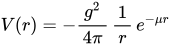
which is the same as a Coulomb potential except for the sign and the exponential factor. The sign will make the interaction attractive between all particles (the electromagnetic interaction is repulsive for same electrical charge sign particles). This is explained by the fact that the Yukawa particle has spin zero and even spin always results in an attractive potential. (It is a non-trivial result of quantum field theory that the exchange of even-spin bosons like the pion (spin 0, Yukawa force) or the graviton (spin 2, gravity) results in forces always attractive, while odd-spin bosons like the gluons (spin 1, strong interaction), the photon (spin 1, electromagnetic force) or the rho meson (spin 1, Yukawa-like interaction) yields a force that is attractive between opposite charge and repulsive between like-charge.) The negative sign in the exponential gives the interaction a finite effective range, so that particles at great distances will hardly interact any longer (interaction forces fall off exponentially with increasing separation).
As for other forces, the form of the Yukawa potential has a geometrical interpretation in term of the field line picture introduced by Faraday: The 1/r part results from the dilution of the field line flux in space. The force is proportional to the number of field lines crossing an elementary surface. Since the field lines are emitted isotropically from the force source and since the distance r between the elementary surface and the source varies the apparent size of the surface (the solid angle) as 1/r2 the force also follows the 1/r2 dependence. This is equivalent to the 1/r part of the potential. In addition, the exchanged mesons are unstable and have a finite lifetime. The disappearance (radioactive decay) of the mesons causes a reduction of the flux through the surface that results in the additional exponential factor of the Yukawa potential. Massless particles such as photons are stable and thus yield only 1/r potentials. (Note however that other massless particles such as gluons or gravitons do not generally yield 1/r potentials because they interact with each other, distorting their field pattern. When this self-interaction is negligible, such as in weak-field gravity (Newtonian gravitation) or for very short distances for the strong interaction (asymptotic freedom), the 1/r potential is restored.)

The Yukawa interaction is an interaction between a scalar field (or pseudoscalar field) ϕ and a Dirac field ψ of the type
Hub AI
Yukawa coupling AI simulator
(@Yukawa coupling_simulator)
Yukawa coupling
In particle physics, the Yukawa coupling or Yukawa interaction, named after Hideki Yukawa, is an interaction between particles according to the Yukawa potential. Specifically, it is between a scalar field (or pseudoscalar field) and a Dirac field of the type
The Yukawa coupling was developed to model the strong force between hadrons. Yukawa couplings are thus used to describe the nuclear force between nucleons mediated by pions (which are pseudoscalar mesons).
Yukawa couplings are also used in the Standard Model to describe the coupling between the Higgs field and massless quark and lepton fields (i.e., the fundamental fermion particles). Through spontaneous symmetry breaking, these fermions acquire a mass proportional to the vacuum expectation value of the Higgs field. This Higgs-fermion coupling was first described by Steven Weinberg in 1967 to model lepton masses.
If two fermions interact through a Yukawa interaction mediated by a Yukawa particle of mass , the potential between the two particles, known as the Yukawa potential, will be:
which is the same as a Coulomb potential except for the sign and the exponential factor. The sign will make the interaction attractive between all particles (the electromagnetic interaction is repulsive for same electrical charge sign particles). This is explained by the fact that the Yukawa particle has spin zero and even spin always results in an attractive potential. (It is a non-trivial result of quantum field theory that the exchange of even-spin bosons like the pion (spin 0, Yukawa force) or the graviton (spin 2, gravity) results in forces always attractive, while odd-spin bosons like the gluons (spin 1, strong interaction), the photon (spin 1, electromagnetic force) or the rho meson (spin 1, Yukawa-like interaction) yields a force that is attractive between opposite charge and repulsive between like-charge.) The negative sign in the exponential gives the interaction a finite effective range, so that particles at great distances will hardly interact any longer (interaction forces fall off exponentially with increasing separation).
As for other forces, the form of the Yukawa potential has a geometrical interpretation in term of the field line picture introduced by Faraday: The 1/r part results from the dilution of the field line flux in space. The force is proportional to the number of field lines crossing an elementary surface. Since the field lines are emitted isotropically from the force source and since the distance r between the elementary surface and the source varies the apparent size of the surface (the solid angle) as 1/r2 the force also follows the 1/r2 dependence. This is equivalent to the 1/r part of the potential. In addition, the exchanged mesons are unstable and have a finite lifetime. The disappearance (radioactive decay) of the mesons causes a reduction of the flux through the surface that results in the additional exponential factor of the Yukawa potential. Massless particles such as photons are stable and thus yield only 1/r potentials. (Note however that other massless particles such as gluons or gravitons do not generally yield 1/r potentials because they interact with each other, distorting their field pattern. When this self-interaction is negligible, such as in weak-field gravity (Newtonian gravitation) or for very short distances for the strong interaction (asymptotic freedom), the 1/r potential is restored.)
The Yukawa interaction is an interaction between a scalar field (or pseudoscalar field) ϕ and a Dirac field ψ of the type