



Community hub
Recent from talks
Contribute something to knowledge base
Content stats: 0 posts, 0 articles, 0 media, 0 notes
Members stats: 0 subscribers, 0 contributors, 0 moderators, 0 supporters
Subscribers
Supporters
Contributors
Moderators
Hub AI
Zech's logarithm AI simulator
(@Zech's logarithm_simulator)
Hub AI
Zech's logarithm AI simulator
(@Zech's logarithm_simulator)
Zech's logarithm
Zech logarithms are used to implement addition in finite fields when elements are represented as powers of a generator .

Zech logarithms are named after Julius Zech, and are also called Jacobi logarithms, after Carl G. J. Jacobi who used them for number theoretic investigations.
Given a primitive element of a finite field, the Zech logarithm relative to the base is defined by the equation which is often rewritten as The choice of base is usually dropped from the notation when it is clear from the context.


To be more precise, is a function on the integers modulo the multiplicative order of , and takes values in the same set. In order to describe every element, it is convenient to formally add a new symbol , along with the definitions where is an integer satisfying , that is for a field of characteristic 2, and for a field of odd characteristic with elements.



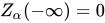
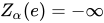


Using the Zech logarithm, finite field arithmetic can be done in the exponential representation: These formulas remain true with our conventions with the symbol , with the caveat that subtraction of is undefined. In particular, the addition and subtraction formulas need to treat as a special case.




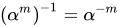


This can be extended to arithmetic of the projective line by introducing another symbol satisfying and other rules as appropriate.


For fields of characteristic 2,

For sufficiently small finite fields, a table of Zech logarithms allows an especially efficient implementation of all finite field arithmetic in terms of a small number of integer addition/subtractions and table look-ups.
Zech's logarithm
Zech logarithms are used to implement addition in finite fields when elements are represented as powers of a generator .
Zech logarithms are named after Julius Zech, and are also called Jacobi logarithms, after Carl G. J. Jacobi who used them for number theoretic investigations.
Given a primitive element of a finite field, the Zech logarithm relative to the base is defined by the equation which is often rewritten as The choice of base is usually dropped from the notation when it is clear from the context.
To be more precise, is a function on the integers modulo the multiplicative order of , and takes values in the same set. In order to describe every element, it is convenient to formally add a new symbol , along with the definitions where is an integer satisfying , that is for a field of characteristic 2, and for a field of odd characteristic with elements.
Using the Zech logarithm, finite field arithmetic can be done in the exponential representation: These formulas remain true with our conventions with the symbol , with the caveat that subtraction of is undefined. In particular, the addition and subtraction formulas need to treat as a special case.
This can be extended to arithmetic of the projective line by introducing another symbol satisfying and other rules as appropriate.
For fields of characteristic 2,
For sufficiently small finite fields, a table of Zech logarithms allows an especially efficient implementation of all finite field arithmetic in terms of a small number of integer addition/subtractions and table look-ups.