


Community hub
Recent from talks
Contribute something to knowledge base
Content stats: 0 posts, 0 articles, 1 media, 0 notes
Members stats: 0 subscribers, 0 contributors, 0 moderators, 0 supporters
Subscribers
Supporters
Contributors
Moderators
Hub AI
Blocking (American football) AI simulator
(@Blocking (American football)_simulator)
Hub AI
Blocking (American football) AI simulator
(@Blocking (American football)_simulator)
Blocking (American football)
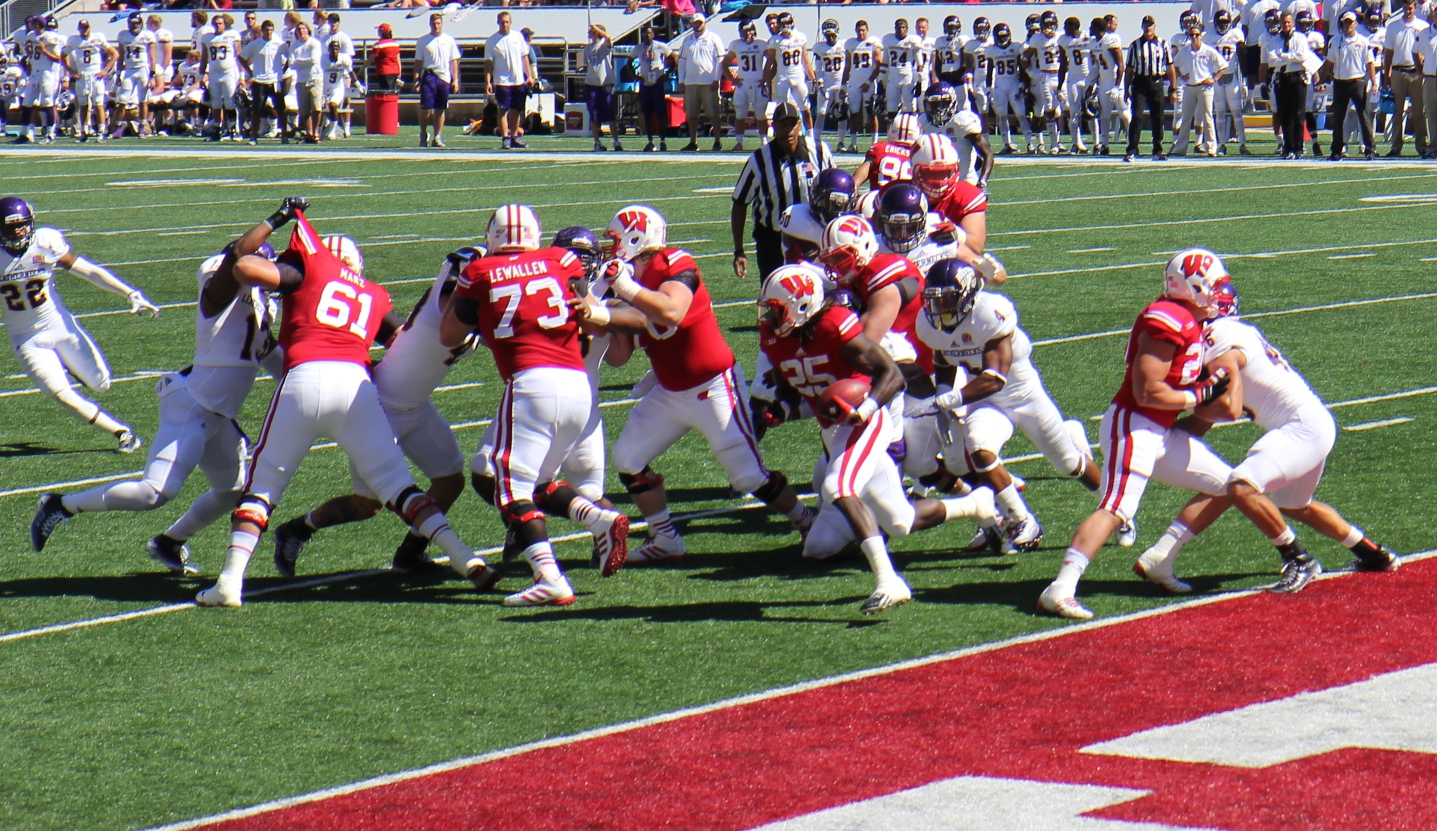
In American football, blocking or interference (or running interference) involves legal movements in which one player uses their body to obstruct another player's path. The purpose of blocking is to prevent defensive players from tackling the ball carrier, or to protect a quarterback who is attempting to pass, hand off or run the ball. Offensive linemen and fullbacks tend to do the most blocking, although wide receivers are often asked to help block on running plays and halfbacks may be asked to help block on passing plays, while tight ends perform pass blocking and run blocking if they are not running routes to receive passes. Overall, blocking is a skill that virtually every football player may be required to do at some point, even defensive players in the event of a turnover.
Essentially, blocking is pushing, with certain restrictions; in blocking one may not grasp another player or do any sort of pulling, and the hands must not extend beyond the line of each armpit; otherwise a holding penalty will be assessed. Players may not block a non-ballcarrying player of the other team from behind and above the waist, which is considered a block in the back. Blocking is also not permitted beyond five yards from the line of scrimmage until the quarterback has handed off the ball to a runner or a receiver has touched the ball after it has been passed.
Outside sports, "running interference" is a metaphor that refers to a person's helping someone in the performance of a task without directly assisting in the task. Often this is done by attracting attention to oneself (so as to deflect attention from the other person) or throwing oneself into harm's way.
Zone blocking is a technique that is a simple and effective scheme for creating lanes for running plays. In a zone blocking scheme, fleet-footedness and athletic ability trump size as desirable qualities in offensive linemen. Coordination and technique matter more than muscle in implementing a successful scheme because defensive linemen are often double-teamed at the point of attack. In this blocking scheme, which takes much from the Veer blocking system, creating movement on the defensive line is more important than opening a specific hole in the defense.
One of the simplest reasons many teams have incorporated zone blocking in their offenses is that zone blocking rules do not change based on the defensive front. In a "man block" system, blockers are paired with defenders according to certain rules to create a running lane. If the defensive front changes, or if the defense stunts or blitzes, the blocking rules may change. This requires learning multiple rules for the same play. Zone blocking uses very consistent rules that do not change according to the defensive front.
Some teams base their entire offense on it, including the NFL's Washington Commanders, New Orleans Saints, Seattle Seahawks, Kansas City Chiefs, Green Bay Packers, and Los Angeles Rams. Adopting a variation of this scheme's core principles, the West Virginia Mountaineers rely on it in the run-based spread offense, devised by former head coach Rich Rodriguez and former offensive line coach Rick Trickett, that they have used even after their departure. The University of Iowa under head coach Kirk Ferentz, a former NFL offensive line coach, utilizes zone blocking and the inside/outside stretch play as the basis for their offense. The University of Michigan also started using zone blocking under head coach Lloyd Carr in the 2006 season, and continued to do so under his successor, Rich Rodriguez.
The Carolina Panthers made the switch to zone blocking under offensive coordinator Jeff Davidson for the 2007 season. They had previously employed a man-blocking scheme for a downhill running attack under coordinator Dan Henning, but during the 2006 season, the team's undersized linemen were consistently overpowered by opposing defensive linemen. The power running game became stagnant, and especially ineffective in goal-line/short yardage situations, thus resulting in Henning's firing and the switch to zone blocking. Thanks in part to the new blocking scheme they implemented, the Panthers saw their 2008 campaign characterized by the running of DeAngelo Williams and Jonathan Stewart to great effect, gaining them play off status. That season also saw the emergence of rookie Steve Slaton with the Houston Texans under their new Alex Gibbs-designed zone blocking scheme.
Using a running back out of the backfield, zone plays are usually categorized into three types: Inside Zone (IZ), Outside Zone (OZ) and Stretch. These types describe the initial landmark of the ball carrier. A common approach is: Inside the tackles for IZ, just outside the tackle for OZ and just inside the last offensive player for the stretch.
Blocking (American football)
In American football, blocking or interference (or running interference) involves legal movements in which one player uses their body to obstruct another player's path. The purpose of blocking is to prevent defensive players from tackling the ball carrier, or to protect a quarterback who is attempting to pass, hand off or run the ball. Offensive linemen and fullbacks tend to do the most blocking, although wide receivers are often asked to help block on running plays and halfbacks may be asked to help block on passing plays, while tight ends perform pass blocking and run blocking if they are not running routes to receive passes. Overall, blocking is a skill that virtually every football player may be required to do at some point, even defensive players in the event of a turnover.
Essentially, blocking is pushing, with certain restrictions; in blocking one may not grasp another player or do any sort of pulling, and the hands must not extend beyond the line of each armpit; otherwise a holding penalty will be assessed. Players may not block a non-ballcarrying player of the other team from behind and above the waist, which is considered a block in the back. Blocking is also not permitted beyond five yards from the line of scrimmage until the quarterback has handed off the ball to a runner or a receiver has touched the ball after it has been passed.
Outside sports, "running interference" is a metaphor that refers to a person's helping someone in the performance of a task without directly assisting in the task. Often this is done by attracting attention to oneself (so as to deflect attention from the other person) or throwing oneself into harm's way.
Zone blocking is a technique that is a simple and effective scheme for creating lanes for running plays. In a zone blocking scheme, fleet-footedness and athletic ability trump size as desirable qualities in offensive linemen. Coordination and technique matter more than muscle in implementing a successful scheme because defensive linemen are often double-teamed at the point of attack. In this blocking scheme, which takes much from the Veer blocking system, creating movement on the defensive line is more important than opening a specific hole in the defense.
One of the simplest reasons many teams have incorporated zone blocking in their offenses is that zone blocking rules do not change based on the defensive front. In a "man block" system, blockers are paired with defenders according to certain rules to create a running lane. If the defensive front changes, or if the defense stunts or blitzes, the blocking rules may change. This requires learning multiple rules for the same play. Zone blocking uses very consistent rules that do not change according to the defensive front.
Some teams base their entire offense on it, including the NFL's Washington Commanders, New Orleans Saints, Seattle Seahawks, Kansas City Chiefs, Green Bay Packers, and Los Angeles Rams. Adopting a variation of this scheme's core principles, the West Virginia Mountaineers rely on it in the run-based spread offense, devised by former head coach Rich Rodriguez and former offensive line coach Rick Trickett, that they have used even after their departure. The University of Iowa under head coach Kirk Ferentz, a former NFL offensive line coach, utilizes zone blocking and the inside/outside stretch play as the basis for their offense. The University of Michigan also started using zone blocking under head coach Lloyd Carr in the 2006 season, and continued to do so under his successor, Rich Rodriguez.
The Carolina Panthers made the switch to zone blocking under offensive coordinator Jeff Davidson for the 2007 season. They had previously employed a man-blocking scheme for a downhill running attack under coordinator Dan Henning, but during the 2006 season, the team's undersized linemen were consistently overpowered by opposing defensive linemen. The power running game became stagnant, and especially ineffective in goal-line/short yardage situations, thus resulting in Henning's firing and the switch to zone blocking. Thanks in part to the new blocking scheme they implemented, the Panthers saw their 2008 campaign characterized by the running of DeAngelo Williams and Jonathan Stewart to great effect, gaining them play off status. That season also saw the emergence of rookie Steve Slaton with the Houston Texans under their new Alex Gibbs-designed zone blocking scheme.
Using a running back out of the backfield, zone plays are usually categorized into three types: Inside Zone (IZ), Outside Zone (OZ) and Stretch. These types describe the initial landmark of the ball carrier. A common approach is: Inside the tackles for IZ, just outside the tackle for OZ and just inside the last offensive player for the stretch.
Recent media
Recent media