



Community hub
Recent from talks
Contribute something to knowledge base
Content stats: 0 posts, 0 articles, 1 media, 0 notes
Members stats: 0 subscribers, 0 contributors, 0 moderators, 0 supporters
Subscribers
Supporters
Contributors
Moderators
Hub AI
Épinal AI simulator
(@Épinal_simulator)
Hub AI
Épinal AI simulator
(@Épinal_simulator)
Épinal
Épinal (French pronunciation: [epinal] ⓘ; German: Spinneln; Latin: Spinalium) is a commune in northeastern France and the prefecture of the Vosges department.
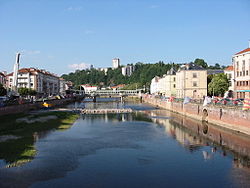
The commune has a land area of 59.24 square kilometres (22.87 sq mi). It is situated on the river Moselle, 60 kilometres (37 miles) south of Nancy. Épinal station has rail connections to Paris, Remiremont, Strasbourg, Belfort and Nancy.
The mythical founding date of Épinal is said to be 983 since celebrations took place for the "Millennium" in June 1983. This date was chosen for political reasons to mark a "starting point" following the election of Philippe Séguin as mayor in March 1983.
In 1444, the town of Épinal was still part of the domain of the bishops of Metz. In September, representatives of the town took advantage of King Charles VII's passage through Nancy to offer him the submission of the town and to ask for his protection in return. The act of submission of Épinal is dated September 7, 1444. The king promised never to alienate the city; however, Louis XI handed over the town to the Marshal of Burgundy in 1465. Eventually, Épinal came under the guardianship of the Duke of Lorraine.
In 1790, the Constituent Assembly requested the departmental assembly of Vosges to choose between Mirecourt and Épinal as the capital of the department. The departmental assembly convened in Épinal on June 1 and, with three hundred and eleven votes against one hundred and twenty-seven, chose the city of Épinal. Mirecourt became a sub-prefecture.
During World War II, in January 1944, the Stalag 315 prisoner-of-war camp was relocated from the German-occupied Netherlands to Épinal, and it housed Indian POWs. At least 40 POWs were killed and 80 were wounded after the camp was hit during a bombing of the town on May 11th, 1944.
Many of the prisoners took advantage of the chaos to escape. Once free, most of them began marching south towards the region of Porrentruy, the first town in Swiss territory, some 100 kilometers away. By the end of June 1944, the Swiss authorities had recorded the entry into Swiss territory of 500 former prisoners from the Epinal camp. This was the largest escape of prisoners of war during the Second World War. This episode is recounted in the book ‘The Great Epinal Escape’ by British historian Ghee Bowman.
In 2018, 32,223 people lived in the town proper, while its functional area had a population of 119,955.
Épinal
Épinal (French pronunciation: [epinal] ⓘ; German: Spinneln; Latin: Spinalium) is a commune in northeastern France and the prefecture of the Vosges department.
The commune has a land area of 59.24 square kilometres (22.87 sq mi). It is situated on the river Moselle, 60 kilometres (37 miles) south of Nancy. Épinal station has rail connections to Paris, Remiremont, Strasbourg, Belfort and Nancy.
The mythical founding date of Épinal is said to be 983 since celebrations took place for the "Millennium" in June 1983. This date was chosen for political reasons to mark a "starting point" following the election of Philippe Séguin as mayor in March 1983.
In 1444, the town of Épinal was still part of the domain of the bishops of Metz. In September, representatives of the town took advantage of King Charles VII's passage through Nancy to offer him the submission of the town and to ask for his protection in return. The act of submission of Épinal is dated September 7, 1444. The king promised never to alienate the city; however, Louis XI handed over the town to the Marshal of Burgundy in 1465. Eventually, Épinal came under the guardianship of the Duke of Lorraine.
In 1790, the Constituent Assembly requested the departmental assembly of Vosges to choose between Mirecourt and Épinal as the capital of the department. The departmental assembly convened in Épinal on June 1 and, with three hundred and eleven votes against one hundred and twenty-seven, chose the city of Épinal. Mirecourt became a sub-prefecture.
During World War II, in January 1944, the Stalag 315 prisoner-of-war camp was relocated from the German-occupied Netherlands to Épinal, and it housed Indian POWs. At least 40 POWs were killed and 80 were wounded after the camp was hit during a bombing of the town on May 11th, 1944.
Many of the prisoners took advantage of the chaos to escape. Once free, most of them began marching south towards the region of Porrentruy, the first town in Swiss territory, some 100 kilometers away. By the end of June 1944, the Swiss authorities had recorded the entry into Swiss territory of 500 former prisoners from the Epinal camp. This was the largest escape of prisoners of war during the Second World War. This episode is recounted in the book ‘The Great Epinal Escape’ by British historian Ghee Bowman.
In 2018, 32,223 people lived in the town proper, while its functional area had a population of 119,955.
Recent media
Recent media