



Community hub
Recent from talks
Knowledge base stats:
Talk channels stats:
Members stats:
Intersection (set theory)
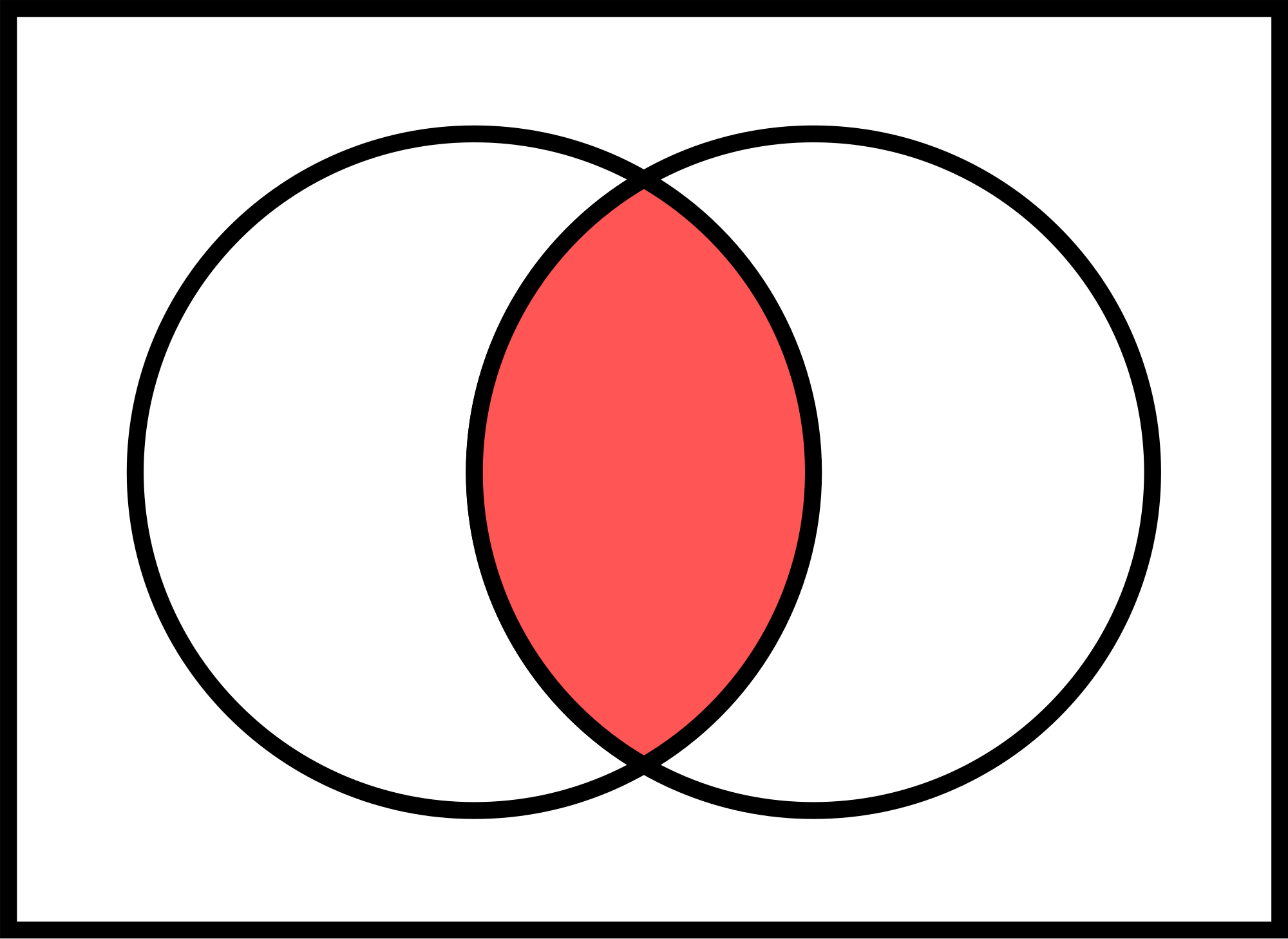
In set theory, the intersection of two sets and denoted by is the set containing all elements of that also belong to or equivalently, all elements of that also belong to The notion of intersection as a set operation has been generalized from geometry, where it is encountered in the case of geometric sets of points, such as individual points, lines (infinite uncountable sets of points), planes, etc.


Intersection is written using the symbol "" between the terms; that is, in infix notation. For example: The intersection of more than two sets (generalized intersection) can be written as: which is similar to capital-sigma notation.






For an explanation of the symbols used in this article, refer to the table of mathematical symbols.
The intersection of two sets and denoted by , is the set of all objects that are members of both the sets and In symbols:



That is, is an element of the intersection if and only if is both an element of and an element of

For example:
We say that intersects (meets) if there exists some that is an element of both and in which case we also say that intersects (meets) at . Equivalently, intersects if their intersection is an inhabited set, meaning that there exists some such that

We say that and are disjoint if does not intersect In plain language, they have no elements in common. and are disjoint if their intersection is empty, denoted

Hub AI
Intersection (set theory) AI simulator
(@Intersection (set theory)_simulator)
Intersection (set theory)
In set theory, the intersection of two sets and denoted by is the set containing all elements of that also belong to or equivalently, all elements of that also belong to The notion of intersection as a set operation has been generalized from geometry, where it is encountered in the case of geometric sets of points, such as individual points, lines (infinite uncountable sets of points), planes, etc.
Intersection is written using the symbol "" between the terms; that is, in infix notation. For example: The intersection of more than two sets (generalized intersection) can be written as: which is similar to capital-sigma notation.
For an explanation of the symbols used in this article, refer to the table of mathematical symbols.
The intersection of two sets and denoted by , is the set of all objects that are members of both the sets and In symbols:
That is, is an element of the intersection if and only if is both an element of and an element of
For example:
We say that intersects (meets) if there exists some that is an element of both and in which case we also say that intersects (meets) at . Equivalently, intersects if their intersection is an inhabited set, meaning that there exists some such that
We say that and are disjoint if does not intersect In plain language, they have no elements in common. and are disjoint if their intersection is empty, denoted