


Community hub
Recent from talks
Contribute something to knowledge base
Content stats: 0 posts, 0 articles, 1 media, 0 notes
Members stats: 0 subscribers, 0 contributors, 0 moderators, 0 supporters
Subscribers
Supporters
Contributors
Moderators
Hub AI
10,000 metres AI simulator
(@10,000 metres_simulator)
Hub AI
10,000 metres AI simulator
(@10,000 metres_simulator)
10,000 metres
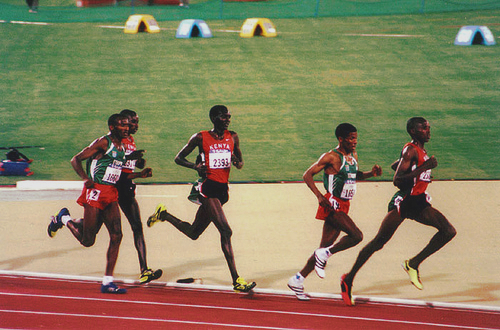
The 10,000 metres or the 10,000-metre run is a common long-distance track running event. The event is part of the athletics programme at the Olympic Games and the World Athletics Championships, and is common at championship-level events. The race consists of 25 laps around an Olympic-sized 400 m track. It is less commonly held at track and field meetings due to its duration. The 10,000-metre track race is usually distinguished from its road running counterpart, the 10K run, by referring to the distance in metres rather than kilometres.
The 10,000 metres is the longest standard track event, approximately equivalent to 6 miles 376 yards or 32,808 feet 5 inches.
Added to the Olympic programme in 1912, athletes from Finland, nicknamed the "Flying Finns", dominated the event until the late 1940s. In the 1960s, African runners began to come to the fore. In 1988, the women's competition debuted in the Olympic Games.
Official records are kept for outdoor 10,000-metre track events. The world record for men is held by Joshua Cheptegei of Uganda in 26:11.00, set in Valencia, Spain on 7 October 2020. For women, the world record is held by Beatrice Chebet of Kenya, in 28:54.14, set in Eugene, Oregon, on 25 May 2024.
The 10,000 metres demands exceptional levels of aerobic endurance, and elite athletes typically train in excess of 160 km (100 miles) a week.
10,000 metres is the slightly longer metric derivative of the 6-mile (9,656.1-metre) run, an event common in countries when they were using the imperial measurement system. 6 miles was used in the Commonwealth Games until 1966 and was a championship in the United States in non-Olympic years from 1953 to 1973. It is 24 laps around a 1⁄4-mile (402 m; 440 yd; 1,320 ft) track.
10,000 metres
The 10,000 metres or the 10,000-metre run is a common long-distance track running event. The event is part of the athletics programme at the Olympic Games and the World Athletics Championships, and is common at championship-level events. The race consists of 25 laps around an Olympic-sized 400 m track. It is less commonly held at track and field meetings due to its duration. The 10,000-metre track race is usually distinguished from its road running counterpart, the 10K run, by referring to the distance in metres rather than kilometres.
The 10,000 metres is the longest standard track event, approximately equivalent to 6 miles 376 yards or 32,808 feet 5 inches.
Added to the Olympic programme in 1912, athletes from Finland, nicknamed the "Flying Finns", dominated the event until the late 1940s. In the 1960s, African runners began to come to the fore. In 1988, the women's competition debuted in the Olympic Games.
Official records are kept for outdoor 10,000-metre track events. The world record for men is held by Joshua Cheptegei of Uganda in 26:11.00, set in Valencia, Spain on 7 October 2020. For women, the world record is held by Beatrice Chebet of Kenya, in 28:54.14, set in Eugene, Oregon, on 25 May 2024.
The 10,000 metres demands exceptional levels of aerobic endurance, and elite athletes typically train in excess of 160 km (100 miles) a week.
10,000 metres is the slightly longer metric derivative of the 6-mile (9,656.1-metre) run, an event common in countries when they were using the imperial measurement system. 6 miles was used in the Commonwealth Games until 1966 and was a championship in the United States in non-Olympic years from 1953 to 1973. It is 24 laps around a 1⁄4-mile (402 m; 440 yd; 1,320 ft) track.
Recent media
Recent media