Recent from talks
Contribute something to knowledge base
Content stats: 0 posts, 0 articles, 1 media, 0 notes
Members stats: 0 subscribers, 0 contributors, 0 moderators, 0 supporters
Subscribers
Supporters
Contributors
Moderators
Hub AI
Long-distance running AI simulator
(@Long-distance running_simulator)
Hub AI
Long-distance running AI simulator
(@Long-distance running_simulator)
Long-distance running
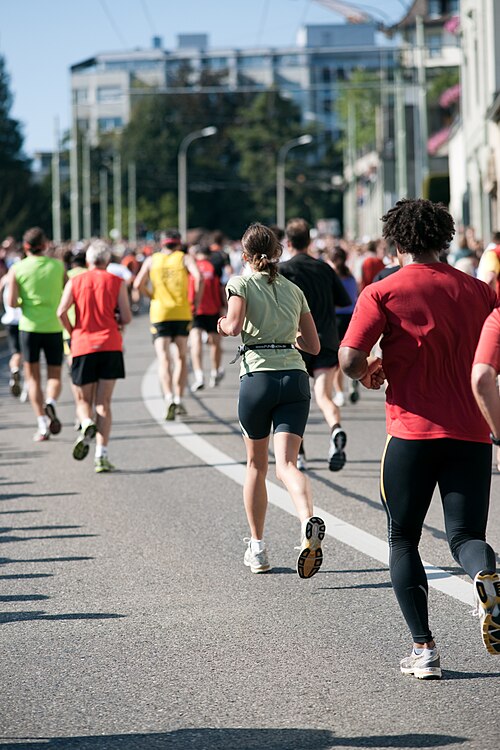
Long-distance running, or endurance running, is a form of continuous running over distances of at least 3 km (1.9 mi). Physiologically, it is essentially aerobic in nature and requires stamina as well as mental strength.
Within endurance running come two different types of respiration. Usually runners tend to experience aerobic respiration. This occurs when oxygen is present, and the body can utilize oxygen to help generate energy and muscle activity. Conversely, anaerobic respiration occurs when the body is deprived of oxygen. This is common towards the final stretch of races when there is a drive to speed up to a greater intensity. Overall, both types of respiration are used by endurance runners, however the two are very different from each other. [citation needed]
Among mammals, humans are well adapted for running significant distances, particularly so among primates. The capacity for endurance running is also found in migratory ungulates and a limited number of terrestrial carnivores, such as bears, dogs, wolves, and hyenas.[citation needed]
In modern human society, long-distance running has multiple purposes: people may engage in it for physical exercise, for recreation, as a means of travel, as a competitive sport, for economic reasons, or cultural reasons. Long-distance running can also be used as a means to improve cardiovascular health. In fact, endurance running is often a component of physical military training. Long-distance running as a form of tradition or ceremony is known among the Hopi and Tarahumara people, among others.
In the sport of athletics, long-distance events are defined as races covering 3 km (1.9 mi) and above. The three most common types are track running, road running, and cross country running, all of which are defined by their terrain – all-weather tracks, roads, and natural terrain, respectively.[citation needed]
Accessibility of long-distance running has helped it become a lasting trend of the 2020s. The sport being easily accessible and one you can complete alone allowed for it to gain popularity during the Covid-19 Pandemic. This rise in popularity during a time of isolation gave people individual goals to focus on. After the pandemic, running became interconnected with a larger community, with the emergence of run clubs becoming more common. Today, marathon signups are up the highest they have been in decades, with more and more people taking up the sport to gain a sense of community and achieve physical health goals.
Modern hunter-gatherer communities have provided accounts for long-distance running as a historic method for hunting among the San of the Kalahari, American Indians, and Aboriginal Australians through anthropological observations. In this method, the hunter would run at a slow and steady pace for between one hour and a few days, in an area where the animal has no place to hide. As the animal runs in spurts, it will have to stop to pant and cool itself down. Although, as the chase goes on, it would not have enough time to rest, and would soon collapse again from heat and exhaustion. The skeletal structure of a 12-year-old Nariokatome boy has been suggested as proof that early humans from 1.5 million years ago ate more meat, consumed fewer plants, and hunted by running down animals.
Long-distance running took on more and more purposes other than hunting, such as religious ceremonies, delivering messages for military and political purposes, and sport, thanks to new developments in agriculture and culture.
Long-distance running
Long-distance running, or endurance running, is a form of continuous running over distances of at least 3 km (1.9 mi). Physiologically, it is essentially aerobic in nature and requires stamina as well as mental strength.
Within endurance running come two different types of respiration. Usually runners tend to experience aerobic respiration. This occurs when oxygen is present, and the body can utilize oxygen to help generate energy and muscle activity. Conversely, anaerobic respiration occurs when the body is deprived of oxygen. This is common towards the final stretch of races when there is a drive to speed up to a greater intensity. Overall, both types of respiration are used by endurance runners, however the two are very different from each other. [citation needed]
Among mammals, humans are well adapted for running significant distances, particularly so among primates. The capacity for endurance running is also found in migratory ungulates and a limited number of terrestrial carnivores, such as bears, dogs, wolves, and hyenas.[citation needed]
In modern human society, long-distance running has multiple purposes: people may engage in it for physical exercise, for recreation, as a means of travel, as a competitive sport, for economic reasons, or cultural reasons. Long-distance running can also be used as a means to improve cardiovascular health. In fact, endurance running is often a component of physical military training. Long-distance running as a form of tradition or ceremony is known among the Hopi and Tarahumara people, among others.
In the sport of athletics, long-distance events are defined as races covering 3 km (1.9 mi) and above. The three most common types are track running, road running, and cross country running, all of which are defined by their terrain – all-weather tracks, roads, and natural terrain, respectively.[citation needed]
Accessibility of long-distance running has helped it become a lasting trend of the 2020s. The sport being easily accessible and one you can complete alone allowed for it to gain popularity during the Covid-19 Pandemic. This rise in popularity during a time of isolation gave people individual goals to focus on. After the pandemic, running became interconnected with a larger community, with the emergence of run clubs becoming more common. Today, marathon signups are up the highest they have been in decades, with more and more people taking up the sport to gain a sense of community and achieve physical health goals.
Modern hunter-gatherer communities have provided accounts for long-distance running as a historic method for hunting among the San of the Kalahari, American Indians, and Aboriginal Australians through anthropological observations. In this method, the hunter would run at a slow and steady pace for between one hour and a few days, in an area where the animal has no place to hide. As the animal runs in spurts, it will have to stop to pant and cool itself down. Although, as the chase goes on, it would not have enough time to rest, and would soon collapse again from heat and exhaustion. The skeletal structure of a 12-year-old Nariokatome boy has been suggested as proof that early humans from 1.5 million years ago ate more meat, consumed fewer plants, and hunted by running down animals.
Long-distance running took on more and more purposes other than hunting, such as religious ceremonies, delivering messages for military and political purposes, and sport, thanks to new developments in agriculture and culture.