
Wikipedia
10-20-Life
View on Wikipedia
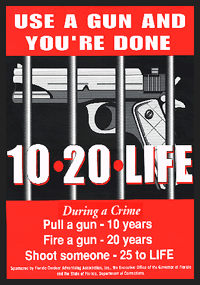
The Florida Statute 775.087,[1] known as the 10-20-Life law, is a mandatory minimum sentencing law in the U.S. state of Florida. The law concerns the use of a firearm during the commission of a forcible felony.[2][3] The Florida Statute's name comes from a set of three basic minimum sentences it provides for. A public service announcement campaign accompanied the law after its passage under the slogan "Use a gun, and you're done."[4][5][6]
Background
[edit]As of 1998, the year before the law went into effect, guns were used in 31,643 violent felonies in Florida. At that time, the mandatory sentence for using a gun in a violent felony was three years in prison. That same year, Jeb Bush, then a candidate for governor in the 1998 gubernatorial election, proposed the 10-20-Life law and advocated it as a core element of his campaign platform. Following his successful election and assumption of office in January 1999, the Florida Legislature passed the governor's proposal. The law went into effect on July 1, 1999, amending section 775.087 of the Florida Statutes.[7] In 2000, the Legislature extended the mandatory sentences to cover 16- and 17-year-olds who fire a gun (during a violent crime), and those offenders with prior criminal records.[4][8]
Provisions
[edit]The law specifies exactly what categories of crimes fall under it, mandates that offenders be sentenced to the law's maximum allowable extent for the committed felony, and states that the mandatory sentences must be completed consecutively to any additional sentence an offender must serve.[4][8]
The law's name comes from three main mandatory sentences: 1) producing a firearm during the commission of certain felonies mandates at least a 10-year prison sentence; 2) firing one mandates at least a 20-year prison sentence; and 3) shooting someone mandates a minimum sentence of 25 years to life regardless of whether a victim is killed or minorly injured. The maximum penalty is a life sentence unless the defendant is charged with felony murder or first degree murder in which case the maximum is the death penalty.[4][8]
In addition to the "10-20-Life" rule itself, the law also established or increased other mandatory minimum prison sentences:[4]
- Three years for felons who possess a firearm;
- Three years for aggravated assault with a firearm;
- Three years for aggravated assault on a police officer;
- Three years for aggravated assault on a person aged 65 years or older;
- Five years for aggravated battery on an officer;
- Eight years for possessing a machine gun, or semiautomatic firearm while committing any type of battery on an officer or person aged 65 years or older;
- Fifteen years if the offender is in possession of either a machine gun or a semiautomatic gun with a high-capacity box magazine while committing a crime listed under statute 775.087.
It also created minimum sentences for convicted drug traffickers. Drug offenses that warrant a mandatory sentence begin at the level of a three-year prison term. Depending on the type of drug, the amount of it, and also whether the drug has resulted in anyone's death, the minimum penalties may increase to 7, 15 or 25 years, life or death.[4]
Waiver of mandatory minimums
[edit]Under Florida law, the prosecutor in a case is the only person eligible to waive any mandatory minimum.[9] Judges can issue a waiver if the defendant is sentenced as a youthful offender, which would cap the maximum penalty at 6 years of any supervision whether it be prison or probation. One of the qualifications for a youthful offender sentence is that the defendant be no more than 20 years of age at the time of the sentence.[10][11]
Concurrent acts designed for repeat offenders
[edit]In addition to the 10-20-Life system, Jeb Bush and Florida Legislature also implemented or modified several other acts designed for repeat offenders.[6][12] These acts include Violent Career Criminal, Habitual felony offender, Habitual violent felony offender, Three-time violent felony offender, Prison Releasee Reoffender, and Dangerous Sexual Felony Offender.
These acts, as designed, hand down mandatory minimum sentencing for offenders that fall under them. It is the prosecutor's decision whether or not to classify a defendant under any of these acts if the criteria present themselves. If the prosecutor does not classify the defendant under any of these acts even though they qualify, a reason must be written and filed into the court records.[13]
Effectiveness
[edit]According to the Florida Parole Commission (FPC), in 2000, there was a 26.4% decrease in violent, gun-related crime compared to 1998. Florida's "Index Crime" rate for 2000, which is based on a variety of different crimes, had dropped 18% from the previous year, and had reached its lowest level in 28 years.[4] According to the Florida Department of Corrections (FDC), by 2004, violent gun crime rates had fallen 30% since 1998, and the Index Crime rate had reached the lowest in 34 years, despite a 16.8% increase in population during that time period.[8] The Florida Parole Commission and Department of Corrections both acknowledged that these results were influenced by a multitude of crime prevention programs in addition to the 10-20-Life law, such as the Three-Strike Violent Felony Offender Act, the Habitual Juvenile Offender Accountability Act and "Operation T.H.U.G.S." ("Taking Hoodlums Using Guns Seriously"), a program targeting felons with warrants for violent-crime and a violent history.[6][8]
University of Florida criminologist Alex Piquero, who conducted a study on the legislation in 2006, noted the Florida Department of Law Enforcement's joint anti-crime programs with local law enforcement, such as Operation T.H.U.G.S., along with the “use a gun and you’re done” public service announcement campaign. He also noted that the overall crime rate had been declining before the law's passage. Contrary to the FDC and FPC, Piquero stated that the drop in state crime since the law's passage was more likely attributable to the national decline in crime over the same time period.[6]
See also
[edit]

References
[edit]- ^ Full text of Florida Statute 775.087
- ^ Florida Statute 776.08 (lists forcible felonies)
- ^ "10-20-Life Criminals Sentenced to Florida's Prisons: The Justice Impact of Governor Bush's Initiative on Armed Felons". National Institute of Corrections. October 31, 2006. Archived from the original on 2010-06-26. Retrieved 5 July 2010.
- ^ a b c d e f g "10-20-Life". Florida Parole Commission. 2004. Archived from the original on 2010-12-19. Retrieved 5 July 2010.
- ^ "Gun Safety". 10 News. Pacific and Southern Company, Inc. Retrieved 5 July 2010.
- ^ a b c d Keen, Cathy (January 10, 2006). "UF study shows Florida's three-strikes law fails to curb crime". University of Florida News. Gainesville, FL. Archived from the original on 2010-06-08. Retrieved 5 July 2010.
- ^ "STATE v. WOOTEN STATE of Florida, Appellant, v. Derek WOOTEN, Appellee. No. 2D00-1004. -- January 31, 2001". FindLaw. Retrieved 5 July 2010.
- ^ a b c d e "Florida 10-20-LIFE -- Mandatory Minimum Prison Sentences". Florida Department of Corrections. Retrieved 5 July 2010.
- ^ Lee, Suevon. "Given Fla.'s budget, some look to ease sentencing laws". Ocala news.
- ^ "Florida Statute 921.00265 on sentencing". Florida Legislature.
- ^ "Florida Statute 958.04 on Youthful Offenders". Florida Legislature.
- ^ "Jeb Bush on Crime". On the Issues.
- ^ "FL Statute 775.082(3)(D)(2)". FL Senate.
External links
[edit]Grokipedia
10-20-Life
View on GrokipediaHistorical Context and Enactment
Crime Trends Leading to the Law
In the mid-1990s, Florida experienced peak levels of violent crime, with the state recording the nation's highest rate in 1996 at 1,051 incidents per 100,000 residents, exceeding the U.S. average of 637 by more than 65%.[8][9] This surge included elevated rates of robbery (583 per 100,000 in 1996) and aggravated assault, often involving firearms, amid ongoing challenges from the crack cocaine epidemic's aftermath, urban gang conflicts, and drug-related turf wars concentrated in cities like Miami and Jacksonville.[10][11] Homicide rates compounded the crisis, averaging 9-11 per 100,000 population annually from 1990 to 1996, with firearms used in over 80% of cases statewide by the decade's end.[12] Miami, in particular, led U.S. cities in overall violent crime rates as of 1990, driven by gun-fueled disputes and random shootings that heightened public fear.[13] These patterns reflected broader national trends in firearm proliferation during felonies but were amplified in Florida by lenient prior sentencing, repeat offender recidivism, and insufficient deterrence for armed perpetrators.[4] Legislative responses emphasized incapacitation, as data showed that many violent offenders evaded substantial prison time despite carrying guns, perpetuating cycles of escalation.[8] By 1998, with violent crime still 20-30% above national levels despite a nascent downward national trajectory post-1991 peak, policymakers, including incoming Governor Jeb Bush, prioritized mandatory enhancements to curb gun use in enumerated felonies like armed burglary, robbery, and aggravated battery.[14][10] This culminated in the 10-20-Life provisions, signed into law on May 24, 1999, and effective October 1, 1999, explicitly targeting the deterrent void exposed by rising firearm-involved offenses.[1]Legislative Development and Passage
The 10-20-Life law emerged as a cornerstone of Governor Jeb Bush's 1998 gubernatorial campaign in Florida, where he pledged to impose severe penalties on criminals using firearms to deter violent offenses amid concerns over escalating gun-related felonies in the state during the 1990s.[15] Following Bush's inauguration in January 1999, the Florida Legislature prioritized the measure during its regular session, with both the House and Senate advancing companion bills that established mandatory minimum sentences of 10 years for possessing or displaying a firearm during enumerated felonies, 20 years for discharging it, and 25 years to life for causing injury or death.[16] The legislation built on prior enhancements to Florida's sentencing code, replacing a previous 3-year minimum for firearm possession with stricter, non-discretionary terms to incapacitate repeat violent offenders.[17] Lawmakers reconciled differences between the House and Senate versions amid debates over the scope of applicable felonies and potential fiscal impacts on prisons, ultimately approving a unified bill that applied to forcible felonies like armed robbery, carjacking, and aggravated assault.[16] On March 25, 1999, the Legislature transmitted the bill to Governor Bush for consideration.[18] Supporters, including Bush administration officials, argued the law would reduce recidivism by ensuring lengthy incarceration for armed criminals, drawing inspiration from federal initiatives like Project Exile.[19] Bush signed the bill into law on April 1, 1999, fulfilling a key campaign commitment to prioritize public safety through enhanced penalties.[20] The measure took effect on July 1, 1999, as Chapter 99-12, Laws of Florida, amending section 775.087 of the Florida Statutes.[21] Passage faced opposition from African-American legislators, who contended the mandatory minima could disproportionately incarcerate minority defendants given existing disparities in firearm offense arrests, though proponents countered that the focus on behavior rather than demographics justified the approach.[21]Core Provisions
Mandatory Minimum Sentences
Florida's 10-20-Life law, codified in § 775.087(2), Florida Statutes, imposes mandatory minimum prison terms on individuals convicted of possessing, discharging, or using a firearm or destructive device to cause harm during the commission or attempted commission of enumerated felonies, such as murder, sexual battery, robbery, burglary, aggravated assault, carjacking, aggravated stalking, or drug trafficking.[1] These minimums apply regardless of the underlying felony's statutory maximum and prohibit suspension of sentence, deferral of sentence, placement on probation, or any form of early release except through executive pardon or clemency, with the offender required to serve the full term.[1] Under subsection (2)(a)1., actual possession of a firearm or destructive device during one of the specified felonies mandates a minimum sentence of 10 years' imprisonment, except in cases like possession of a firearm by a convicted felon under § 790.23 or burglary of a conveyance, which carry a 3-year minimum instead.[1] If the firearm or device is discharged during the offense, the minimum increases to 20 years.[1] For discharges resulting in death or great bodily harm, the minimum is 25 years' imprisonment or life, with the court imposing life unless it explicitly finds it inappropriate, in which case the 25-year term applies.[1] Subsection (3)(a) extends heightened minimums to possession of a semiautomatic firearm equipped with a high-capacity detachable magazine, a machine gun, or a semiautomatic firearm with a conversion kit during the same enumerated felonies, requiring a 15-year minimum for possession, 20 years for discharge, and 25 years to life if the discharge causes death or great bodily harm.[1] These sentences run consecutively to any punishment for the underlying felony and to each other if multiple qualifying violations occur in a single criminal episode.[1] The provisions do not apply to law enforcement officers or military personnel acting in their official capacities.[1]Scope of Applicable Felonies
The 10-20-Life law, under Florida Statute § 775.087(2), imposes mandatory minimum sentences for a specified set of serious felonies when committed with the actual possession of a firearm or destructive device, its discharge, or its discharge resulting in death or great bodily harm. These applicable felonies are enumerated explicitly and include murder; sexual battery; robbery; burglary; arson; aggravated battery; aggravated assault; kidnapping; escape; aircraft piracy; aggravated child abuse; aggravated abuse of an elderly person or disabled adult; any felony involving the unlawful use or attempted use of a destructive device or bomb; carjacking; home-invasion robbery; aggravated stalking; drug trafficking offenses under § 893.135(1); possession of a firearm or destructive device by a convicted felon; and human trafficking.[1] The statute excludes from these enhancements any felony for which the possession, display, use, or threat to use of a weapon or firearm constitutes an essential element of the offense itself, such as unlawful possession of a firearm by a felon or grand theft of a firearm, where the enhancement would redundantly apply to the core conduct, as clarified by the Florida Supreme Court in a recent ruling.[1][22] For burglary of a conveyance, a reduced minimum of 3 years applies upon conviction involving firearm possession, reflecting the legislature's calibration for less severe property crimes.[1] These provisions target violent and high-risk offenses to deter firearm involvement, with minimum terms scaling as follows: 10 years for possession during the felony, 20 years for discharge, and 25 years to life for discharge causing death or great bodily harm, all nonwaivable except by executive clemency.[1]- Murder: Triggers enhancements if firearm possessed or discharged during commission.[1]
- Robbery and Burglary: Applies to armed variants, excluding cases where firearm element is inherent.[1]
- Aggravated Battery and Assault: Enhancements for firearm use beyond the statutory definition.[1]
- Drug Trafficking (§ 893.135(1)): Specific to certain quantities and types, with firearm possession elevating penalties.[1][23]
Sentence Enhancements and Concurrent Application
Florida Statute § 775.087(2) establishes tiered mandatory minimum sentences for individuals convicted of specified felonies while possessing or using a firearm, enhancing penalties based on the degree of firearm involvement. Possession of a firearm during the commission of an enumerated felony, such as aggravated assault, robbery, or carjacking, requires a minimum term of 10 years' imprisonment, with no eligibility for suspension, probation, or early release through gain time or parole.[1] Actual discharge of the firearm without causing death or great bodily harm elevates the minimum to 20 years, while discharge resulting in death or great bodily harm mandates a minimum of 25 years up to life imprisonment.[1] These enhancements integrate into the sentence for the underlying felony rather than constituting a separate offense, overriding lighter recommendations from Florida's Criminal Punishment Code scoresheet.[24] Exceptions reduce the possession minimum to 3 years for convictions involving possession of a firearm by a convicted felon under § 790.23 or burglary of a conveyance.[1] When multiple qualifying felonies arise from the same criminal episode involving a single firearm possession or discharge, the mandatory minimums apply to each conviction but cannot be imposed consecutively, preventing the stacking of enhancements for one act of firearm use.[25] Under Florida Statute § 921.16, courts exercise discretion to run sentences for such offenses concurrently or consecutively, though consecutive application of the same enhancement across counts from one episode is restricted to avoid disproportionality.[26][25] This concurrent framework ensures the effective minimum aligns with the most severe enhancement triggered, while allowing judicial flexibility for distinct episodes or additional charges.[7]Exceptions and Prosecutorial Discretion
Waiver Mechanisms
Florida Statute § 775.087 imposes mandatory minimum sentences for firearm possession, discharge, or use causing injury during enumerated felonies, explicitly prohibiting courts from suspending, deferring, withholding, or otherwise reducing these terms absent specific statutory authority.[1] Judicial discretion is curtailed, with sentences required to run consecutively for multiple qualifying offenses and ineligible for discretionary gain time, leaving primary waiver authority to prosecutors.[1] Prosecutors exercise discretion by electing not to include firearm enhancement allegations in charging documents or negotiating plea agreements to lesser offenses excluding the enumerated felonies or firearm elements, effectively bypassing the mandatory minimums.[27] This charging authority allows avoidance of the statute's application when evidence of possession or use is marginal or when broader case considerations, such as cooperation short of substantial assistance, warrant leniency.[7] Such decisions remain prosecutorial prerogative, unconstrained by the statute, though subject to ethical guidelines under Florida Bar rules. A further mechanism involves substantial assistance to law enforcement, governed by Florida Statute § 924.34, enabling sentence reductions below the mandatory minimum upon motion by the state attorney certifying the defendant's aid in investigating or prosecuting crimes.[28] Courts may suspend or reduce terms—including 10-20-Life minimums—if the assistance is deemed substantial, typically involving information leading to arrests or convictions, though approval rates vary by jurisdiction and evidentiary value.[28] This provision, enacted to incentivize cooperation, represents the principal post-conviction path to mitigation, distinct from pretrial diversions unavailable for most violent firearm felonies.[29]Judicial Limitations and Reforms
The 10-20-Life law, codified in Florida Statute § 775.087, imposes strict limitations on judicial discretion by requiring courts to mandate the specified minimum prison terms—10 years for actual possession of a firearm during enumerated felonies, 20 years for its discharge, and life imprisonment if discharge causes death or great bodily harm—without authority to suspend, defer, or withhold adjudication.[1][7] These provisions apply consecutively to the underlying felony sentence and preclude downward departures based on mitigating factors such as offender history or case specifics, shifting sentencing power predominantly to prosecutors via waiver options.[29][30] Judges retain no independent mechanism to impose sentences below the minima absent a prosecutor's filing of a substantial assistance motion, under which the court may reduce or suspend the term if the defendant provides verifiable aid in investigating or prosecuting crimes.[31][27] This structure, enacted in 1999, prioritizes deterrence through uniformity but has drawn critique for rigidity, as evidenced by cases where first-time offenders faced decade-long terms for non-discharged firearms in lower-severity felonies.[32] A key reform occurred in 2016 through Senate Bill 228, which amended § 775.087 by excluding aggravated assault from the offenses triggering the 10-year minimum for firearm possession, thereby reducing the applicable minimum to three years and restoring limited judicial discretion to deviate further in such non-injurious scenarios.[33][34] The change, effective for offenses committed on or after July 1, 2016, allows courts to forgo the enhanced mandatory term if the judge determines the firearm was not in the defendant's actual possession or under specific evidentiary findings, addressing prior inflexibility without retroactive application.[35][36] This adjustment narrowed the law's scope to more severe applications while preserving core minima for discharge-related cases.[37]Implementation and Evolution
Early Application and Case Examples
The 10-20-Life law, codified in Florida Statute § 775.087, became effective on October 1, 1999, following its enactment earlier that year as part of efforts to impose stricter penalties for firearm use in violent felonies.[4] Early applications primarily targeted enumerated offenses such as armed robbery, aggravated assault, carjacking, and aggravated battery, where defendants possessed, displayed, discharged, or caused injury or death with a firearm during the commission of the crime.[7] Prosecutors invoked the statute's mandatory minimums in initial prosecutions to deter gun violence, with sentences stacking consecutively onto underlying felony terms and prohibiting suspension or probation in most instances.[38] A peer-reviewed analysis of sentencing data from the Florida Department of Corrections examined 1,069 offenders convicted under the 10-20-Life provisions between October 1, 1999, and December 31, 2001, providing insight into early implementation patterns.[39] These cases revealed a profile dominated by young adult males (average age 27.5 years), with 82% Black and 16% White defendants, and 91% having prior criminal histories, including 62% with violent priors.[40] The study documented an average sentence length of 22.3 years for 10-20-Life enhancements, significantly exceeding pre-law averages of 8 years for comparable offenses, reflecting the statute's rigid application across jurisdictions like Miami-Dade and Broward Counties, where gun-related felonies were prevalent.[39] Most convictions involved discharge of a firearm (triggering 20-year minimums) or resulting injury (25 years to life), underscoring prosecutorial focus on escalation factors.[40] One documented early case occurred in Palm Beach County in April 2000, involving Pedro Valdez, who was stopped after a traffic incident where a loaded firearm was found in his vehicle.[41] Charged with carrying a concealed firearm by a convicted felon and facing potential life imprisonment under the 10-20-Life minimums due to his prior record, Valdez accepted a plea deal for a reduced 15-year sentence, marking one of the first resolved prosecutions under the law in that jurisdiction and illustrating initial prosecutorial leverage in negotiations.[41] Appellate challenges in these formative years, such as disputes over "possession" definitions and jury findings, began emerging by 2001, testing the statute's constitutionality but generally upholding its mandatory structure.[4] By late 2001, cumulative sentencing data indicated over 1,200 applications statewide, with minimal waivers granted, affirming the law's swift enforcement amid rising urban violence rates.[39]Key Amendments, Including 2016 Changes
Florida Statute § 775.087, establishing the 10-20-Life mandatory minimum sentencing provisions, was enacted in 1999 and took effect on October 1 of that year, imposing inflexible prison terms for specified felonies committed with firearms: a minimum of 10 years for possession of a firearm, 20 years for discharge, and 25 years to life for instances causing great bodily harm or death.[4][1] Prior amendments prior to 2016 were limited in scope, primarily involving technical clarifications to felony definitions, weapon classifications, and procedural elements without substantially altering the rigid minimum sentence framework or list of applicable offenses.[42] The 2016 amendments, enacted via Senate Bill 228 (Chapter 2016-7, Laws of Florida), introduced the most significant modifications by revising subsections (2) and (3) to exclude aggravated assault from the enumerated felonies triggering the 10-, 20-, or life-year enhancements for firearm possession, discharge, or use resulting in injury.[33] Under the revised subsection (2), convictions for aggravated assault committed while possessing a firearm now carry a mandatory minimum of three years' imprisonment, a reduction from the prior 10-year baseline that escalated based on discharge or harm.[7] Similarly, subsection (3)—addressing semiautomatic firearms or machine guns with large-capacity magazines—removed aggravated assault from its enhancement list, maintaining 15-, 20-, or 25-to-life-year minimums for the remaining specified felonies.[43] These changes also eliminated former subsection (6), which had allowed trial courts to deviate below mandatory minimums for aggravated assault upon documented findings that the firearm was not used as a weapon, an object, or a means of threat.[43] The amendments preserved the enhancements' applicability to more severe offenses, such as aggravated battery, carjacking, home-invasion robbery, and sexual battery, while affording judges modest additional discretion in aggravated assault scenarios to mitigate overly punitive outcomes without undermining deterrence for gun violence.[44] No further structural overhauls to the core provisions have occurred since, though subsequent legislative sessions have addressed related sentencing flexibilities in broader criminal justice reforms.[45]Empirical Assessment
Observed Crime Rate Changes
Florida's violent crime rate, as measured by the Florida Department of Law Enforcement (FDLE), was 814.7 incidents per 100,000 population in 1999, the year the 10-20-Life law took effect on October 1.[46] By 2009, this rate had declined to 586.6 per 100,000, reflecting a reduction of approximately 28% over the decade.[47] This downward trend encompassed key index offenses targeted by the law, including aggravated assaults (83,424 incidents in 1999, down 20% by volume through the early 2000s) and robberies (31,996 in 1999, with rates falling in tandem with national patterns).[46] Firearm-involved violent crimes showed sharper initial declines. The Florida Parole Commission reported a 26.4% drop in violent, gun-related offenses from 1998 to 2000, coinciding with the law's early enforcement.[4] FBI Uniform Crime Reporting (UCR) data corroborated broader reductions in violent crime, with Florida's rate falling from 709.3 per 100,000 in 1999 to 503.7 by 2010, outpacing some national averages during the period but aligning with the ongoing U.S. crime decline that began in the early 1990s. Robberies, often firearm-associated, decreased by over 50% statewide from peak levels in the mid-1990s through 2010.[10]| Year | Violent Crime Rate (per 100,000) | Key Notes |
|---|---|---|
| 1999 | 814.7 (FDLE) / 709.3 (FBI UCR) | Law enactment; pre-decline stabilization.[46] |
| 2000 | ~750 (estimated decline) | 26.4% drop in gun-related violent crime vs. 1998.[4] |
| 2009 | 586.6 (FDLE) | Continued reduction in assaults and robberies.[47] |
| 2010 | 503.7 (FBI UCR) | Over 28% total decline from 1999 UCR baseline.[10] |
Methodological Analyses of Causality
Assessing the causal impact of the 10-20-Life sentencing enhancements (Penal Code § 12022.53) on crime rates requires isolating the law's effects from confounding factors, such as national crime trends, economic conditions, policing changes, and concurrent policies like California's Three Strikes law enacted in 1994.[49] Simple pre-post comparisons of California gun crime rates post-1999 enactment show declines—for instance, firearm-related homicides dropped approximately 40% from 2000 to 2010—but these cannot establish causality due to nationwide reductions in violent crime during the same period, driven by factors including reduced lead exposure and improved emergency medical responses.[50] One methodological approach leverages sentencing enhancements as a source of exogenous variation in expected punishment length to estimate deterrence elasticities, distinguishing general deterrence from incapacitation effects. In a difference-in-differences framework, Abrams (2012) exploits discontinuities in sentence add-ons for firearm possession during robberies under California law, comparing gun-involved crimes to non-gun crimes before and after enhancement implementation.[51] The analysis estimates that a 100% increase in sentence length via enhancements yields a roughly 1-5% reduction in gun robberies within 2-3 years, implying modest marginal deterrence but limited overall crime reduction given the enhancements' scope.[51] This method assumes enhancements primarily affect potential offenders' perceived risks without substantial substitution to unenhanced crimes, though endogeneity from prosecutorial discretion in charging could bias estimates upward. Synthetic control methods offer another quasi-experimental strategy to construct counterfactual trends for California by weighting control states without similar gun enhancements, addressing aggregate time-series limitations. While applied to broader reforms like Proposition 47 (which reduced some penalties), such techniques reveal no significant post-reform crime spikes, indirectly supporting prior enhancements' potential role in stabilizing rates but lacking specificity to § 12022.53.[52] Limitations include assumptions of no spillovers (e.g., offenders migrating to untreated areas) and challenges matching California's unique demographics and urban density. Overall, rigorous causal evidence remains sparse, with the California Law Revision Commission noting an absence of comprehensive empirical studies linking firearm enhancements to public safety outcomes or recidivism reductions.[49] Potential biases in observational data—such as underreporting of gun crimes or omitted variables like gang injunctions—complicate attribution, underscoring the need for instrumental variable approaches or randomized evaluations, which are infeasible for policy-scale interventions. Multiple studies on analogous enhancements confirm small elasticities (crime reductions of 0.1-0.3% per additional year of incarceration), suggesting 10-20-Life's effects, if any, are incremental rather than transformative.[51][50]Criticisms and Challenges
Claims of Racial and Socioeconomic Disparities
Critics, including criminal justice reform advocates, have claimed that Florida's 10-20-Life law disproportionately impacts racial minorities, particularly Black defendants, leading to higher incarceration rates among Black and Hispanic populations relative to their share of the state's demographics.[53] These assertions often attribute disparities to systemic bias in enforcement or charging, suggesting the mandatory minimums exacerbate overrepresentation without accounting for underlying offense patterns.[54] Empirical profiles of 10-20-Life offenders, however, indicate that sentencing outcomes align with documented disparities in firearm-related criminal activity. A 2003 analysis of early convictions under the law found that Black offenders received significantly longer average sentences than non-Black counterparts, with all nine life sentences imposed on Black defendants, reflecting cases involving discharge causing serious injury or death—triggers for the law's maximum penalties.[39] [40] The mandatory structure of the law limits judicial discretion, reducing opportunities for race-based leniency or severity in sentencing, though prosecutorial decisions on charges may influence applicability.[55] Arrest statistics for predicate offenses further contextualize these patterns, as Black individuals, about 16% of Florida's population, comprise over 50% of arrests for violent felonies like murder and robbery—crimes frequently enhanced by 10-20-Life when firearms are involved.[56] Local data, such as a Gainesville review of gun-related cases from 2019-2023, showed over 77% of defendants identifying as Black, mirroring national trends where Black arrestees account for approximately 51% of murder arrests despite lower population proportions.[57] Such offending disparities, corroborated by victim reports and clearance data, suggest the law's application reflects crime incidence rather than invidious discrimination, though sources advancing bias narratives often underemphasize these causal antecedents due to institutional emphases on equity over behavioral realism.[58] Socioeconomic claims posit that the law burdens low-income communities, where firearm crimes concentrate, but evidence links this to correlated factors like urban poverty, prior criminal histories, and limited education among offenders rather than the statute's design.[59] Florida felony arrest rates remain elevated in disadvantaged demographics—e.g., 3.8% for African Americans versus 1.93% for whites in recent years—indicating that socioeconomic conditions contribute to offending propensity, which the law then addresses punitively without creating the underlying inequities.[59] Reform-oriented analyses, frequently from advocacy groups, highlight these correlations to argue for leniency but seldom isolate the law from broader causal drivers like family structure or cultural norms in high-crime locales.[53]Arguments on Over-Incarceration and Costs
Critics of California's Penal Code § 12022.53, known as the 10-20-Life law, argue that its mandatory firearm enhancements promote over-incarceration by imposing severe, inflexible penalties that extend sentences beyond what is proportionate to the offense, particularly for peripheral gun involvement in felonies. For instance, the provision adding 25 years to life for discharging a firearm causing great bodily injury or death has resulted in 8,168 individuals incarcerated as of July 2022 serving an average additional 24.1 years, contributing to a total of nearly 194,000 extra prison years from this enhancement alone.[60] Such enhancements nearly double the median sentence length for affected inmates, from 7 years to 16.3 years overall, and account for a significant portion of California's prison population, exacerbating overcrowding that reached 133% of design capacity in 2016 and prompted the U.S. Supreme Court's 2011 ruling in Brown v. Plata declaring the conditions unconstitutional due to inadequate care amid excessive population.[60][61][62] Reform advocates, including former state Senator Loni Hancock, contend this rigidity punishes individuals multiple times for the same firearm use and fills prisons with low-risk, aging inmates who pose minimal public safety threats, as evidenced by cases where base sentences of 7–15 years balloon to 32-to-life or 109-to-life.[61] Proponents of reform further assert that over 30,000 people have been incarcerated under the 10-20-Life provisions, representing a substantial share of the state's roughly 31% of prisoners (about 40,000 in 2016) serving life or virtual life terms, the highest rate nationally.[63] This has been linked to systemic prison strains, including heightened violence and reduced rehabilitation opportunities, with critics like Loyola Law School professor Michael Vitiello arguing that "everybody loses" from overcrowded facilities prioritizing long-term housing over alternatives.[61] While the California Policy Lab's analysis highlights racial disparities in enhancement application—78% of Black incarcerated individuals versus 58% of White—reformers emphasize that the law's broad application to serious felonies without judicial discretion fosters unnecessary incarceration for offenses where gun use was not the primary harm.[60] On fiscal impacts, detractors claim the enhancements drive exorbitant taxpayer costs by prolonging incarceration periods without commensurate reductions in recidivism or gun violence, with California's per-inmate annual expense reaching $132,860 as of fiscal year 2022–23, up over 90% from a decade prior.[64] In 2016, state spending exceeded $55,000 per inmate amid enhancement-driven overcrowding, contributing to overall prison budgets ballooning from $1 billion in the 1980s to $9.5 billion by 2014, as new facilities were built to accommodate extended terms.[61][63] Critics, including those from sentencing reform groups, argue this represents an economic drain, incarcerating thousands for decades at high marginal costs—potentially hundreds of millions annually when factoring enhancement-added years—while diverting funds from prevention or community-based interventions, though direct causal attribution to 10-20-Life remains debated due to overlapping policies like Three Strikes.[63][61]Defenses and Evidence of Efficacy
Deterrence and Incapacitation Effects
Proponents of the 10-20-Life law contend that its mandatory minimum sentences create a strong deterrent effect by increasing the perceived certainty and severity of punishment for firearm-related felonies, thereby discouraging potential offenders from carrying or using guns during crimes. Following the law's enactment on October 1, 1999, Florida experienced a substantial decline in violent crime rates, dropping from 938.7 incidents per 100,000 population in 1998 to 542.4 per 100,000 in 2010—a 36% reduction that outpaced the national decline of 23% over the same period.[4] Defenders, including state officials, have attributed part of this trend to the law's role in elevating the risks associated with armed criminality, with one analysis noting an 8,134 fewer armed robberies compared to 1998 baseline figures during the law's early implementation years.[65] However, empirical assessments of specific deterrence remain limited, as studies on awareness reveal that over half of Florida residents were unaware of the law's provisions, with only 20% able to correctly identify the mandatory minimums, potentially undermining its general deterrent impact.[66] Despite such findings, supporters argue that the law's targeted severity influences the behavior of repeat offenders familiar with the justice system, contributing to reduced gun crime incidence through heightened individual risk aversion. The incapacitation effects of 10-20-Life are posited to stem from its extension of prison terms for firearm-involved felons, removing high-recidivism offenders from communities during their peak offending years and preventing an estimated volume of future crimes. The law mandates consecutive minimum sentences—10 years for possession, 20 for discharge without injury, and 25 years to life for discharge causing injury or death—resulting in thousands of additional incarceration years annually, which proponents claim directly correlates with Florida's post-1999 crime reductions by neutralizing prolific violent actors.[67] For instance, enhanced penalties under the statute have led to significantly longer average sentences for qualifying offenders, with data showing Black offenders receiving terms averaging higher than the pre-law baseline of 8 years, thereby amplifying time off the streets and averting recidivist offenses.[68] While national incarceration trends also contributed to broader declines, Florida's stricter firearm sentencing is credited by advocates for providing a marginal but measurable incapacitative benefit beyond general imprisonment effects.[69]Comparative Data with National Trends
Florida's violent crime rate, which stood at 768.7 incidents per 100,000 inhabitants in 1999—the year the 10-20-Life law took effect—declined to 465.4 per 100,000 by 2011, representing a 39.5% reduction.[4] In comparison, the national violent crime rate fell from 523.0 per 100,000 in 1999 to 386.3 per 100,000 in 2011, a 26.1% decrease over the same period.[4] This steeper proportional decline in Florida narrowed the gap with the national average from 245.7 points in 1999 to 79.1 points in 2011, despite the state beginning with one of the highest rates in the nation.[15]| Year | Florida Violent Crime Rate (per 100,000) | National Violent Crime Rate (per 100,000) |
|---|---|---|
| 1999 | 768.7 | 523.0 |
| 2011 | 465.4 | 386.3 |