


Community hub
Recent from talks
Contribute something to knowledge base
Content stats: 0 posts, 0 articles, 1 media, 0 notes
Members stats: 0 subscribers, 0 contributors, 0 moderators, 0 supporters
Subscribers
Supporters
Contributors
Moderators
10-20-Life
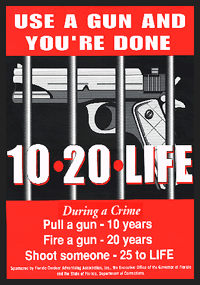
The Florida Statute 775.087, known as the 10-20-Life law, is a mandatory minimum sentencing law in the U.S. state of Florida. The law concerns the use of a firearm during the commission of a forcible felony. The Florida Statute's name comes from a set of three basic minimum sentences it provides for. A public service announcement campaign accompanied the law after its passage under the slogan "Use a gun, and you're done."
As of 1998, the year before the law went into effect, guns were used in 31,643 violent felonies in Florida. At that time, the mandatory sentence for using a gun in a violent felony was three years in prison. That same year, Jeb Bush, then a candidate for governor in the 1998 gubernatorial election, proposed the 10-20-Life law and advocated it as a core element of his campaign platform. Following his successful election and assumption of office in January 1999, the Florida Legislature passed the governor's proposal. The law went into effect on July 1, 1999, amending section 775.087 of the Florida Statutes. In 2000, the Legislature extended the mandatory sentences to cover 16- and 17-year-olds who fire a gun (during a violent crime), and those offenders with prior criminal records.
The law specifies exactly what categories of crimes fall under it, mandates that offenders be sentenced to the law's maximum allowable extent for the committed felony, and states that the mandatory sentences must be completed consecutively to any additional sentence an offender must serve.
The law's name comes from three main mandatory sentences: 1) producing a firearm during the commission of certain felonies mandates at least a 10-year prison sentence; 2) firing one mandates at least a 20-year prison sentence; and 3) shooting someone mandates a minimum sentence of 25 years to life regardless of whether a victim is killed or minorly injured. The maximum penalty is a life sentence unless the defendant is charged with felony murder or first degree murder in which case the maximum is the death penalty.
In addition to the "10-20-Life" rule itself, the law also established or increased other mandatory minimum prison sentences:
It also created minimum sentences for convicted drug traffickers. Drug offenses that warrant a mandatory sentence begin at the level of a three-year prison term. Depending on the type of drug, the amount of it, and also whether the drug has resulted in anyone's death, the minimum penalties may increase to 7, 15 or 25 years, life or death.
Under Florida law, the prosecutor in a case is the only person eligible to waive any mandatory minimum. Judges can issue a waiver if the defendant is sentenced as a youthful offender, which would cap the maximum penalty at 6 years of any supervision whether it be prison or probation. One of the qualifications for a youthful offender sentence is that the defendant be no more than 20 years of age at the time of the sentence.
In addition to the 10-20-Life system, Jeb Bush and Florida Legislature also implemented or modified several other acts designed for repeat offenders. These acts include Violent Career Criminal, Habitual felony offender, Habitual violent felony offender, Three-time violent felony offender, Prison Releasee Reoffender, and Dangerous Sexual Felony Offender.
10-20-Life
The Florida Statute 775.087, known as the 10-20-Life law, is a mandatory minimum sentencing law in the U.S. state of Florida. The law concerns the use of a firearm during the commission of a forcible felony. The Florida Statute's name comes from a set of three basic minimum sentences it provides for. A public service announcement campaign accompanied the law after its passage under the slogan "Use a gun, and you're done."
As of 1998, the year before the law went into effect, guns were used in 31,643 violent felonies in Florida. At that time, the mandatory sentence for using a gun in a violent felony was three years in prison. That same year, Jeb Bush, then a candidate for governor in the 1998 gubernatorial election, proposed the 10-20-Life law and advocated it as a core element of his campaign platform. Following his successful election and assumption of office in January 1999, the Florida Legislature passed the governor's proposal. The law went into effect on July 1, 1999, amending section 775.087 of the Florida Statutes. In 2000, the Legislature extended the mandatory sentences to cover 16- and 17-year-olds who fire a gun (during a violent crime), and those offenders with prior criminal records.
The law specifies exactly what categories of crimes fall under it, mandates that offenders be sentenced to the law's maximum allowable extent for the committed felony, and states that the mandatory sentences must be completed consecutively to any additional sentence an offender must serve.
The law's name comes from three main mandatory sentences: 1) producing a firearm during the commission of certain felonies mandates at least a 10-year prison sentence; 2) firing one mandates at least a 20-year prison sentence; and 3) shooting someone mandates a minimum sentence of 25 years to life regardless of whether a victim is killed or minorly injured. The maximum penalty is a life sentence unless the defendant is charged with felony murder or first degree murder in which case the maximum is the death penalty.
In addition to the "10-20-Life" rule itself, the law also established or increased other mandatory minimum prison sentences:
It also created minimum sentences for convicted drug traffickers. Drug offenses that warrant a mandatory sentence begin at the level of a three-year prison term. Depending on the type of drug, the amount of it, and also whether the drug has resulted in anyone's death, the minimum penalties may increase to 7, 15 or 25 years, life or death.
Under Florida law, the prosecutor in a case is the only person eligible to waive any mandatory minimum. Judges can issue a waiver if the defendant is sentenced as a youthful offender, which would cap the maximum penalty at 6 years of any supervision whether it be prison or probation. One of the qualifications for a youthful offender sentence is that the defendant be no more than 20 years of age at the time of the sentence.
In addition to the 10-20-Life system, Jeb Bush and Florida Legislature also implemented or modified several other acts designed for repeat offenders. These acts include Violent Career Criminal, Habitual felony offender, Habitual violent felony offender, Three-time violent felony offender, Prison Releasee Reoffender, and Dangerous Sexual Felony Offender.
Recent media
Recent media