
Recent from talks
Fast Ethernet
Knowledge base stats:
Talk channels stats:
Members stats:
Fast Ethernet
In computer networking, Fast Ethernet physical layers carry traffic at the nominal rate of 100 Mbit/s. The prior Ethernet speed was 10 Mbit/s. Of the Fast Ethernet physical layers, 100BASE-TX is by far the most common.
Fast Ethernet was introduced in 1995 as the IEEE 802.3u standard and remained the fastest version of Ethernet for three years before the introduction of Gigabit Ethernet. The acronym GE/FE is sometimes used for devices supporting both standards.
The 100 in the media type designation refers to the transmission speed of 100 Mbit/s, while the BASE refers to baseband signaling. The letter following the dash (T or F) refers to the physical medium that carries the signal (twisted pair or fiber, respectively), while the last character (X, 4, etc.) refers to the line code method used. Fast Ethernet is sometimes referred to as 100BASE-X, where X is a placeholder for the FX and TX variants.
Fast Ethernet is an extension of the 10-megabit Ethernet standard. It runs on twisted pair or optical fiber cable in a star wired bus topology, similar to the IEEE standard 802.3i called 10BASE-T, itself an evolution of 10BASE5 (802.3) and 10BASE2 (802.3a). Fast Ethernet devices are generally backward compatible with existing 10BASE-T systems, enabling plug-and-play upgrades from 10BASE-T. Most switches and other networking devices with ports capable of Fast Ethernet can perform autonegotiation, sensing a piece of 10BASE-T equipment and setting the port to 10BASE-T half duplex if the 10BASE-T equipment cannot perform autonegotiation itself. The standard specifies the use of CSMA/CD for media access control. A full-duplex mode is also specified and in practice, modern networks use Ethernet switches and operate in full-duplex mode, even as legacy devices that use half duplex still exist.
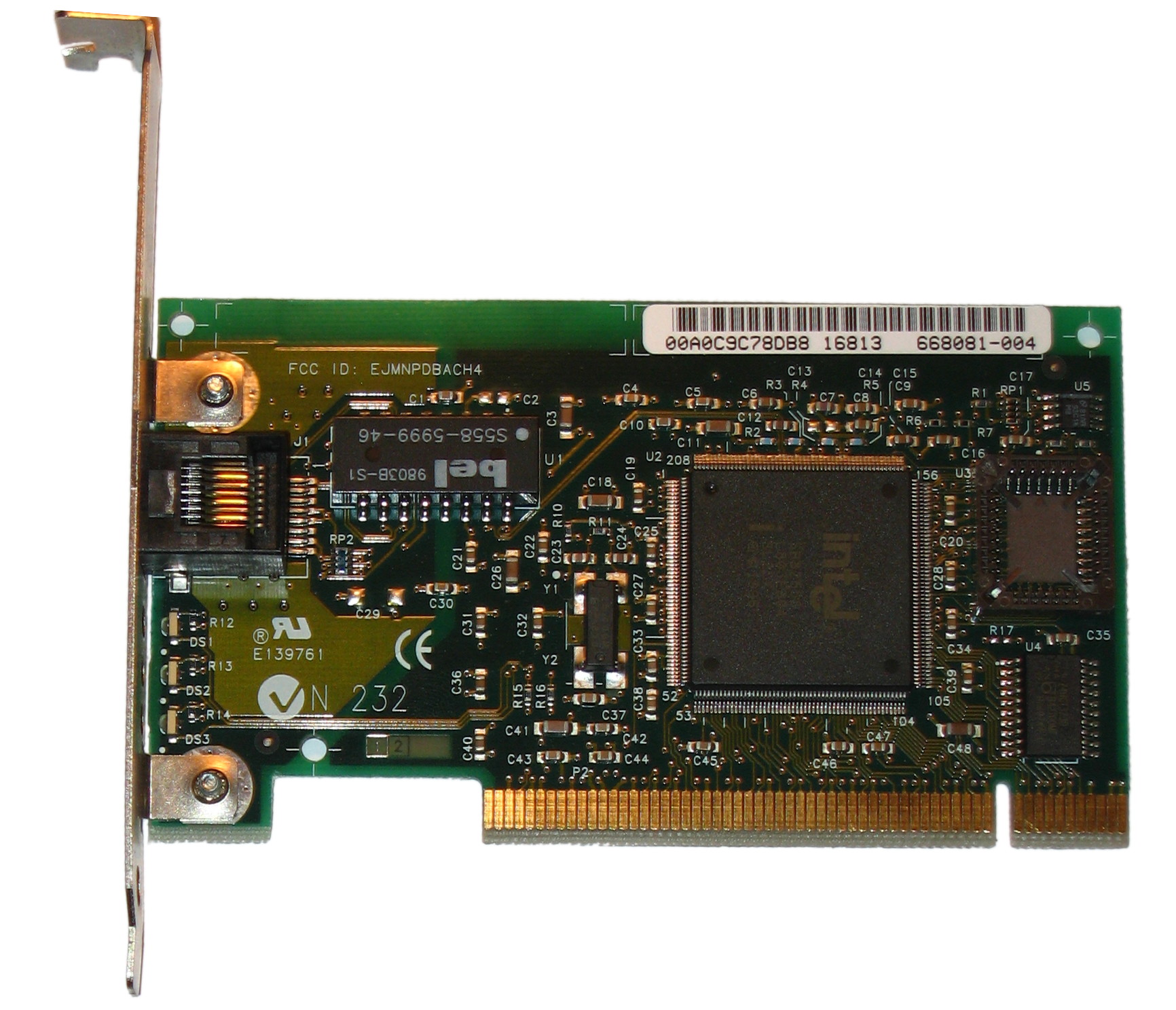
A Fast Ethernet adapter can be logically divided into a media access controller (MAC), which deals with the higher-level issues of medium availability, and a physical layer interface (PHY). The MAC is typically linked to the PHY by a four-bit 25 MHz synchronous parallel interface known as a media-independent interface (MII), or by a two-bit 50 MHz variant called reduced media independent interface (RMII). In rare cases, the MII may be an external connection but is usually a connection between ICs in a network adapter or even two sections within a single IC. The specs are written based on the assumption that the interface between MAC and PHY will be an MII but they do not require it. Fast Ethernet or Ethernet hubs may use the MII to connect to multiple PHYs for their different interfaces.
The MII fixes the theoretical maximum data bit rate for all versions of Fast Ethernet to 100 Mbit/s. The information rate actually observed on real networks is less than the theoretical maximum, due to the necessary header and trailer (addressing and error-detection bits) on every Ethernet frame, and the required interpacket gap between transmissions.
100BASE-T is any of several Fast Ethernet standards for twisted pair cables,[dubious – discuss] including: 100BASE-TX (100 Mbit/s over two-pair Cat5 or better cable), 100BASE-T4 (100 Mbit/s over four-pair Cat3 or better cable, defunct), 100BASE-T2 (100 Mbit/s over two-pair Cat3 or better cable, also defunct). The segment length for a 100BASE-T cable is limited to 100 metres (328 ft) (the same limit as 10BASE-T and gigabit Ethernet). All are or were standards under IEEE 802.3 (approved 1995). Almost all 100BASE-T installations are 100BASE-TX.
100BASE-TX is the predominant form of Fast Ethernet, and runs over two pairs of wire inside a Category 5 or above cable. Cable distance between nodes can be up to 100 metres (328 ft). One pair is used for each direction, providing full-duplex operation at 100 Mbit/s in each direction.
Hub AI
Fast Ethernet AI simulator
(@Fast Ethernet_simulator)
Fast Ethernet
In computer networking, Fast Ethernet physical layers carry traffic at the nominal rate of 100 Mbit/s. The prior Ethernet speed was 10 Mbit/s. Of the Fast Ethernet physical layers, 100BASE-TX is by far the most common.
Fast Ethernet was introduced in 1995 as the IEEE 802.3u standard and remained the fastest version of Ethernet for three years before the introduction of Gigabit Ethernet. The acronym GE/FE is sometimes used for devices supporting both standards.
The 100 in the media type designation refers to the transmission speed of 100 Mbit/s, while the BASE refers to baseband signaling. The letter following the dash (T or F) refers to the physical medium that carries the signal (twisted pair or fiber, respectively), while the last character (X, 4, etc.) refers to the line code method used. Fast Ethernet is sometimes referred to as 100BASE-X, where X is a placeholder for the FX and TX variants.
Fast Ethernet is an extension of the 10-megabit Ethernet standard. It runs on twisted pair or optical fiber cable in a star wired bus topology, similar to the IEEE standard 802.3i called 10BASE-T, itself an evolution of 10BASE5 (802.3) and 10BASE2 (802.3a). Fast Ethernet devices are generally backward compatible with existing 10BASE-T systems, enabling plug-and-play upgrades from 10BASE-T. Most switches and other networking devices with ports capable of Fast Ethernet can perform autonegotiation, sensing a piece of 10BASE-T equipment and setting the port to 10BASE-T half duplex if the 10BASE-T equipment cannot perform autonegotiation itself. The standard specifies the use of CSMA/CD for media access control. A full-duplex mode is also specified and in practice, modern networks use Ethernet switches and operate in full-duplex mode, even as legacy devices that use half duplex still exist.
A Fast Ethernet adapter can be logically divided into a media access controller (MAC), which deals with the higher-level issues of medium availability, and a physical layer interface (PHY). The MAC is typically linked to the PHY by a four-bit 25 MHz synchronous parallel interface known as a media-independent interface (MII), or by a two-bit 50 MHz variant called reduced media independent interface (RMII). In rare cases, the MII may be an external connection but is usually a connection between ICs in a network adapter or even two sections within a single IC. The specs are written based on the assumption that the interface between MAC and PHY will be an MII but they do not require it. Fast Ethernet or Ethernet hubs may use the MII to connect to multiple PHYs for their different interfaces.
The MII fixes the theoretical maximum data bit rate for all versions of Fast Ethernet to 100 Mbit/s. The information rate actually observed on real networks is less than the theoretical maximum, due to the necessary header and trailer (addressing and error-detection bits) on every Ethernet frame, and the required interpacket gap between transmissions.
100BASE-T is any of several Fast Ethernet standards for twisted pair cables,[dubious – discuss] including: 100BASE-TX (100 Mbit/s over two-pair Cat5 or better cable), 100BASE-T4 (100 Mbit/s over four-pair Cat3 or better cable, defunct), 100BASE-T2 (100 Mbit/s over two-pair Cat3 or better cable, also defunct). The segment length for a 100BASE-T cable is limited to 100 metres (328 ft) (the same limit as 10BASE-T and gigabit Ethernet). All are or were standards under IEEE 802.3 (approved 1995). Almost all 100BASE-T installations are 100BASE-TX.
100BASE-TX is the predominant form of Fast Ethernet, and runs over two pairs of wire inside a Category 5 or above cable. Cable distance between nodes can be up to 100 metres (328 ft). One pair is used for each direction, providing full-duplex operation at 100 Mbit/s in each direction.
Recent media