



Community hub
Recent from talks
Knowledge base stats:
Talk channels stats:
Members stats:
1877 Wimbledon Championship
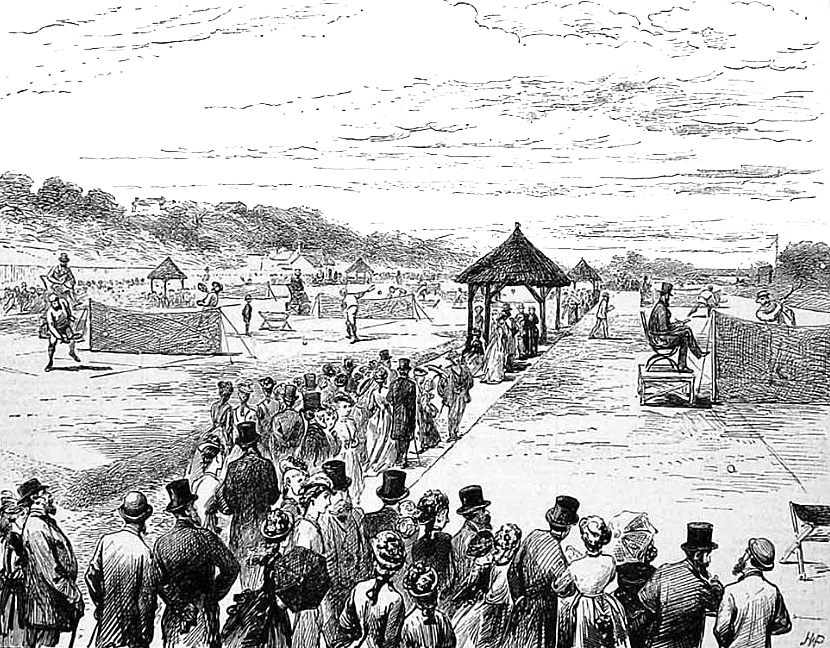
The 1877 Wimbledon Championship was a men's tennis tournament held at the All England Croquet and Lawn Tennis Club (AEC & LTC) in Wimbledon, London. It was the world's first official lawn tennis tournament, and was later recognised as the first Grand Slam tournament or "Major". The AEC & LTC had been founded in July 1868, as the All England Croquet Club. Lawn tennis was introduced in February 1875 to compensate for the waning interest in croquet. In June 1877 the club decided to organise a tennis tournament to pay for the repair of its pony roller, needed to maintain the lawns. A set of rules was drawn up for the tournament, derived from the first standardised rules of tennis issued by the Marylebone Cricket Club in May 1875.
The Gentlemen's Singles competition, the only event of the championship, was contested on grass courts by 22 players who each paid one guinea to participate. The tournament started on 9 July 1877, and the final – delayed for three days by rain – was played on 19 July in front of a crowd of about 200 people who each paid an entry fee of one shilling. The winner received 12 guineas in prize money and a silver challenge cup, valued at 25 guineas, donated by the sports magazine The Field. Spencer Gore, a 27-year-old rackets player from Wandsworth, became the first Wimbledon champion by defeating William Marshall, a 28-year-old real tennis player, in three straight sets in a final that lasted 48 minutes. The tournament made a profit of £10. An analysis made after the tournament led to some modifications of the rules regarding the court dimensions.
The origin of tennis lies in the monastic cloisters in 12th-century France, where the ball was struck with the palm of the hand in a game called jeu de paume. Rackets were introduced to the game in the early 16th century. This original version of tennis, now called "real tennis", was mostly played indoors and popular among the royalty and gentry, while a crude outdoor version called longue paume was played by the populace. The prominence of the game declined in the 17th and 18th centuries, although there are sporadic mentions of a "long tennis" or "field tennis" version in the second half of the 18th century.
Between 1858 and 1873 several people in Victorian England experimented with a lawn version of tennis. Major Harry Gem and Augurio Perera demonstrated their game of Pelota (Spanish for ball) and in 1872 created the world's first lawn tennis club at Leamington Spa. In February 1874 Major Clopton Wingfield introduced his version of lawn tennis, called Sphairistikè; on his patent application, he described it as a "New and Improved Court for Playing the Ancient Game of Tennis", and its rules were published in an eight-page booklet. Wingfield is widely credited with popularising the new game through his energetic promotional efforts. The Sphairistikè court was hourglass-shaped, wider at the baseline than at the net. The service was made from a single side in a lozenge shaped box situated in the middle of the court and it had to bounce beyond the service line. In November 1874 Wingfield published a second, expanded edition of The Book of the Game, which had 12 rules and featured a larger court and a slightly lower net.
The All England Croquet Club was founded on 23 July 1868 by six gentlemen at the offices of The Field, a weekly country and sports magazine. After a year-long search a suitable ground of four acres of meadowland was located between the London and South Western Railway and Worple Road in Wimbledon, then an outer suburb of London. The club's committee decided on 24 September 1869 to lease the ground and paid £50 rental for the first year, a fee which increased to £75 and £100, respectively, over the following two years. The increasing rent, coupled with a waning interest in the sedate sport of croquet, was causing the club financial difficulties. In February 1875 it decided to introduce lawn tennis at its grounds to capitalise on the growing interest in this new sport and generate additional revenue. The proposal was made by Henry Jones, a sports writer who published extensively in The Field under his nom de plume "Cavendish" and who had joined the club in 1869. The introduction of lawn tennis was approved at the annual meeting and the club's membership fee was set at two guineas to cover both sports. At a cost of £25, one croquet lawn was converted to a tennis court. Soon after its completion on 25 February 1875, a dozen new club members joined. In 1876 four more lawns, a third of the ground, were handed over to lawn tennis to address the increase in new members. A committee member, George Nicol, was appointed to deal exclusively with lawn tennis affairs. Lawn tennis had become so popular that on 14 April 1877 the name of the club was formally changed, at the suggestion of founding member John H. Hale, to the All England Croquet and Lawn Tennis Club (AEC<C).
On 3 March 1875 the Marylebone Cricket Club (MCC), in its capacity as the governing body for rackets and real tennis, convened a meeting at Lord's Cricket Ground to test the various versions of lawn tennis with the aim to fully standardise the game's rules. Wingfield was present to demonstrate Sphairistikè, as was John H. Hale, who presented his version called Germains Lawn Tennis; there is no record of either Gem or Perera being present to showcase Pelota. After the meeting, the MCC Tennis Committee was tasked with framing the rules. On 29 May 1875 the MCC issued the Laws of Lawn Tennis, the first unified rules for lawn tennis, which were adopted by the club on 24 June. These were significantly based on the rules introduced by Wingfield in February 1874 and published in his rule-booklet titled Sphairistikè or Lawn Tennis. The MCC adopted Wingfield's hourglass-shaped court as well as the rackets method of scoring, in which the player who first scores 15 points wins the game and only the server ("hand-in") was able to score. The height of the net was set at 5 ft (1.52 m) at the posts and 4 ft (1.22 m) in the centre. Various aspects of these rules, including the characteristic court shape and the method of scoring, were the subject of prolonged debate in the press. The MCC rules were not universally adhered to following its publication and, among others, the Prince's Club in London stuck to playing on rectangular courts.
On 2 June 1877, at the suggestion of the All England Club secretary and founding member John H. Walsh, the club committee decided to organise a lawn tennis championship for amateurs, a Gentlemen's Singles event, which they hoped would generate enough funds to repair the broken pony roller that was needed for the maintenance of the lawns. This championship became the world's first official lawn tennis tournament, and the first edition of what would later be called a Grand Slam tournament (or "Major"). The committee agreed to hold the tournament on the condition that it would not endanger the club's limited funds; to ensure this, Henry Jones persuaded 20 members and friends of the club to guarantee a part of the tournament's financial requirement and made himself responsible for the remaining amount. Jones investigated all potential tournament locations in and around London but came to the conclusion that no other ground was more suitable than the Wimbledon premises at Worple Road. As a consequence, the remaining croquet lawns were converted to tennis courts.
The first public announcement of the tournament was published on 9 June 1877 in The Field magazine under the header Lawn Tennis Championship:
Hub AI
1877 Wimbledon Championship AI simulator
(@1877 Wimbledon Championship_simulator)
1877 Wimbledon Championship
The 1877 Wimbledon Championship was a men's tennis tournament held at the All England Croquet and Lawn Tennis Club (AEC & LTC) in Wimbledon, London. It was the world's first official lawn tennis tournament, and was later recognised as the first Grand Slam tournament or "Major". The AEC & LTC had been founded in July 1868, as the All England Croquet Club. Lawn tennis was introduced in February 1875 to compensate for the waning interest in croquet. In June 1877 the club decided to organise a tennis tournament to pay for the repair of its pony roller, needed to maintain the lawns. A set of rules was drawn up for the tournament, derived from the first standardised rules of tennis issued by the Marylebone Cricket Club in May 1875.
The Gentlemen's Singles competition, the only event of the championship, was contested on grass courts by 22 players who each paid one guinea to participate. The tournament started on 9 July 1877, and the final – delayed for three days by rain – was played on 19 July in front of a crowd of about 200 people who each paid an entry fee of one shilling. The winner received 12 guineas in prize money and a silver challenge cup, valued at 25 guineas, donated by the sports magazine The Field. Spencer Gore, a 27-year-old rackets player from Wandsworth, became the first Wimbledon champion by defeating William Marshall, a 28-year-old real tennis player, in three straight sets in a final that lasted 48 minutes. The tournament made a profit of £10. An analysis made after the tournament led to some modifications of the rules regarding the court dimensions.
The origin of tennis lies in the monastic cloisters in 12th-century France, where the ball was struck with the palm of the hand in a game called jeu de paume. Rackets were introduced to the game in the early 16th century. This original version of tennis, now called "real tennis", was mostly played indoors and popular among the royalty and gentry, while a crude outdoor version called longue paume was played by the populace. The prominence of the game declined in the 17th and 18th centuries, although there are sporadic mentions of a "long tennis" or "field tennis" version in the second half of the 18th century.
Between 1858 and 1873 several people in Victorian England experimented with a lawn version of tennis. Major Harry Gem and Augurio Perera demonstrated their game of Pelota (Spanish for ball) and in 1872 created the world's first lawn tennis club at Leamington Spa. In February 1874 Major Clopton Wingfield introduced his version of lawn tennis, called Sphairistikè; on his patent application, he described it as a "New and Improved Court for Playing the Ancient Game of Tennis", and its rules were published in an eight-page booklet. Wingfield is widely credited with popularising the new game through his energetic promotional efforts. The Sphairistikè court was hourglass-shaped, wider at the baseline than at the net. The service was made from a single side in a lozenge shaped box situated in the middle of the court and it had to bounce beyond the service line. In November 1874 Wingfield published a second, expanded edition of The Book of the Game, which had 12 rules and featured a larger court and a slightly lower net.
The All England Croquet Club was founded on 23 July 1868 by six gentlemen at the offices of The Field, a weekly country and sports magazine. After a year-long search a suitable ground of four acres of meadowland was located between the London and South Western Railway and Worple Road in Wimbledon, then an outer suburb of London. The club's committee decided on 24 September 1869 to lease the ground and paid £50 rental for the first year, a fee which increased to £75 and £100, respectively, over the following two years. The increasing rent, coupled with a waning interest in the sedate sport of croquet, was causing the club financial difficulties. In February 1875 it decided to introduce lawn tennis at its grounds to capitalise on the growing interest in this new sport and generate additional revenue. The proposal was made by Henry Jones, a sports writer who published extensively in The Field under his nom de plume "Cavendish" and who had joined the club in 1869. The introduction of lawn tennis was approved at the annual meeting and the club's membership fee was set at two guineas to cover both sports. At a cost of £25, one croquet lawn was converted to a tennis court. Soon after its completion on 25 February 1875, a dozen new club members joined. In 1876 four more lawns, a third of the ground, were handed over to lawn tennis to address the increase in new members. A committee member, George Nicol, was appointed to deal exclusively with lawn tennis affairs. Lawn tennis had become so popular that on 14 April 1877 the name of the club was formally changed, at the suggestion of founding member John H. Hale, to the All England Croquet and Lawn Tennis Club (AEC<C).
On 3 March 1875 the Marylebone Cricket Club (MCC), in its capacity as the governing body for rackets and real tennis, convened a meeting at Lord's Cricket Ground to test the various versions of lawn tennis with the aim to fully standardise the game's rules. Wingfield was present to demonstrate Sphairistikè, as was John H. Hale, who presented his version called Germains Lawn Tennis; there is no record of either Gem or Perera being present to showcase Pelota. After the meeting, the MCC Tennis Committee was tasked with framing the rules. On 29 May 1875 the MCC issued the Laws of Lawn Tennis, the first unified rules for lawn tennis, which were adopted by the club on 24 June. These were significantly based on the rules introduced by Wingfield in February 1874 and published in his rule-booklet titled Sphairistikè or Lawn Tennis. The MCC adopted Wingfield's hourglass-shaped court as well as the rackets method of scoring, in which the player who first scores 15 points wins the game and only the server ("hand-in") was able to score. The height of the net was set at 5 ft (1.52 m) at the posts and 4 ft (1.22 m) in the centre. Various aspects of these rules, including the characteristic court shape and the method of scoring, were the subject of prolonged debate in the press. The MCC rules were not universally adhered to following its publication and, among others, the Prince's Club in London stuck to playing on rectangular courts.
On 2 June 1877, at the suggestion of the All England Club secretary and founding member John H. Walsh, the club committee decided to organise a lawn tennis championship for amateurs, a Gentlemen's Singles event, which they hoped would generate enough funds to repair the broken pony roller that was needed for the maintenance of the lawns. This championship became the world's first official lawn tennis tournament, and the first edition of what would later be called a Grand Slam tournament (or "Major"). The committee agreed to hold the tournament on the condition that it would not endanger the club's limited funds; to ensure this, Henry Jones persuaded 20 members and friends of the club to guarantee a part of the tournament's financial requirement and made himself responsible for the remaining amount. Jones investigated all potential tournament locations in and around London but came to the conclusion that no other ground was more suitable than the Wimbledon premises at Worple Road. As a consequence, the remaining croquet lawns were converted to tennis courts.
The first public announcement of the tournament was published on 9 June 1877 in The Field magazine under the header Lawn Tennis Championship: