


Community hub
Recent from talks
Contribute something to knowledge base
Content stats: 0 posts, 0 articles, 1 media, 0 notes
Members stats: 0 subscribers, 0 contributors, 0 moderators, 0 supporters
Subscribers
Supporters
Contributors
Moderators
Hub AI
Real tennis AI simulator
(@Real tennis_simulator)
Hub AI
Real tennis AI simulator
(@Real tennis_simulator)
Real tennis
Real tennis – one of several games sometimes called "the sport of kings" – is the original racquet sport from which the modern game of tennis (also called "lawn tennis") is derived. It is also known as court tennis in the United States, royal tennis in England and Australia, and courte-paume in France (to distinguish it from longue-paume, and in reference to the older, racquetless game of jeu de paume, the ancestor of modern handball and racquet games). Many French real tennis courts are at jeu de paume clubs.
The term real was first used by journalists in the early 20th century as a retronym to distinguish the ancient game from modern lawn tennis (even though, at present, the latter sport is seldom contested on lawns outside the few social-club-managed estates such as Wimbledon).
There are 45 active real tennis courts in the world, located in the United Kingdom, Australia, the United States and France. There are also currently six disused courts, such as the two in the Republic of Ireland. The sport is supported and governed by various organizations around the world.
Unlike latex-based technology underlying the modern lawn tennis ball, the game uses a cork-cored ball which is very close in design to the original balls used in the game. The 2+1⁄2-inch (64 mm) diameter balls are handmade and consist of a core made of cork with fabric tape tightly wound around it, compacted by outer windings of string, and covered with a hand-sewn layer of heavy, woven, woollen cloth, traditionally Melton cloth (not felt, which is unwoven and not strong enough to last as a ball covering). The balls were traditionally white, but around the end of the 20th century "optic yellow" was introduced for improved visibility, as had been done years earlier in lawn tennis. The balls are much less bouncy than lawn tennis balls, and weigh about 2+1⁄2 ounces (71 grams); lawn tennis balls typically weigh 2 ounces (57 g).
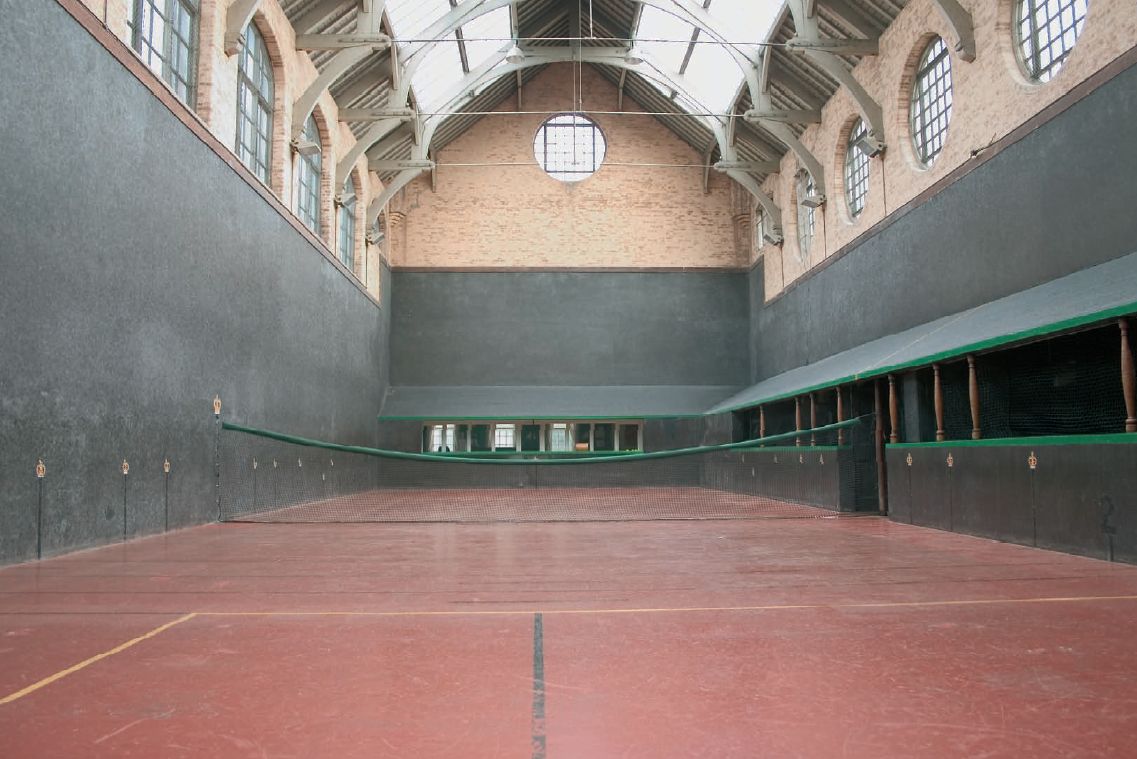
Despite trials by Dunlop to introduce machine-made balls in the 1970s, almost all balls are entirely hand made by club professionals. The inner core of a ball can last several years, but the cover must be replaced every two to three weeks, depending on usage. Balls are produced in sets of around 60 and hand-sewn by the professional at each club. They are not available for purchase by the general public. Balls are stored in a wicker or plastic basket placed in a hole in the floor underneath the net. A trough under the net allows balls hit into the net to roll into the basket. The entire basket of balls is tipped into a tray in the dedans prior to play to reduce time spent fetching balls; ball boys are not required in real tennis.
The spellings racket and racquet are both used by different sources. The 27-inch (690 mm) short, asymmetrical racquets are made of wood and use very tight nylon strings to cope with the heavy balls. The racquet is oval-shaped to make it easier to strike balls close to the floor or in corners, and to facilitate a fast shot with a low trajectory that is difficult for an opponent to return. However, the rackets have a small sweet spot, which discourages a large swing in a shot and emphasises accuracy. Rackets are made of a combination of ash, hickory, vulcanized fibre and willow. Gut strings have now entirely been replaced by nylon, allowing strings to be tighter. Rackets are laminated, with improvements in epoxy resulting in stronger, sturdier rackets which last longer and have changed the game to be faster and more hard hitting.
Most of the rackets in the world are produced by Grays of Cambridge, based in Cambridge in the United Kingdom. Companies that have previously produced real tennis rackets include Dunlop, Slazenger and Gold Leaf Athletics. The introduction of graphite rackets in lawn tennis has reduced the demand for wooden rackets of any sport, resulting in the larger companies leaving the industry. More recently, Harrow Sports has introduced graphite rackets which are not permitted by the rules of the game as of 2025, but are being trialled at the club level.
Due to the small nature of the game, rackets are almost exclusively sold by club professionals, who also provide restringing services to club members. Even at the elite level professionals string their own rackets.
Real tennis
Real tennis – one of several games sometimes called "the sport of kings" – is the original racquet sport from which the modern game of tennis (also called "lawn tennis") is derived. It is also known as court tennis in the United States, royal tennis in England and Australia, and courte-paume in France (to distinguish it from longue-paume, and in reference to the older, racquetless game of jeu de paume, the ancestor of modern handball and racquet games). Many French real tennis courts are at jeu de paume clubs.
The term real was first used by journalists in the early 20th century as a retronym to distinguish the ancient game from modern lawn tennis (even though, at present, the latter sport is seldom contested on lawns outside the few social-club-managed estates such as Wimbledon).
There are 45 active real tennis courts in the world, located in the United Kingdom, Australia, the United States and France. There are also currently six disused courts, such as the two in the Republic of Ireland. The sport is supported and governed by various organizations around the world.
Unlike latex-based technology underlying the modern lawn tennis ball, the game uses a cork-cored ball which is very close in design to the original balls used in the game. The 2+1⁄2-inch (64 mm) diameter balls are handmade and consist of a core made of cork with fabric tape tightly wound around it, compacted by outer windings of string, and covered with a hand-sewn layer of heavy, woven, woollen cloth, traditionally Melton cloth (not felt, which is unwoven and not strong enough to last as a ball covering). The balls were traditionally white, but around the end of the 20th century "optic yellow" was introduced for improved visibility, as had been done years earlier in lawn tennis. The balls are much less bouncy than lawn tennis balls, and weigh about 2+1⁄2 ounces (71 grams); lawn tennis balls typically weigh 2 ounces (57 g).
Despite trials by Dunlop to introduce machine-made balls in the 1970s, almost all balls are entirely hand made by club professionals. The inner core of a ball can last several years, but the cover must be replaced every two to three weeks, depending on usage. Balls are produced in sets of around 60 and hand-sewn by the professional at each club. They are not available for purchase by the general public. Balls are stored in a wicker or plastic basket placed in a hole in the floor underneath the net. A trough under the net allows balls hit into the net to roll into the basket. The entire basket of balls is tipped into a tray in the dedans prior to play to reduce time spent fetching balls; ball boys are not required in real tennis.
The spellings racket and racquet are both used by different sources. The 27-inch (690 mm) short, asymmetrical racquets are made of wood and use very tight nylon strings to cope with the heavy balls. The racquet is oval-shaped to make it easier to strike balls close to the floor or in corners, and to facilitate a fast shot with a low trajectory that is difficult for an opponent to return. However, the rackets have a small sweet spot, which discourages a large swing in a shot and emphasises accuracy. Rackets are made of a combination of ash, hickory, vulcanized fibre and willow. Gut strings have now entirely been replaced by nylon, allowing strings to be tighter. Rackets are laminated, with improvements in epoxy resulting in stronger, sturdier rackets which last longer and have changed the game to be faster and more hard hitting.
Most of the rackets in the world are produced by Grays of Cambridge, based in Cambridge in the United Kingdom. Companies that have previously produced real tennis rackets include Dunlop, Slazenger and Gold Leaf Athletics. The introduction of graphite rackets in lawn tennis has reduced the demand for wooden rackets of any sport, resulting in the larger companies leaving the industry. More recently, Harrow Sports has introduced graphite rackets which are not permitted by the rules of the game as of 2025, but are being trialled at the club level.
Due to the small nature of the game, rackets are almost exclusively sold by club professionals, who also provide restringing services to club members. Even at the elite level professionals string their own rackets.
Recent media
Recent media