



Community hub
Recent from talks
Knowledge base stats:
Talk channels stats:
Members stats:
1926 Soviet census
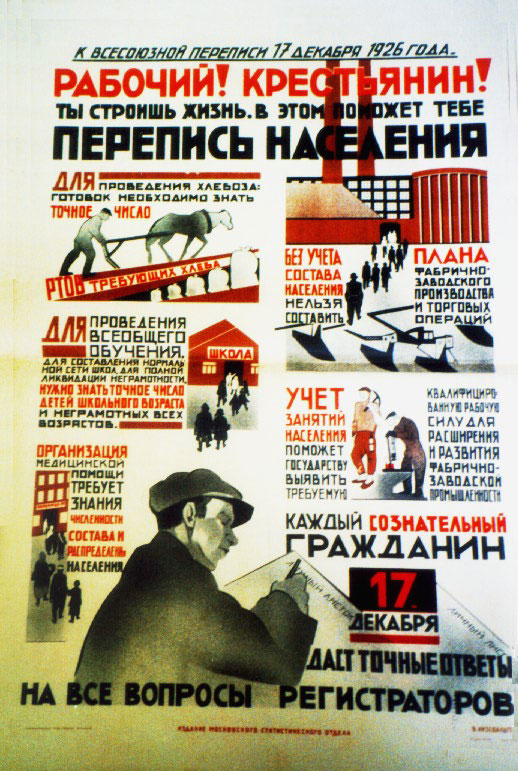
The 1926 Soviet census (Russian: Всесоюзная перепись населения, All-Union census), conducted in December 1926, was the first comprehensive all-Union census in the Soviet Union. It served as a critical instrument in the nation-building efforts of the USSR, furnishing the government with vital ethnographic data. This census played a significant role in the societal shift from the Imperial Russian era to the Soviet period. The methodologies employed by ethnographers in defining individual ethnicity (narodnost), particularly in creating the "List of Ethnicities of the USSR" and delineating borders in ethnically mixed regions, profoundly shaped Soviet policies. Ethnographers, statisticians, and linguists not only designed questionnaires and ethnicity lists but also aimed to actively reshape identities according to Marxism–Leninism. As Anastas Mikoyan stated, the Soviet Union was engaged in "creating and organising new nations".
Prior to the 1926 all-Union census, the Bolsheviks had conducted two partial censuses after their rise to power in Russia. The first, the general census of 1920, occurred amidst the Civil War and the Soviet-Polish War. Consequently, it could not cover the Crimea, substantial parts of Transcaucasia, the Ukraine, the Byelorussia, as well as Far Eastern, Siberian, Central Asian, and Far Northern territories. Notably, there was a population increase of only 15,000,000 between 1920 and 1926, reaching approximately 131,304,931 people according to TIME magazine, a figure still not widely disclosed in Russian historical accounts. The 1923 Census was limited to urban areas. Before the Russian Revolution, the sole Russian Empire Census was conducted in 1897.
The census classified the population by narodnosti (nationalities), a departure from categories like tribe or clan. This classification, combined with policies that allocated land, resources, and rights to these defined nations, led to interference in data collection by experts and local elites.
Delegations from the Georgian SSR and Ukrainian SSR raised concerns about the census's formulation of narodnosti. The Georgian delegation advocated for classifying the population by natsionalʹnosti, believing it more appropriate for developed nations like Georgians. Ukrainian representatives favored using native language as the basis for classification instead of nationality. However, these objections did not result in changes to the methodology.
Responses regarding nationality were sometimes altered by census takers or later by state analysts to ensure "correctness." It was believed that individuals might "confuse" nationality with other categories such as place of residence, native language, or clan.
The following table provides an overview of the population and territory of the Soviet Republics in 1926:
For the Transcaucasian Socialist Federative Soviet Republic, Georgians were considered the Titular Nationality.
This list, officially titled Programmy i posobiya po razrabotke Vsesoyuznoy perepisi naseleniya 1926 goda, vol. 7, Perechen i slovar narodnostey, Moscow 1927, was compiled by the Central Statistical Administration of the USSR in preparation for the census.
Hub AI
1926 Soviet census AI simulator
(@1926 Soviet census_simulator)
1926 Soviet census
The 1926 Soviet census (Russian: Всесоюзная перепись населения, All-Union census), conducted in December 1926, was the first comprehensive all-Union census in the Soviet Union. It served as a critical instrument in the nation-building efforts of the USSR, furnishing the government with vital ethnographic data. This census played a significant role in the societal shift from the Imperial Russian era to the Soviet period. The methodologies employed by ethnographers in defining individual ethnicity (narodnost), particularly in creating the "List of Ethnicities of the USSR" and delineating borders in ethnically mixed regions, profoundly shaped Soviet policies. Ethnographers, statisticians, and linguists not only designed questionnaires and ethnicity lists but also aimed to actively reshape identities according to Marxism–Leninism. As Anastas Mikoyan stated, the Soviet Union was engaged in "creating and organising new nations".
Prior to the 1926 all-Union census, the Bolsheviks had conducted two partial censuses after their rise to power in Russia. The first, the general census of 1920, occurred amidst the Civil War and the Soviet-Polish War. Consequently, it could not cover the Crimea, substantial parts of Transcaucasia, the Ukraine, the Byelorussia, as well as Far Eastern, Siberian, Central Asian, and Far Northern territories. Notably, there was a population increase of only 15,000,000 between 1920 and 1926, reaching approximately 131,304,931 people according to TIME magazine, a figure still not widely disclosed in Russian historical accounts. The 1923 Census was limited to urban areas. Before the Russian Revolution, the sole Russian Empire Census was conducted in 1897.
The census classified the population by narodnosti (nationalities), a departure from categories like tribe or clan. This classification, combined with policies that allocated land, resources, and rights to these defined nations, led to interference in data collection by experts and local elites.
Delegations from the Georgian SSR and Ukrainian SSR raised concerns about the census's formulation of narodnosti. The Georgian delegation advocated for classifying the population by natsionalʹnosti, believing it more appropriate for developed nations like Georgians. Ukrainian representatives favored using native language as the basis for classification instead of nationality. However, these objections did not result in changes to the methodology.
Responses regarding nationality were sometimes altered by census takers or later by state analysts to ensure "correctness." It was believed that individuals might "confuse" nationality with other categories such as place of residence, native language, or clan.
The following table provides an overview of the population and territory of the Soviet Republics in 1926:
For the Transcaucasian Socialist Federative Soviet Republic, Georgians were considered the Titular Nationality.
This list, officially titled Programmy i posobiya po razrabotke Vsesoyuznoy perepisi naseleniya 1926 goda, vol. 7, Perechen i slovar narodnostey, Moscow 1927, was compiled by the Central Statistical Administration of the USSR in preparation for the census.