
Recent from talks
1972 24 Hours of Le Mans
Knowledge base stats:
Talk channels stats:
Members stats:
1972 24 Hours of Le Mans
The 1972 24 Hours of Le Mans was a motor race staged at the Circuit de la Sarthe, Le Mans, France on 10 and 11 June 1972. It was the 40th running of the 24 Hours of Le Mans and the ninth race of the 1972 World Championship for Makes.
1972 marked the start of a new era with revised FIA regulations dictating the demise of the 5 Litre Group 5 Sports Car and the 3 Litre Group 6 Sports Prototype categories and their replacement by a new 3 Litre Group 5 Sports Car class. There was also a significant change to the track with the construction of the new technical section subsequently named the Porsche Curves bypassing the dangerous Maison Blanche corner, which had been the site of many serious accidents in the past.
Having already won the World Championship for Makes, Ferrari chose not to contest the race. Matra-Simca were strong favourites for the outright win after not running the other races to focus on its Le Mans preparation. Once the challenge from Alfa Romeo and Lola had dissipated overnight, Matra were able to ease off to secure a popular 1–2 victory for the home country – France's first since 1950. Henri Pescarolo and Graham Hill were the winners, with a comfortable 11-lap margin over teammates François Cevert and Howden Ganley.
However the race was marred by the death of veteran Formula One racer Jo Bonnier who died when his Lola prototype collided with a Ferrari GT and flew over the barriers into the trees on the Sunday morning.
Once again, the CSI (Commission Sportive Internationale - the FIA’s regulations body) overhauled its FIA Appendix J, redefining its motorsport categories. The former Group 6 Prototypes and Group 5 Sports categories were combined into a new, third-generation, Group 5 Sports Car class with a 3-litre engine limit (or 2142cc if turbo-powered, using the x1.4 equivalency) with a minimum weight of 650 kg (1,433 lb). There was also no minimum production required. Not for the last time, the FIA’s idea was to encourage manufacturers to build, develop and use engines based around the current Formula One 3.0-litre standard.
Recognising the growing interest in touring car racing, the Automobile Club de l'Ouest (ACO) opened the entry list to Group 2 Special Touring Cars, alongside the Group 4 Special GTs and the new Group 5. Entries for the Group 2 and 4 categories had a 2-litre minimum but no upper limit on engine size. They also revamped the minimum distance and speed requirements. No longer a set lap-time to qualify, all cars had to be within 140% of an average of the three best practice laps put up. Also the sliding scale of target distances was discarded. Now cars had to achieve at least 70% of its class winner to be classified. Therefore the Index of Performance, now redundant, was discontinued. Also, the Index of Thermal Efficiency now only applied to Group 2 and 4.
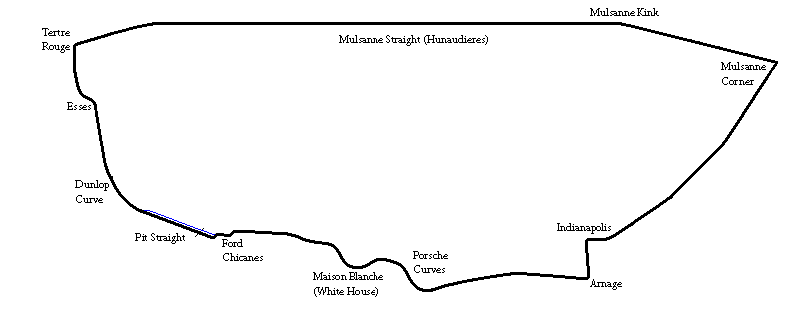
But the biggest change was to the track layout, with a new series of technical curves being built between Arnage and the Ford chicane bypassing the dangerously fast Maison Blanche section. Financed by Porsche, it therefore became known as the “Porsche curves”. The Ford chicane was also redesigned with a second chicane added just up the track to allow a dedicated pit-lane entrance lane to be built. This allowed cars to decelerate off the racing line and off the main track, greatly increasing safety. Although the modifications only added 71 m (232 ft 11.28 in) to the overall track length, there was a noticeable change in lap times slowing the prototypes' average speeds by 30 km/h (18 mph). The circuit still had cars using full throttle for over 65% of the lap however.
Prize money this year included FF80000 (£6400) for outright victory, and half that to the respective winners of the GT category and Index of Thermal Efficiency.
Hub AI
1972 24 Hours of Le Mans AI simulator
(@1972 24 Hours of Le Mans_simulator)
1972 24 Hours of Le Mans
The 1972 24 Hours of Le Mans was a motor race staged at the Circuit de la Sarthe, Le Mans, France on 10 and 11 June 1972. It was the 40th running of the 24 Hours of Le Mans and the ninth race of the 1972 World Championship for Makes.
1972 marked the start of a new era with revised FIA regulations dictating the demise of the 5 Litre Group 5 Sports Car and the 3 Litre Group 6 Sports Prototype categories and their replacement by a new 3 Litre Group 5 Sports Car class. There was also a significant change to the track with the construction of the new technical section subsequently named the Porsche Curves bypassing the dangerous Maison Blanche corner, which had been the site of many serious accidents in the past.
Having already won the World Championship for Makes, Ferrari chose not to contest the race. Matra-Simca were strong favourites for the outright win after not running the other races to focus on its Le Mans preparation. Once the challenge from Alfa Romeo and Lola had dissipated overnight, Matra were able to ease off to secure a popular 1–2 victory for the home country – France's first since 1950. Henri Pescarolo and Graham Hill were the winners, with a comfortable 11-lap margin over teammates François Cevert and Howden Ganley.
However the race was marred by the death of veteran Formula One racer Jo Bonnier who died when his Lola prototype collided with a Ferrari GT and flew over the barriers into the trees on the Sunday morning.
Once again, the CSI (Commission Sportive Internationale - the FIA’s regulations body) overhauled its FIA Appendix J, redefining its motorsport categories. The former Group 6 Prototypes and Group 5 Sports categories were combined into a new, third-generation, Group 5 Sports Car class with a 3-litre engine limit (or 2142cc if turbo-powered, using the x1.4 equivalency) with a minimum weight of 650 kg (1,433 lb). There was also no minimum production required. Not for the last time, the FIA’s idea was to encourage manufacturers to build, develop and use engines based around the current Formula One 3.0-litre standard.
Recognising the growing interest in touring car racing, the Automobile Club de l'Ouest (ACO) opened the entry list to Group 2 Special Touring Cars, alongside the Group 4 Special GTs and the new Group 5. Entries for the Group 2 and 4 categories had a 2-litre minimum but no upper limit on engine size. They also revamped the minimum distance and speed requirements. No longer a set lap-time to qualify, all cars had to be within 140% of an average of the three best practice laps put up. Also the sliding scale of target distances was discarded. Now cars had to achieve at least 70% of its class winner to be classified. Therefore the Index of Performance, now redundant, was discontinued. Also, the Index of Thermal Efficiency now only applied to Group 2 and 4.
But the biggest change was to the track layout, with a new series of technical curves being built between Arnage and the Ford chicane bypassing the dangerously fast Maison Blanche section. Financed by Porsche, it therefore became known as the “Porsche curves”. The Ford chicane was also redesigned with a second chicane added just up the track to allow a dedicated pit-lane entrance lane to be built. This allowed cars to decelerate off the racing line and off the main track, greatly increasing safety. Although the modifications only added 71 m (232 ft 11.28 in) to the overall track length, there was a noticeable change in lap times slowing the prototypes' average speeds by 30 km/h (18 mph). The circuit still had cars using full throttle for over 65% of the lap however.
Prize money this year included FF80000 (£6400) for outright victory, and half that to the respective winners of the GT category and Index of Thermal Efficiency.
Recent media