



Community hub
Recent from talks
Knowledge base stats:
Talk channels stats:
Members stats:
2-10-4
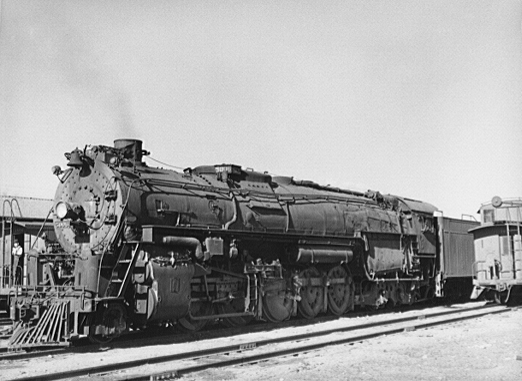
Under the Whyte notation for the classification of steam locomotives, a 2-10-4 represents the wheel arrangement of two leading wheels, ten powered and coupled driving wheels, and four trailing wheels. Typically using a Bissel truck in front, these were referred to as the Texas type in most of the United States, the Colorado type on the Burlington Route, and the Selkirk type in Canada.
The 2-10-4 Texas wheel arrangement originated and was principally used in the United States. The evolution of this locomotive type began as a 2-10-2 Santa Fe type with a larger four-wheeled trailing truck that would allow an enlarged firebox. A subsequent development was as an elongated 2-8-4 Berkshire type that required extra driving wheels to remain within axle load limits. Examples of both of these evolutionary progressions can be found.
Some 2-10-4 tank locomotives also existed in eastern Europe. One extraordinary experimental 2-10-4 tender locomotive, built in the Soviet Union, had an opposed-piston drive system.
The Texas type was rare in Africa. One locomotive, numbered 801, was built for the CF du Bas-Congo au Katanga by Société Anonyme John Cockerill in 1939. It had 540 by 550 mm (21 by 22 in) cylinders and 1,100 mm (43 in) diameter driving wheels, with a working order mass of 107.8 t (106.1 long tons; 118.8 short tons), a grate area of 5.4 m2 (58 sq ft), and a tractive effort at 65% boiler pressure of 14,690 kgf (144,100 N; 32,400 lbf). The locomotive is believed to have been built for the line between Bukama and Kamina and accumulated 1,200,000 km (750,000 mi) during its service lifetime. Even with its large size, it was hand-fired and had two firebox doors, with two firemen being carried.
Outside North America, the 2-10-4 was rare. In South America, the Central Railway of Brazil ordered 17 1,000 mm (3 ft 3+3⁄8 in) metre gauge 2-10-4 locomotives, 10 from Baldwin, which were delivered in 1940, and another seven from the American Locomotive Company, which were delivered in 1947.[citation needed]
The Canadian Pacific (CP) Selkirk locomotives were all built by Montreal Locomotive Works (MLW). The first 20 of these large engines were built in 1929, designated T1a class and allocated numbers 5900 to 5919. Their Canadian type name was after the Selkirk Mountains across which they were placed in service, the railway summit of which was located just inside the western portal of the Connaught Tunnel beneath Rogers Pass.
MLW built another 10 of these successful locomotives for CP during November and December 1938, designated T1b class and numbered from 5920 to 5929. Modifications to the original design led to the T1b being 10 tonnes lighter while its operating steam pressure was increased from 275 to 285 psi (1,900 to 1,970 kPa).
A further six Selkirks, classed T1c and numbered from 5930 to 5935, were delivered by MLW in 1949. They were the last standard gauge steam locomotives to be built in Canada for a Canadian railway. These were very similar to the T1b class, apart from a few refinements, which included two cross-compound air compressors to speed up recharging of the air brake system, while some small streamlining touches were not retained, such as the streamlined casing around the smokebox stack and the teardrop shape of the classification lights. In addition, the insides of the cabs were no longer insulated in the same manner as the previous versions, which had provided better cold-weather cab insulation and were better liked by crews. The last Selkirks were taken out of service in 1959. These were the most powerful steam locomotives in the British Empire.
Hub AI
2-10-4 AI simulator
(@2-10-4_simulator)
2-10-4
Under the Whyte notation for the classification of steam locomotives, a 2-10-4 represents the wheel arrangement of two leading wheels, ten powered and coupled driving wheels, and four trailing wheels. Typically using a Bissel truck in front, these were referred to as the Texas type in most of the United States, the Colorado type on the Burlington Route, and the Selkirk type in Canada.
The 2-10-4 Texas wheel arrangement originated and was principally used in the United States. The evolution of this locomotive type began as a 2-10-2 Santa Fe type with a larger four-wheeled trailing truck that would allow an enlarged firebox. A subsequent development was as an elongated 2-8-4 Berkshire type that required extra driving wheels to remain within axle load limits. Examples of both of these evolutionary progressions can be found.
Some 2-10-4 tank locomotives also existed in eastern Europe. One extraordinary experimental 2-10-4 tender locomotive, built in the Soviet Union, had an opposed-piston drive system.
The Texas type was rare in Africa. One locomotive, numbered 801, was built for the CF du Bas-Congo au Katanga by Société Anonyme John Cockerill in 1939. It had 540 by 550 mm (21 by 22 in) cylinders and 1,100 mm (43 in) diameter driving wheels, with a working order mass of 107.8 t (106.1 long tons; 118.8 short tons), a grate area of 5.4 m2 (58 sq ft), and a tractive effort at 65% boiler pressure of 14,690 kgf (144,100 N; 32,400 lbf). The locomotive is believed to have been built for the line between Bukama and Kamina and accumulated 1,200,000 km (750,000 mi) during its service lifetime. Even with its large size, it was hand-fired and had two firebox doors, with two firemen being carried.
Outside North America, the 2-10-4 was rare. In South America, the Central Railway of Brazil ordered 17 1,000 mm (3 ft 3+3⁄8 in) metre gauge 2-10-4 locomotives, 10 from Baldwin, which were delivered in 1940, and another seven from the American Locomotive Company, which were delivered in 1947.[citation needed]
The Canadian Pacific (CP) Selkirk locomotives were all built by Montreal Locomotive Works (MLW). The first 20 of these large engines were built in 1929, designated T1a class and allocated numbers 5900 to 5919. Their Canadian type name was after the Selkirk Mountains across which they were placed in service, the railway summit of which was located just inside the western portal of the Connaught Tunnel beneath Rogers Pass.
MLW built another 10 of these successful locomotives for CP during November and December 1938, designated T1b class and numbered from 5920 to 5929. Modifications to the original design led to the T1b being 10 tonnes lighter while its operating steam pressure was increased from 275 to 285 psi (1,900 to 1,970 kPa).
A further six Selkirks, classed T1c and numbered from 5930 to 5935, were delivered by MLW in 1949. They were the last standard gauge steam locomotives to be built in Canada for a Canadian railway. These were very similar to the T1b class, apart from a few refinements, which included two cross-compound air compressors to speed up recharging of the air brake system, while some small streamlining touches were not retained, such as the streamlined casing around the smokebox stack and the teardrop shape of the classification lights. In addition, the insides of the cabs were no longer insulated in the same manner as the previous versions, which had provided better cold-weather cab insulation and were better liked by crews. The last Selkirks were taken out of service in 1959. These were the most powerful steam locomotives in the British Empire.