Hubbry Logo
2-8-02-8-0Main
Open search
2-8-0
Community hub
2-8-0
logo
8 pages, 0 posts
0 subscribers
Be the first to start a discussion here.
2-8-0
2-8-0
from Wikipedia
2-8-0 (Consolidation)
Diagram of one small leading wheel, and four large driving wheels joined by a coupling rod
Front of locomotive at left
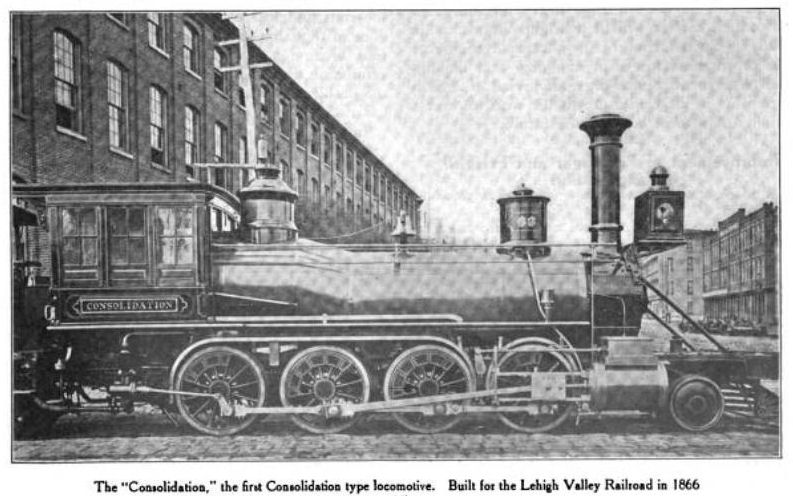
Lehigh and Mahanoy Railroad's Consolidation of 1866, the first 2-8-0 built
Equivalent classifications
UIC class1D, 1'D
French class140
Turkish class45
Swiss class4/5
Russian class1-4-0
First known tank engine version
First use1907
CountryGerman South West Africa
LocomotiveSouth West African 2-8-0T
RailwayLüderitzbucht Eisenbahn
DesignerOrenstein & Koppel
BuilderOrenstein & Koppel
First known tender engine version
First usec. 1864
CountryUnited States of America
RailwayPennsylvania Railroad
DesignerJohn P. Laird
BuilderJohn P. Laird
Evolved from0-8-0
Evolved to2-8-2
BenefitsBetter stability through curves
DrawbacksPoor steaming and limited speed.
First known "True type" version
First use1866
CountryUnited States of America
LocomotiveConsolidation
RailwayLehigh and Mahanoy Railroad
DesignerAlexander Mitchell
BuilderBaldwin Locomotive Works
Evolved from0-8-0
Evolved to2-8-2

Under the Whyte notation for the classification of steam locomotives, 2-8-0 represents the wheel arrangement of two leading wheels on one axle, usually in a leading truck, eight powered and coupled driving wheels on four axles, and no trailing wheels. In the United States and elsewhere, this wheel arrangement is commonly known as a Consolidation, after the Lehigh and Mahanoy Railroad’s Consolidation, the name of the first 2-8-0.[1]

The notation 2-8-0T indicates a tank locomotive of this wheel arrangement, the "T" suffix indicating a locomotive on which the water is carried in side-tanks mounted on the engine rather than in an attached tender.

The Consolidation represented a notable advance in locomotive power. After 1875, it became "the most popular type of freight locomotive in the United States and was built in greater quantities than any other single wheel arrangement."[2]

Overview

[edit]

Of all the locomotive types that were created and experimented with in the 19th century, the 2-8-0 was a relative latecomer.[3]

The first locomotive of this wheel arrangement was possibly built by the Pennsylvania Railroad (PRR). Like the first 2-6-0s, this first 2-8-0 had a leading axle that was rigidly attached to the locomotive's frame, rather than on a separate truck or bogie. To create this 2-8-0, PRR master mechanic John P. Laird modified an existing 0-8-0, the Bedford, in 1863.

The 2-6-0 Mogul type, first created in the early 1860s, is often considered as the logical forerunner to the 2-8-0. However, a claim is made that the first true 2-8-0 engine evolved from the 0-8-0 and was ordered by the United States' Lehigh and Mahanoy Railroad, which named all its engines. The name given to the new locomotive was Consolidation, the name that was later almost globally adopted for the type. According to this viewpoint, the first 2-8-0 order by Lehigh dates to 1866 and antedates the adoption of the type by other railways and coal and mountain freight haulers.[3]

From its introduction in 1866 and well into the early 20th century, the 2-8-0 design was considered to be the ultimate heavy-freight locomotive. The 2-8-0's forte was starting and moving "impressive loads at unimpressive speeds" and its versatility gave the type its longevity. The practical limit of the design was reached in 1915, when it was realised that no further development was possible with a locomotive of this wheel arrangement.[3]

Usage

[edit]

As in the United States, the 2-8-0 was also a popular type in Europe, again largely as a freight hauler. The type was also used in Australia, New Zealand, and Southern Africa.

Australia

[edit]

The 2-8-0 locomotive was used extensively throughout Australia. It served on the 5 ft 3 in (1,600 mm) broad gauge, 4 ft 8+12 in (1,435 mm) standard gauge and 3 ft 6 in (1,067 mm) narrow gauge and was employed mostly as a freight locomotive, although it was often also employed in passenger service in Victoria.[4]

The first Australian locomotive class with this wheel arrangement were the Queensland Railways C13 and C15, built as goods locomotives in 1879 by Baldwin Locomotive Works. Another lot of Consolidation engines consisted of 20 standard-gauge New South Wales Government Railways (NSWGR) J Class engines, which arrived from Baldwin Locomotive Works in 1891. The Js remained in service until 1915, when they were withdrawn. Wartime shortages between 1916 and 1920 had six engines re-entering service after being shopped and fitted with superheaters. The last engine of this class was finally withdrawn in 1934 and all were scrapped by 1937.[4]

The next batch of NSW 2-8-0 locomotives to appear, between 1896 and 1916, was the T class engines. The class was delivered from one local and several overseas builders, 151 locomotives from Beyer, Peacock & Company, 84 from North British Locomotive Company, 10 from Neilson & Company, 30 from Clyde Engineering in Australia, and five from Dübs & Company. During World War II, 14 of these locomotives were equipped with superheaters, which raised their tractive effort from 28,777 lbf (128.0 kN) to 33,557 lbf (149.3 kN).[4]

From 1899, the Victorian Railways (VR) also used a range of broad-gauge 2-8-0 locomotives.

  • The first of these locomotives were the Baldwin-built V class. These engines were built at Phoenix Foundry in Ballarat. By 1930, they had disappeared from the VR.
  • The VR's next type was the 26 C class engines, which saw freight and passenger service.
  • In 1922, a smaller and lighter 2-8-0, the K class, was introduced for branchline freight and later also passenger services.
Victorian Railways J class No. J 515
  • Finally, the VR introduced sixty light 2-8-0 J class engines in 1954. These also worked both freight and passenger services.[4]

The first 2-8-0 engines in private service on the Midland Railway of Western Australia arrived in 1912. These were 3 ft 6 in (1,067 mm) gauge locomotives. The five in the class operated until 1958. All were gone by 1963.[4]

In 1912, some of the NSWGR T class types were also purchased by the private East Greta Railway, later to become the South Maitland Railway, but these were converted to 2-8-2 tank locomotives. The class proved to be successful throughout its long service life, until being retired from government revenue service in 1973.[4]

During 1916, Commonwealth Railways acquired eight K class for the Trans-Australian Railway.[4]

In 1924, a private coal company, J & A Brown in NSW, obtained three ex-British military Railway Operating Division ROD 2-8-0 locomotives. Brown later ordered another 10 of these locomotives, but only nine of that order arrived in Australia. The last was withdrawn in 1973.[4]

Belgium

[edit]

To compensate for wartime losses, Belgian railways acquired 300 2-8-0 locomotives in 1946. They were built in North America, 160 by Montreal Locomotive Works in Canada, 60 by the Canadian Locomotive Company, and 80 by the American Locomotive Company in the United States. These machines proved to be very reliable and were used for mixed traffic until the end of the steam era, when number 29.013 hauled the last scheduled steam passenger train from Ath to Denderleeuw on 20 December 1966.[5]

This locomotive survived in preservation and is used on special excursions. On 16 December 2006, number 29.013 re-enacted the last 1966 run on the same route.[6]

Canada

[edit]
CP N-2-c no. 3716 at Canyon View

The Canadian Pacific Railway (CP) N-2-a, b, and c class locomotives were a class of altogether 182 Consolidation type locomotives, built by Montreal Locomotive Works between 1912 and 1914. They were numbered in the range from 3600 to 3799 and were used almost everywhere around the system. The order for these engines came about when CP needed bigger locomotives for their mainline since their current engines were wearing out and were too small for the loads that were being hauled. Most of the class were converted to oil-firing in later years.[7][8]

One of the locomotives, No. 3716, is run and maintained in Summerland, BC as part of the Kettle Valley Steam Railway.[9][10]

Finland

[edit]

Finland had five tender locomotive classes with a 2-8-0 wheel arrangement, the classes Tk1, Tk2, Tk3, Tv1, and Tv2. The class Tk1s were numbered from 271 to 290 and were nicknamed Amerikan Satikka.

Class Tk3 No. 1136 in special service from Kouvola to Kotka

The class Tk2s were numbered 407 to 426 and 457 to 470. They were nicknamed Satikka. Three were preserved, No. 407 at Närpes, No. 418 at Junction City, Oregon, in the United States, and No. 419 at Haapamäki. The class Tk3s were numbered 800 to 899, 1100 to 1118, and 1129 to 1170. They were built by Tampella, Lokomo, and Frichs. The class Tv1s were numbered 594 to 617, 685 to 741, 900 to 948, and 1200 to 1211. They were built by Tampella and were nicknamed Jumbo. Four were preserved, No. 609 at Haapamäki, No. 933 at the Veturi museum at Toijala, No. 940 at Lapinlahti and No. 943 at Ylivieska. The class Tv2s were numbered from 618 to 637. They were nicknamed Wilson. Only No. 618 was preserved, also at Haapamäki.

Finland had only one tank locomotive class with a 2-8-0 wheel arrangement, the class M1 consisting of one solitary locomotive numbered 66. It was not preserved.

Germany

[edit]

The 2-8-0 wheel arrangement enjoyed a brief period of popularity in Germany during the era of the Länderbahnen or State Railways, from about 1840 to 1920, prior to the establishment after the First World War of the Deutsche Reichsbahn, the German National Railways. Under the Deutsche Reichsbahn-Gesellschaft (DRG) classification system, all 2-8-0 locomotives were assigned to class 56 (Baureihe or BR 56), with different types receiving subclassifications. The earliest type was the Prussian G73 of 1893.

Indonesia

[edit]
SS Class 900 or DKA D50

In response to the increasing need for freight and passenger transports on the BuitenzorgBandungBanjar line, the Java Staatsspoorwegen at the time ordered 42 Consolidation locomotives from 4 different engine manufacturers, including Swiss Locomotive and Machine Works (SLM), Hanomag, Hartmann and Werkspoor, came in 1914, 1915 and 1921, classified as SS Class 900 (901–942). These locomotives were made to fulfill the requirements that submitted by SS, being able to haul 550 tons of freight with speeds of up to 50 km/h (31 mph) or 30 km/h (18.6 mph) on lines with a gradient of 4% or 1 in 25. In order to be able to negotiate 150 meters curve radius, the leading wheels adopted Adam axle system which could enable to turn radially by 70 mm. As for the fourth driving wheels, adopted Golsdorf axle system (patented by Karl Golsdorf), this make the outer driving wheels able to move laterally by 100 mm. As by result, it's not only able to turn at 150 meters curve radius, but speeds up to 75 km/h (46.6 mph) was made possible from its initial of 50 km/h (31 mph). Based on record in 1938, the SS Class 900/DKA 50s ever been used to haul the Eendaagsche Express or One Day Express train on BandungBanjar southern-west line replacing the 2-8-8-0 SS Class 1250 (DKA DD52) due to resource and asset saving policies during Great Depression[11] and 2-6-2T SS Class 1700/DKA C30s which were considered to be inefficient in serving the increasingly congested volume of freights and passenger transport. In 1939, the Eendaagsche Express shortened the time journey for BandungYogyakartaSurabaya to only 11 hours. These locomotives worked on Bandung–Purwakarta–Batavia line and also assigned to work the eastern express trains in East Java on BanyuwangiSurabaya line in tandem with 4-6-4T SS Class 1100 (DKA C27). To make the SS 900s have the characteristics of express locomotive, each unit received the modification of two pair of smoke deflectors.[12][13] In the need of increasing freight transport in South Sumatra, the Java Staatsspoorwegen allocated 4 of them to serve coal transport from Bukit Asam to Kertapati. Not quite a long, the South Sumatra division of SS or so called Zuid-Sumatra Staatsspoorwegen (ZSS) were also ordered 11 of these from two German engine manufacturers, 5 were imported from Hartmann in 1925 and the rest of 6 from Hanomag in 1926.[14][15]

Preservation

[edit]
SS 911 or DKA D5011 at the Transportation Museum of Taman Mini Indonesia Indah

During Japanese occupation in 1942, all Dutch East Indies railway locomotives were renumbered based on Japanese numberings, this including the SS Class 900s were renumbered to D50s and this numbering system still used after the Independence of Indonesia by Djawatan Kereta Api (DKA) or Department of Railways of the Republic of Indonesia up to now. During Indonesian National Revolution some of SS Class 900/DKA D50 were used among the others to haul trains belonging to Republican fighters and the Dutch military. In some records, some of them were destroyed in action due to the conflict. While the SS911 or DKA D50 11 was captured by 2nd Company of 1e Bataljon, 15 Regiment Infanterie of Dutch Marines during Operation Kraai in Yogyakarta. After the acknowledgement of Indonesian sovereignty by Dutch in 1949, the SS Class 900 were transferred to Djawatan Kereta Api. In 1976, most of D50s were found regularly in Jember, East Java which many of them had been dumped out and seemed to be derelict. While the rest of them are still used regularly in South Sumatra pulling some coal trains. Out of 61 units, only DKA D50 11 (ex-SS911) survived and now preserved as static display in Transportation Museum of Taman Mini Indonesia Indah.[16][17][18]

Italy

[edit]

In Italy, the state-controlled railways company Ferrovie dello Stato (FS), after comparing two models of 2-8-0 engine in 1906 (a simple-expansion [simplex] locomotive purchased from Baldwin and a compound type assembled by German and Italian builders) opted for a simplex 2-8-0 as basic power for its freight and mixed trains. Production of such locomotives, classified Gr. 740 in Italy, began in 1911 and stopped four years later when Italy entered the First World War.

Thereafter, Italian industry was devoted to producing military equipment, so FS bought locomotives from North American firms. From 1917 to 1922, American Locomotive Company and Montreal Locomotive Works built 400 2-8-0 locomotives for Italy but only 393 were delivered. The FS classified these engines as Gr. 735 and used them for freight and passenger services. After the war, the supply of Italian-built Gr. 740 resumed. Both Gr. 740 and Gr 735, very similar in performance, remained in service until the end of the 1960s.

Japan

[edit]
JNR Class 9600 No. 9608, oldest surviving example of the class, on static display at Ome Railway Park.

The Baldwin supplied the first three 2-8-0 9000 class locomotives for export to Japan in 1893, in use of Hokkaido Colliery and Railway Company, which were taken over Japanese Government Railway under Railway Nationalization Act of 1906.

Among several classes, most successful examples were 770 of JNR Class 9600, built from 1913 to 1926. Some independent shortlines had equivalent locomotives to 9600 both factory-new and secondhand from JNR, the last example was Yubari Colliery and Railway No. 21, built in 1941 by Kawasaki. Despite obsolescence and early replacement by 2-8-2 D51, 9600s were still widely utilized thanks to high performance and appropriate route availability. The last example, No. 79602, kept longevity until March 1976, making the very final steam traction in service on JNR. No. 79602 was nearly preserved, however, sadly, it was subsequently destroyed by arson attack at Oiwake roundhouse.[19]

New Zealand

[edit]

Several 2-8-0 locomotives were supplied to New Zealand by the Baldwin Locomotive Works of Philadelphia in the United States. Six O Class locomotives were built for the New Zealand Railways in 1885.

The Wellington and Manawatu Railway Company, which operated the Wellington-Manawatu line, had four similar locomotives built by Baldwin, two in 1888, one in 1894 and one in 1896. The WMR locomotives of 1894 and 1896, No. 12 and No. 13, were Vauclain compound locomotives, the first in New Zealand and the first narrow-gauge compounds in the world. While standard gauge compounds usually had the low-pressure cylinder mounted below the high-pressure cylinder on each side, this was often reversed on narrow-gauge locomotives, which had the larger low-pressure cylinders mounted above the high-pressure cylinders to provide greater clearance at platforms.

In 1908, when the WMR was nationalized, these locomotives were classified into three NZR subclasses because of detail differences, the two 1888 locomotives as OB class, the 1894 locomotive as OA class, and the 1896 locomotive as OC class.

North Korea

[edit]

The Korean State Railway have locally built 500-series (used by rubber recycling plant[20]) and 810 series Japanese built[21] narrow gauge (762mm) 2-8-0 locomotives. The 810 series was likely retired in 2006 and 500-series may still be operating.

Russia

[edit]

In Russia, the 2-8-0 wheel arrangement was represented by the prerevolutionary Sch (Shuka-pike) class. These two-cylinder compound locomotives without superheaters were declared the standard Russian freight locomotive in 1912, but since they were relatively low-powered, they were only useful on easier lines without steep gradients such as the Saint Petersburg-Moscow route.

South Africa

[edit]

Five 2-8-0 locomotive classes saw service in South Africa, all of them initially acquired by the Cape Government Railways (CGR), which classified all but two as 8th Class. All of them were variations on the same design, used saturated steam, and had cylinders with overhead slide valves, actuated by inside Stephenson valve gear.[22]

SAR Class 8X, circa 1930
  • In 1901 and 1902, the CGR placed 16 Consolidations in service. Designed by H.M. Beatty, chief locomotive superintendent of the CGR from 1896 to 1910, they were ordered from the Schenectady Locomotive Works in the United States and partly delivered by Schenectady in 1901, with the remainder delivered from the newly established American Locomotive Company in 1902. Conceived as mixed-traffic locomotives, they had bar frames and narrow fireboxes. In 1912, when these locomotives were assimilated into the South African Railways (SAR), they were designated Class 8X.[22][23][24][25]
  • In 1902, the CGR also placed a single experimental tandem compound Consolidation in service, based on its Schenectady/ALCO-built 8th Class. Delivered by ALCO in 1902, the locomotive was not classified and was simply referred to as the Tandem Compound. In 1912, it was designated Class Experimental 2 on the SAR.[22][23][24]
SAR Class Experimental 2
  • In 1903, the CGR received a second experimental tandem compound Consolidation from ALCO. It was similar to the earlier one, but with a larger fire grate and an increased heating surface which enhanced its steaming ability. It also remained unclassified and was also simply referred to as a Tandem Compound. In 1912, it was designated Class Experimental 3 on the SAR.[22][23][24]
  • Also in 1903, the CGR received four more Consolidations from Kitson and Company of Hunslet in Leeds. They were very similar to the earlier Schenectady and ALCO-built Consolidations, but with the boiler pitch raised by 2 in (51 mm). Coupled with a shallow firebox, this enabled the grate to be extended out sideways over the fourth set of drivers, resulting in a grate area of 30.9 sq ft (2.871 m2) compared to the 20 sq ft (1.858 m2) of the previous model. In 1912, they were designated Class 8Y on the SAR.[22][23][24]
SARClass 8Z
  • In 1904, the CGR placed its last eight Consolidations in service. These were ordered from the North British Locomotive Company of Glasgow in Scotland and were very similar to the previous four Kitson-built locomotives, but slightly larger in boiler and firegrate area dimensions. In 1912, these eight were designated Class 8Z on the SAR.[22][23][24][26]

While subjecting the Consolidations to exhaustive testing on all types of traffic and under varying conditions, some trouble was experienced with the leading pony truck and it was dropped in favour of a four-wheeled bogie in later orders for more eighth class locomotives. All subsequent Cape eighth class locomotives were therefore built with a 4-8-0 Mastodon wheel arrangement.[22]

South West Africa

[edit]
DSWA eight-coupled tank

In 1907 and 1910, the Staatsbahn Keetmanshoop (Keetmanshoop State Railway) in German South West Africa placed 21 tank locomotives in service. After the first World War, when all railways in the territory came under the administration of the South African Railways in 1922, five locomotives of the batch of 1910 survived. They were not classified or renumbered, but were referred to as the eight-coupled tanks.[23][27]

In 1911, nine tender locomotives were placed in service by the Staatsbahn Lüderitzbucht-Keetmanshoop (Lüderitzbucht-Keetmanshoop State Railway). After the first World War, all nine locomotives came onto the roster of the SAR, where they were referred to as the eight-coupled tenders.[23][27]

Sweden

[edit]
Swedish M3t Steam Turbine Locomotive

The unusual M3t Turbine Steam Locomotive was of this type. 90 of the Swedish E (0-8-0) class were rebuilt between 1935 and 1951 and given a lead truck, designated the class E2.

Turkey

[edit]
Turkish 8F at the National Railway Museum, Shildon, England

Turkey was a neutral country during the Second World War and to retain Turkish goodwill, Great Britain supplied several locomotives to the Turkish Railways, where they were classified 8F.

Two of these 8F class locomotives were brought back from Turkey early in 2011 and one of them is on display at the National Railway Museum in Shildon, England.

United Kingdom

[edit]
GWR 2800 Class

The 2-8-0 gradually became the standard heavy-freight steam locomotive type in the United Kingdom during the first half of the 20th century, replacing the 0-8-0 types that had appeared as mineral locomotives in the 1890s. These had themselves been a replacement for these heavier tasks of the 0-6-0 locomotives used for freight since the mid 19th century. The 0-6-0 remained a common type for lighter use and on branch lines, but the 0-8-0 largely disappeared in favour of the better-riding 2-8-0.

The first 2-8-0 to be built in Britain was the Great Western Railway's 2800 Class, with 84 locomotives built between 1903 and 1919, followed by a further 83 of the very similar GWR 2884 Class between 1938 and 1942. In 1904, George Whale of the London and North Western Railway (LNWR) began to rebuild some of his predecessor's Class B 0-8-0 compound locomotives to 2-8-0, classes E and F.

With coal trains increasing in size and scale, the GWR needed to develop a more powerful locomotive to meet these requirements, on what were relatively short haul routes. Thus in 1906, Chief Engineer G.J. Churchward took the basic design of his GWR 2800 Class, and adapted it. After proposing a 2-8-2T design, Churchward developed the UK's first 2-8-0 tank engine, the 4200 class.

Preserved GCR Class 8K

In 1911, John G. Robinson of the Great Central Railway (GCR) introduced his very successful GCR Class 8K for heavy freight. 129 of these were originally built by the GCR. During the First World War, the design was adopted by the Ministry of Munitions and it became the standard locomotive of the Railway Operating Division of the Royal Engineers as the ROD 2-8-0. Altogether, 521 of these ROD locomotives were built during the war. After the war, large numbers of these were purchased by the LNWR and GWR, while some were also sold to a private Australian coal company, J&A Brown in New South Wales. Altogether, 273 were purchased by the LNWR during the early 1920s.[4]

GNR Class O2

Other successful 2-8-0 designs were built in the UK. The GNR Class O1 and O2 were introduced by Nigel Gresley of the Great Northern Railway in 1913 and 1918, respectively, and the Class 7F by Henry Fowler of the Somerset and Dorset Joint Railway in 1914. Whilst most British 2-8-0 designs were intended for heavy freight, the GWR 4700 Class were designed for heavy mixed-traffic work, but were initially employed mainly on fast overnight freight trains; later they were used on express excursions in the summer.[28]

The most successful British 2-8-0 class was the Class 8F, designed in 1935 by William Stanier for the London, Midland and Scottish Railway. By 1946, 852 had been built. During the Second World War, the War Department originally chose the class 8F as its standard freight locomotive, and large numbers of them saw service overseas, notably in the Middle East.

The Class 8F was superseded after 1943 by the cheaper WD Austerity 2-8-0 for war service. A total of 935 of these were built and again, many saw service overseas.

United States

[edit]
Pennsylvania Railroad Consolidation No. 2106, circa 1907
Baltimore & Ohio Consolidation No. 2300, circa 1907
Drawings for Lake Superior and Ishpeming SC-1, circa 1916

In the United States, only a few railroads purchased Consolidation types when Baldwin Locomotive Works first introduced its version. Even the Baltimore & Ohio railroad, which eventually had nearly 180 2-8-0 locomotives in regular service by 1885, did not purchase any of this type until 1873. The Buffalo, Rochester and Pittsburgh Railway, which eventually became part of B&O, purchased 15 of this type from Brooks Locomotive Works in 1883.[29]

The 2-8-0 design was given a major boost in 1875, when the Pennsylvania Railroad made it their standard freight locomotive, and 1875 was also when the Erie Railroad began replacing its 4-4-0s in freight service with 2-8-0s. The railroads had found that the 2-8-0 could move trains twice as heavy at half the cost of its predecessors. From a financial standpoint at the time, the choice of the 2-8-0 as new freight locomotive was therefore clear.[29]

The S160 Class of the United States Army Transportation Corps was built by American manufacturers and was designed for use in Europe for heavy freight work during the Second World War. A total of 2,120 of this class was built and they worked on railroads across the world. Production of the 2-8-0 type in the United States totalled more than 23,000 locomotives, of which 12,000 were export versions.[30]

Preservation

[edit]

Great Northern Railway Consolidation No. 1147 is on display in a park in Wenatchee, Washington.

Great Northern Railway Consolidation No. 1246 is in storage in southern Oregon.

Maine Central class W 2-8-0 locomotives numbered 501 and 519 were officially property of the European and North American Railway (E&NA) as a condition of the lease of that company by the Maine Central Railroad. While all other Maine Central steam locomotives were scrapped when replaced by diesel locomotives, these two survived as a lease obligation until Maine Central purchased E&NA in 1955. The advantages of preservation were recognized by that date, so No. 501 is awaiting restoration to operating condition at the Conway Scenic Railroad in Conway, New Hampshire, and No. 519 was on display at the Steamtown National Historic Site in Scranton, Pennsylvania.[31]

Southern Pacific No. 895, a 2-8-0 Consolidation locomotive built by ALCO in 1913 is on static display at Roseland Park in Baytown, Texas. SP No. 895 was retired after 44 years of service and donated by Southern Pacific Railroad to the Robert E. Lee High School Key Club, then towed on temporary tracks to its current location at Roseland Park in April, 1957.

Southern Pacific 2579 is on static display under a shed in Klamath Falls, Oregon.

Baltimore & Ohio No. 545 "A.J Cromwell", built in 1888, is preserved at the B&O Railroad Museum in Baltimore, Maryland.

Southern Pacific's No. 2562

The Southern Pacific Railroad's locomotive No. 2562 was built by the Baldwin Locomotive Works in 1909, serial No. 29064. It is on exhibit in the Arizona Railway Museum in Chandler, Arizona. The locomotive and its tender are listed in the National Register of Historic Places, reference No. 09000511.

The Atchison, Topeka, and Santa Fe Railroad's class 759 locomotive No. 761 was built around 1890. When active, it was used on the railroad's mainline between Chicago and the west. No. 761 is plinthed next to the historic Wickenburg, Arizona, train depot that is now the town's visitor center.

Santa Fe class 769 locomotive No. 769 is currently on static display in Madrid, New Mexico, but is awaiting a future restoration to run on the Santa Fe Southern Railway.[32]

Denver and Rio Grande Western No. 346 is operational at the Colorado Railroad Museum. Rio Grande No. 318 is also on static display at the same museum, along with Denver, Leadville and Gunnison 191.

Denver and Rio Grande Western No. 315 is operational and owned by the Durango Historical Society.

The Colorado & Southern (C&S) narrow-gauge No. 60 is on display in Idaho Springs, Colorado, while C&S No. 71 is in Central City, Colorado.

A Ks1 class 2-8-0, No. 630, is run and maintained in Chattanooga, Tennessee, by the Tennessee Valley Railroad Museum. In 2014, this locomotive participated in the Norfolk Southern 21st Century Steam program.

No. 18 operating at the Arcade and Attica Railroad.

In 1962, the Arcade and Attica Railroad purchased an ALCO-build locomotive from the Boyne City Railroad in Michigan. The locomotive, now numbered 18, is billed as the last operating steam excursion in New York State.[33]

Three out of the four SC-1 hogs from the Lake Superior and Ishpeming survived being scrapped. Engine No. 33 has been restored by the Hocking Valley Scenic Railway, before being purchased by the Age of Steam Roundhouse in Sugarcreek, Ohio, where it operates today. Engine No. 35 has been on static display at the Illinois Railway Museum in Union, Illinois since 1985.[34]

No. 734 operating at the Western Maryland Scenic Railroad.

In 1991, the Western Maryland Scenic Railroad, based in Cumberland, Maryland, acquired SC-1 class No. 734. The locomotive was restored to operating condition and cosmetically changed to look like an original Western Maryland 2-8-0. The locomotive was renumbered 734 in honor, so to speak, of the H-7 (Nos. 701-764) class of 2-8-0 that the Western Maryland harbored and of which none was preserved, although it has an overall appearance of an H-8. Over the years it was overworked and according to the WMSR 734 is in very poor mechanical condition. It was pulled from service officially in 2016. As of 2023, Mountain Thunder, as No. 734 is nicknamed, is undergoing restoration to operating condition.

No. 29 on static display at the Grand Canyon Railway, 2015.

In the late 1980s, four ex-LS&I 2-8-0s were purchased by the Grand Canyon Railway based in Williams, Arizona. They were Nos. 18, 19, 20, and 29. Only No. 29 remains in Williams, undergoing its 1,472-day inspection, while No. 18 is undergoing a rebuild at the Colebrookdale Railroad in Boyertown, Pennsylvania,[35] No. 19 is on static display in Frisco, Texas, and No. 20 is on static display in Allan, Texas.

Other preserved Ex-LS&I 2-8-0s include No. 21, which is being rebuilt in Baraboo, Wisconsin, No. 22, which is on static display at the Mid-Continent Railway Museum in North Freedom, Wisconsin, No. 23, which is being rebuilt at the Empire State Railway Museum in Phoenicia, New York, and No. 24, which is on static display at the National Railroad Museum in Green Bay, Wisconsin.

UPRR No. 561 is on static display along US Highway 81 in Columbus, Nebraska.

UPRR No. 423 is on static display on 10th street in Gering, Nebraska.

UPRR No. 6072 is on static display at Wyman park in Fort Riley, Kansas.

No. 40 operating at the New Hope Railroad.

Baldwin Locomotive Works No. 40, built in December 1925 for the Lancaster and Chester Railroad in South Carolina, and later purchased by the Cliffside Railroad in North Carolina, now pulls scenic excursion trains at the New Hope and Ivyland Railroad in New Hope, Pennsylvania, which opened in August, 1966.[36]

Great Western No. 60, built in August 1937 by the American Locomotive Company in Schenectady, New York, is currently operated on the Black River and Western Railroad in Ringoes, New Jersey. No. 60 originally operated on the Great Western Railway of Colorado.[37]

Baldwin Steam Locomotive No. 1702, built in 1942 for the United States Army, was purchased by the Great Smoky Mountains Railroad (GSMR) of Bryson City, North Carolina, in the mid-1990s for use on its scenic railway excursions. After a decade of service, No. 1702 was retired in 2004. In October 2012, a partnership formed between GSMR and Swain County to provide funding to restore the locomotive. In 2013, a complete restoration was launched and the locomotive returned to service during summer 2016.[38]

Pennsylvania Railroad No. 1187, of the class R, later H3, is on display at the Railroad Museum of Pennsylvania in Strasburg, Lancaster County, Pennsylvania. This class is described in detail in the book Set Up Running: The Life of a Pennsylvania Railroad Engineman 1904-1949.

No. 97 on static display at the Valley Railroad.

The Valley Railroad, operating in Connecticut as the Essex Steam Train and Riverboat, has one 2-8-0, No. 97 built in 1923 by the American Locomotive Company’s Cooke Machine Works in Paterson, New Jersey for use in Cuba. It stayed at Cooke until the Works’ closure in 1926 and started service on the Birmingham and Southeastern Railroad in Alabama as No. 200. It ran various excursions on the Vermont Railway and New Haven Railroad in the late 1960s under a private owner. No. 97 arrived in Essex in 1970 initially operating between 1973 and 2010. It returned to service in October 2018.[39]

Virginia & Truckee No. 29 is currently operational on the Virginia and Truckee Railroad headquartered in Virginia City, Nevada.

Two USATC General Pershing locomotives survive in the United States. No. 28 is currently undergoing repair to run again at the Texas State Railroad in Palestine, Texas, and No. 101 is on static display at the National Railroad Museum in Green Bay, Wisconsin.[40]

References

[edit]
Revisions and contributorsEdit on WikipediaRead on Wikipedia
from Grokipedia
Under the system for classifying , the 2-8-0 configuration denotes a featuring two leading wheels (one ) ahead of eight powered driving wheels (four axles) and no trailing wheels. This design, commonly known as the Consolidation, was engineered for robust freight hauling, providing high through its large number of driving wheels while the leading truck ensured stability on curves and tracks. Introduced in 1866 by the for the , it marked a significant advancement over earlier rigid-frame locomotives by incorporating a self-centering radial leading truck, which improved and reduced risks. The Consolidation's development stemmed from post-Civil War demands for more powerful freight engines in the United States, evolving from the American type by adding coupled axles and enlarging the firebox and for greater production. Its name derives from the 1866 consolidation of the with the Lehigh & Mahanoy Railroad, for which the first examples were built to handle traffic over challenging grades. By the late , refinements such as superheaters, mechanical stokers, and piston valves enhanced its efficiency, allowing it to pull loads up to twice that of contemporary 4-4-0s at comparable speeds of 30-40 mph. Over 23,000 were constructed in between 1866 and the 1940s, with an additional 12,000 exported worldwide, making it the most prolific freight locomotive type in U.S. railroad history. Widely adopted by major railroads including the , Baltimore & Ohio, Erie, and Reading, the 2-8-0 excelled in heavy freight service across diverse terrains, from Appalachian hauls to Western mountain routes. Notable examples include the No. 310 of 1876, showcased at the in , and the Pennsylvania Railroad's H-class locomotives, which featured 62-inch drivers and up to 50,900 pounds of tractive effort. Some variants, like the Reading's camelback designs with cab-offset boilers, accommodated anthracite firing, while others served in switching or even limited passenger duties. Its stability—owing to the three-point suspension and even weight distribution—enabled reliable operation at higher speeds than earlier switchers, contributing to its longevity into the mid-20th century on lines like the . Though largely supplanted by larger articulated designs like the in the diesel transition era, the Consolidation's legacy endures through preservation efforts, with operational examples at the and Railroad Museum, and static displays including Union Pacific No. 535 at Railroad Heritage Park in . These locomotives highlight the 2-8-0's role in shaping American railroading, embodying the era's focus on power, reliability, and economic .

Wheel Arrangement

Whyte Notation

In the system, the 2-8-0 arrangement denotes a with two unpowered leading wheels on one , eight powered driving wheels on four axles, and no trailing wheels. This classification method, devised by mechanical engineer Frederick Methvan Whyte in 1900, categorizes locomotives based on the sequential counts of these wheel types from front to rear, excluding tender wheels. Although invented in 1900, the notation was applied retrospectively to earlier locomotive designs, including 2-8-0 types that predated the system. Visually, the 2-8-0 is often represented in diagrams as a leading (the two small unpowered wheels) followed by a large set of eight s, with the and cab extending directly over the drivers without additional support wheels at the rear. The leading enhances stability and negotiability on curved tracks, while the extensive driving wheel arrangement delivers substantial for freight hauling. Compared to the related (Mikado) arrangement, the 2-8-0 lacks the two trailing wheels that provide extra support for larger fireboxes and improved stability at speed. In contrast to the (a simple eight-coupled design without leading wheels), the 2-8-0's front truck allows better guidance through turnouts and curves, making it more versatile for mainline freight service.

International Equivalents

In the UIC (Union Internationale des Chemins de fer) and German classification systems, the wheel arrangement is denoted as 1'D, where the numeral 1 signifies a single leading , the letter represents four consecutive powered driving axles, and no trailing axles are present. This notation emphasizes axle counts rather than wheel counts and uses uppercase letters for rigid-frame driving axles (A=1, B=2, C=3, =4) and primes (′) for pivoted leading or trailing axles. The French notation classifies the arrangement as 140, directly indicating one leading axle, four driving axles, and zero trailing axles, following a simple numeric system based on axle groupings from front to rear. In British practice, the 2-8-0 was commonly referred to descriptively as an "8-coupled engine with a leading axle," reflecting the eight driving wheels on four coupled s plus a single leading axle for stability, and it shared the American "Consolidation" designation for heavy freight types. Russian and Soviet notations used an axle-based system of leading-driving-trailing counts, designating the 2-8-0 as 1-4-0; the Щ (Shch) class exemplified this arrangement, with over 1,900 units built primarily for freight service between 1906 and 1924. For tank engine variants lacking a separate tender, the 2-8-0T is classified as 1'D n2t in UIC notation, where "n2t" indicates an unsuperheated, two-cylinder tank locomotive.

History

Origins and Early Development

The origins of the wheel arrangement trace back to the mid-1860s , driven by the need for more powerful freight locomotives to handle increasing coal and merchandise traffic on expanding rail networks. The constructed the first experimental 2-8-0 in 1864, designed by master mechanic John P. Laird, who modified an existing named Bedford by adding a two-wheel leading truck for improved stability and guidance on curves. Although this prototype did not enter regular service and was later scrapped, it demonstrated the potential of the arrangement for road freight operations, providing greater without excessive weight on the rails. The first production 2-8-0, widely recognized as the inaugural "true" Consolidation type, emerged in 1866 when built locomotive No. 63 for the Lehigh and Mahanoy Railroad (soon merged into the ). Designed by Alexander Mitchell, the master mechanic of the Mahanoy Division, this engine was named Consolidation to commemorate the recent merger of the Lehigh and Mahanoy with other lines, including the Beaver Meadow and Pennsylvania & Lehigh railroads. With 20-inch by 24-inch cylinders, 48-inch drivers, and a weight of 90,000 pounds (45 short tons) in working order, it was optimized for hauling heavy coal trains over the mountainous grades of eastern 's anthracite region, offering superior pulling power compared to earlier Americans that often required multiple units for similar loads. Baldwin quickly adopted the design, producing additional 2-8-0s for freight service on level and moderately graded terrain across U.S. railroads, where the arrangement's eight coupled drivers provided high adhesion for starting heavy trains while the leading truck enhanced curve negotiation. By 1875, Baldwin had built dozens of such locomotives for various lines, including the Philadelphia & Erie (later ) and , marking the type's transition from novelty to standard freight hauler following the 's adoption as its standard freight locomotive that year, and replacing less efficient configurations like the on many routes. This early proliferation underscored the 2-8-0's role in supporting the post-Civil War industrial boom, particularly in and iron transport.

Evolution and Peak Usage

The introduction of superheaters to 2-8-0 locomotives around 1910 marked a significant design improvement, enhancing and power output by superheating steam before it entered the cylinders, which reduced fuel consumption and extended the type's viability into the 1920s. This upgrade, often combined with piston valves and feedwater heaters, allowed existing locomotives to handle heavier freight loads more effectively without major redesigns. In the United States, production of 2-8-0s peaked in the early , with over 23,000 units built by the , making it the dominant for freight service on main lines and branch routes until larger designs like the Mikado and Santa Fe emerged in the 1910s and 1920s. Railroads such as the rostered thousands, with the type's stability and proving ideal for hauling coal, ore, and general merchandise across varied terrain. By the 1920s, advancements like mechanical stokers further optimized their performance for sustained operations. World Wars I and II spurred mass production of 2-8-0s for Allied efforts, with the U.S. Army Transportation Corps commissioning standardized designs for global shipment. During , 1,500 Pershing-class locomotives were built for European supply lines, while saw the production of 2,120 S-160-class units by builders like Baldwin and between 1942 and 1945, many equipped with superheaters for heavy freight in war zones. These wartime builds, often exported to allies, exemplified the type's reliability under high-demand conditions. The 2-8-0's prominence began to decline in the as diesel-electric locomotives offered greater efficiency and lower maintenance costs, while larger wheel arrangements provided superior horsepower for mainline service. Limitations in firebox size and driver diameter restricted further scaling, shifting the type to secondary duties. New construction tapered off, with the last significant U.S. builds occurring in the 1940s for wartime needs. Globally, approximately 35,000 2-8-0 locomotives were built, including over 23,000 for domestic U.S. use and around 12,000 exported to various countries.

Technical Features

Design Elements

The 2-8-0 wheel arrangement typically incorporates a leading truck, often of the Bissell or pony design, to facilitate negotiation of curves by allowing the front of the locomotive to swivel independently of the rigid driving wheel assembly. This single-axle truck supports the forward overhang of the boiler and cylinders, reducing derailment risk on uneven or sharply curved track. Wheel diameters for the leading truck commonly ranged from 33 to 36 inches, as seen in various American examples where smaller sizes aided stability without compromising speed. The eight driving wheels, arranged in four coupled axles, form the core of the 2-8-0's power delivery, with diameters typically spanning 50 to 63 inches to balance and speed for freight service. These wheels are rigidly coupled via side rods, maximizing by distributing the locomotive's weight across all eight drivers for superior pulling power on grades and in heavy-haul scenarios. For instance, early designs featured 51-inch drivers, while later variants reached 63 inches for improved efficiency on mainline routes. Boiler configurations in 2-8-0 locomotives generally employed fire-tube designs, with generated in a cylindrical shell containing multiple small tubes for hot gas passage to maximize . Variations included Belpaire fireboxes for increased production volume or radial stays to support the firebox against , particularly in wide designs positioned between or above the rear drivers. diameters ranged from 20 to 26 inches, paired with of 24 to 32 inches, enabling high-pressure expansion for robust operation; examples include 20 x 26-inch cylinders in foundational models and 22 x 30-inch in later iterations. The frame of a 2-8-0 , usually constructed from heavy steel plates or bars, supports the , cylinders, and driving mechanism while optimizing weight distribution for . Cylinders were typically positioned outside the frame for easier and to accommodate larger sizes, though inside arrangements were occasionally used in some designs for compactness. Total weight typically ranged from 120,000 to 250,000 pounds (60 to 125 short tons), with adhesive weight on the drivers often 100,000 to 200,000 pounds (50 to 100 short tons) to enhance grip; for example, Baltimore & Ohio variants weighed around 200,000 to 226,000 pounds (100 to 113 short tons) overall. While most 2-8-0s operated as tender locomotives drawing fuel and from a separate car, tank variants (denoted 2-8-0T) adapted the design for self-contained industrial or operations by integrating side or well tanks along the frame or sides. These tanks held 2,000 to 4,000 gallons of and bunkers for coal, eliminating the need for tenders in short-haul, confined environments like collieries or quarries, though such configurations were less common than tendered versions.

Advantages and Limitations

The (TE) of a 2-8-0 is calculated using the formula TE=0.85×P×d2×sDTE = 0.85 \times P \times \frac{d^2 \times s}{D}, where PP is the pressure in psi, dd is the diameter in inches, ss is the in inches, and DD is the diameter in inches; this accounts for the (typically 85% of pressure) and transmission to the drivers. For typical 2-8-0 designs with pressures of 180-220 psi, dimensions of 20-25 inches diameter by 24-28 inches , and 50-63 inch drivers, this yields a starting tractive effort of 30,000-50,000 lbf, enabling the pulling of heavy freight trains on grades. A primary advantage of the 2-8-0 configuration is its high from eight wheels, providing superior starting power for heavy freight loads—often up to twice that of earlier types—due to the increased weight on drivers (typically 120,000-200,000 lbs). This design also offers stability on straight tracks and relatively low construction costs, making it economical for widespread freight service on mainlines and branches. However, the 2-8-0 suffers from limitations in high-speed , with poor steaming capacity above 40 mph owing to smaller drivers and constraints, restricting sustained freight speeds to 25-35 mph. The absence of trailing wheels limits firebox size, as it must fit above or between the drivers, reducing evaporative capacity for prolonged runs. Additionally, the long rigid (approximately 15-17 feet) complicates handling on sharp curves without advanced designs, and loads are generally capped at 15-20 short tons to avoid track damage.

Usage by Region

North America

In the United States, the 2-8-0 Consolidation locomotive dominated freight operations, with over 23,000 units constructed for domestic service between the late and the mid-20th century. This became the standard for heavy freight hauling due to its balance of and stability on uneven tracks. During , the (USRA) standardized the design with its Consolidation class, producing 1,200 units in 1918 to bolster wartime logistics and rail capacity. Major railroads extensively adopted the type; the introduced its H-class in the , eventually amassing more than 3,300 examples by the for coal and general freight duties across its vast network. Similarly, the Southern Pacific operated over 500 units across various subclasses, such as the C-8 and C-9, from the through the , leveraging their power for transcontinental hauls in the West. In , the 2-8-0 proved equally vital for resource extraction and transport, particularly on lines serving remote frontiers. The Canadian Pacific Railway's N-2 class comprised 182 locomotives built by between 1912 and 1914, designed for rugged mountain grades and heavy freight loads. These engines supported the railway's expansion, pulling trains of grain, timber, and minerals. The Grand Trunk Western, operating in Michigan's industrial heartland, deployed numerous 2-8-0s for operations in forested areas and ore shipment from iron mines, where their robust frame handled short, heavy hauls efficiently. North American 2-8-0s featured regional adaptations to local fuel availability and operational needs, enhancing their versatility. Western locomotives, such as those on the Southern Pacific, were commonly fitted as oil burners to utilize abundant petroleum supplies, while eastern examples like the 's H-class burned from Appalachian fields. By the 1920s, as railroads like the transitioned to on high-traffic corridors, many 2-8-0s were reassigned to secondary freight routes. The type reached its zenith from 1900 to 1940, powering the transport of from eastern mines, from forests, and critical wartime supplies during both world wars, thereby underpinning North America's industrial growth.

Europe

In Europe, the 2-8-0 was widely adopted for heavy freight duties, particularly during the World Wars, where austerity designs emphasized rapid production and reliability under demanding conditions. , many classes transitioned to peacetime industrial use before dieselization, with some adaptations for specific regional needs like narrow-gauge operations in . This configuration's and stability on undulating tracks made it suitable for wartime and mineral transport across the continent. In , the 2-8-0 was less common than the , with examples including the Baden VI c class (35 built 1898-1907) for freight. The pioneered several influential 2-8-0 designs, starting with the Great Western Railway's 2800 Class, introduced in 1903 as the first British locomotive with this . Designed by for heavy freight, 84 units of the 2800 subclass were built at between 1903 and 1919, featuring a long boiler and inside cylinders for efficient coal hauling in . During , the Railway Operating Division (ROD) of the Royal Engineers standardized the 2-8-0 for overseas freight in , procuring 521 examples based on the Great Central Railway's Robinson O4 design from 1917 to 1919. These ROD locomotives, built by firms like Kitson and North British, supported Allied supply lines in with their robust 17-ton and 4,000 horsepower capability, many remaining in service post-war on British railways. In , the London, Midland and Scottish Railway's Stanier Class 8F became a cornerstone of freight operations, designed in 1935 for mixed-traffic but excelling in heavy hauling. The LMS ordered 666 units between 1935 and 1946, with many requisitioned by the War Department for export; these "Austerity" variants powered wartime efforts across Europe and beyond, including shipments to allied nations. Notably, 20 were sold to during the war for strategic logistics, highlighting the design's versatility in export roles. Other European nations imported or adapted 2-8-0s to address wartime devastation. Belgium's SNCB acquired 300 Canadian-built 2-8-0s in 1946 to replace losses, though some British WD Austerity models supplemented operations during the immediate postwar transition. In , the VR Class Tk3 (originally K5), a light 2-8-0 for mixed freight and passenger, entered service in 1927 with 161 units built until 1953 by Lokomo and Frichs; these "Little Giants" handled timber and ore on Finland's 1,524 mm gauge until the , with final withdrawals in 1975. Sweden's Trafikaktiebolaget Grängesberg–Oxelösund (TGOJ) introduced the unique M3t Class in 1932, a steam turbine locomotive developed by Fredrik Ljungström and Nydqvist & Holm for iron ore freight over 255 km routes. Eight units were built, achieving 10% fuel savings on 1:100 gradients while hauling 1,830 tons; they operated until the mid-1950s, with two preserved at Grängesberg Railway Museum, exemplifying experimental adaptations for efficiency. Italy's Ferrovie dello Stato Class 740 (Gruppo 740), the most numerous 2-8-0 in the country, began production in 1911 with 470 units completed by 1925 at Ansaldo, , and other works for versatile freight and secondary passenger service. These inside-cylinder locomotives, with a top speed of 60 km/h, remained active into the 1960s, some supporting work trains until 1980. Turkey received imports of British LMS 8F 2-8-0s during , with 20 units delivered by 1943 to bolster the ' (TCDD) freight capacity amid Allied supply needs; these "Churchill" locomotives continued in service postwar, influencing regional heavy haulage. European 2-8-0s often featured austerity measures like simplified valves and boilers for wartime urgency, while Scandinavian examples incorporated turbines or scaled designs for local ore and forestry, underscoring the type's adaptability before widespread in the 1960s-1970s. The and later extensively employed the Ш (Sh) class 2-8-0 for heavy freight, with approximately 200 units produced from 1914 by manufacturers including NoHAB in and German firms like Borsig and Henschel. Designed by Wacław Łopuszyński for the Railway, these locomotives were pivotal in hauling bulk goods across vast, rugged terrains under Soviet rail expansion. Their robust construction suited demanding freight operations, with production continuing into the post-World War II era for industrial and mainline service.

Asia and Oceania

In Japan, the (JNR) Class 9600 represented a of freight operations, with 770 units produced between and by various builders including Kawasaki and . These 2-8-0 locomotives were primarily employed for hauling trains and mixed passenger-freight services across Japan's expanding rail network, serving until 1976 when the last examples were withdrawn. Narrow-gauge adaptations of similar designs were utilized on industrial lines, particularly for extraction in remote regions. In colonial , the Staatsspoorwegen () Class 900, later redesignated as D50, consisted of 2-8-0 locomotives built between 1914 and 1921 by manufacturers such as , , SLM, and Werkspoor, with an initial batch of around 20 units focused on freight duties. These engines powered sugar plantation railways and contributed to express services on Java's main lines, operating under harsh tropical conditions that necessitated modifications like enhanced lubrication systems to combat humidity and dust. Post-independence, several D50 locomotives remained in service with Djawatan Kereta Api (DKA) into the mid-20th century, supporting agricultural transport. North Korea inherited and imported 2-8-0 locomotives, notably the 810 series, as pre-war Japanese-built units for narrow-gauge operations. These locomotives, adapted for the country's rugged terrain, were predominantly used in industries, hauling and on isolated lines well into the late . Their retention post-colonial period underscores the enduring reliance on power for resource extraction in isolated networks. In , the (NSWGR) J Class, comprising 20 units built by in 1891 and 1892, served as early Consolidation-type locomotives on standard 4 ft 8½ in gauge lines until their withdrawal around 1934. These engines handled general freight and goods traffic, with some later conversions or variants operating on narrow-gauge industrial branches. In , the New Zealand Railways (NZR) O Class included six 2-8-0 locomotives ordered from Baldwin in 1885, entering service between December 1885 and February 1886 for mixed-traffic duties on 3 ft 6 in gauge lines in both the North and South Islands. They supported goods hauling on branch lines like and Napier, remaining active for nearly 35 years until retirement in the early 1920s. Across and , 2-8-0 designs underwent tropical adaptations, such as enlarged sand domes to improve traction on dusty tracks and reinforced boilers for high-humidity environments, particularly in Indonesian sugar operations and Australian coastal routes. These modifications, drawn from British export influences, enhanced reliability in colonial-era industrial rail systems.

Africa and Other Regions

In , the Cape Government Railways (CGR) introduced the 8th Class 2-8-0 locomotives in the early 1900s as a key freight hauler, designed by Chief Locomotive Superintendent H.M. Beatty to handle the demands of the region's expanding rail network. Thirty-eight units were built between 1902 and 1903 by Neilson, Reid and Company (34 locomotives) and (4 locomotives), distributed across the CGR's Midland, Eastern, and Western systems for general freight duties, including the transport of coal and mineral ores. These engines were renumbered and reclassified as South African Railways (SAR) Class 8 upon unification in 1910, remaining in service for heavy freight until the 1950s, with some modified for and extended use in shunting and industrial roles. In (modern ), twenty-three 2-8-0T tank locomotives were supplied by between 1907 and 1910 to the Lüderitzbucht Eisenbahn, a Cape gauge line supporting diamond mining operations in the arid coastal region. These compact engines were tailored for short-haul mining freight, navigating isolated tracks through harsh desert terrain where water scarcity and sand ingress posed significant challenges. Adaptations such as dust shields over the coupled wheels and were incorporated to mitigate abrasive sand damage from the Desert, enhancing reliability in low-maintenance environments. Post-World War II, the (now ) received imports of various to rebuild war-damaged , including some 2-8-0 types for on lines like the Bas-Congo au Katanga Railway. These acquisitions, often from North American and European builders, supported and haulage in tropical environments, though 2-8-0 usage remained limited compared to more common 2-8-2 Mikados. In the , limited adoption of 2-8-0 locomotives occurred through British exports, notably 92 ROD-class units requisitioned in 1941 and shipped to regions including , , , and for wartime freight support on networks like the Egyptian State Railways and Iraqi State Railways. These engines, originally designed by Great Central Railway's John G. Robinson, operated until the mid-1950s in desert conditions, with some retained in storage into the for occasional heavy ore and supply duties.

Preservation

Operational Examples

In the United States, several preserved 2-8-0 locomotives continue to operate on tourist and lines, providing passengers with experiences of historical freight hauling. The & Rio Grande Western No. 315, a class C-18 Consolidation built in 1895, has been restored to operation and runs on the Cumbres & Toltec Scenic Railroad in , where it hauls trains through mountainous terrain following a return to service in August 2023; it remains on loan for operations through at least 2025. Similarly, the Arcade & Railroad's No. 18, an Alco-built Consolidation from 1920, completed restoration in August 2024 and debuted in service in September 2024, pulling passenger trains across . Another example is the Rio Grande Southern No. 41, a class C-19 built in 1881, which returned to operation at Knott's Berry Farm in in December 2023 after overhaul, operating short-haul theme park . In Canada, the Canadian Pacific No. 3716, a Consolidation built by the Montreal Locomotive Works in 1912, remains active in tourist service at the Kettle Valley Steam Railway in Summerland, British Columbia, where it hauls passenger excursions through the Okanagan Valley; it was observed in operation as recently as September 2025. This locomotive, known for its role in the 1982 film The Grey Fox, demonstrates occasional freight-style demonstrations alongside regular tourist runs. The hosts a robust roster of operational preserved 2-8-0s, many from wartime or freight classes, running on heritage railways. The London, Midland and Scottish Railway (LMS) No. 48624, built in 1943 at Ashford Works, is under overhaul at the in as of November 2025; it last operated mainline-style excursions and freight recreations in the 2010s. Other examples include the No. 3802, restored and running passenger services on the Llangollen Railway in since its 1938 origins, and the No. 4247 at the Paignton & Dartmouth Steam Railway, which returned to regular tourist operations in July 2025 following overhaul. U.S. Army Transportation Corps S160 Class locomotives, such as No. 3278 (built 1944), have been reactivated for excursions at the in , with No. 3278 returning to service in June 2024 after restoration. In other regions, operational examples are fewer but notable for their cultural significance. Japan's JNR Class 9600 No. 49671, a 1920 Kawasaki-built Consolidation, operates limited tourist runs at the Mooka Railway in , pulling excursion trains on preserved lines as part of ongoing heritage efforts into 2025. No currently operational Finnish VR Class Tk3 2-8-0s were identified for 2025 tourist service, though the class's historical role in light freight persists in preservation discussions.

North America

Several preserved 2-8-0 Consolidation-type steam locomotives are on static display in museums, highlighting their historical role in freight haulage across and the . In , No. 2141, built in 1912 by the Canadian Locomotive Company for the Canadian Northern Railway, is exhibited at Exporail () in Delson/. This locomotive, which hauled the last steam-powered train on in 1958, was relocated to the museum in 1994 following restoration efforts by the 2141 Locomotive Preservation Society to prevent scrapping. In the United States, No. 764, a 2-8-0 Consolidation constructed in 1928 by the , stands as a static exhibit at the National Museum of Transportation in , . It represents one of the few surviving examples from the Illinois Central's fleet, used extensively for freight service in the Midwest. No major relocations or restorations of static 2-8-0 displays in were reported between 2021 and 2025.

Europe

European museums preserve a number of 2-8-0 locomotives on static display, often showcasing post-World War II designs adapted for heavy freight duties. In the , Great Western Railway 2800 Class No. 3822, built in 1919 at , is maintained on static display at in . Owned by the Great Western Railway 2800 Trust, this locomotive exemplifies the class's role in long-distance mineral transport and has remained at the site since its preservation in the . In , SNCB Type 29 No. 29.013, a 2-8-0 built in 1945 by the Belgian locomotive works, is housed at Train World, the in , . It was selected for preservation as a representative of the class that powered 's final steam passenger services in 1966. No significant relocations or display-only restorations for European 2-8-0 locomotives occurred from 2021 to 2025.

Asia and

Preserved 2-8-0 locomotives in and are featured in outdoor museums, emphasizing colonial-era and early industrial rail networks. In , Class 9600 No. 29002, constructed in 1914 by Kawasaki Dockyard as Japan's first standard mainline freight locomotive, is on static display at Ome Railway Park in . This example, part of a class of over 800 built, illustrates the transition to technology in early 20th-century . In , Z12 Class No. 1243, built in 1882 by Atlas Engineering in , is preserved on static display at the in . As one of the earliest locally built mainline locomotives, it hauled passenger and freight trains during the expansion of Australia's colonial rail system. No relocations or restorations for static displays in the region were noted from 2021 to 2025.

Africa and Other Regions

In , static displays of 2-8-0 locomotives focus on southern African variants used in and agricultural transport. No updates involving relocations or restorations for static 2-8-0 displays in occurred between 2021 and 2025.

References

Add your contribution
Related Hubs
User Avatar
No comments yet.