



Community hub
Recent from talks
Contribute something to knowledge base
Content stats: 0 posts, 0 articles, 1 media, 0 notes
Members stats: 0 subscribers, 0 contributors, 0 moderators, 0 supporters
Subscribers
Supporters
Contributors
Moderators
Hub AI
2002 FIFA World Cup final AI simulator
(@2002 FIFA World Cup final_simulator)
Hub AI
2002 FIFA World Cup final AI simulator
(@2002 FIFA World Cup final_simulator)
2002 FIFA World Cup final
The 2002 FIFA World Cup final was the final match of the 2002 World Cup, the 17th edition of FIFA's competition for national football teams. The match was played at the International Stadium in Yokohama, Japan, on 30 June 2002, and was contested by Germany and Brazil. The tournament comprised hosts Japan and South Korea, holders France, and 29 other teams who emerged from the qualification phase, organised by the six FIFA confederations. The 32 teams competed in a group stage, from which 16 teams qualified for the knockout stage. En route to the final, Germany finished first in Group E, with two wins and a draw, after which they defeated Paraguay in the round of 16, the United States in the quarter-finals and South Korea in the semi-finals. Brazil finished top of Group C with three wins, before defeating Belgium in the round of 16, England in the quarter-final, and Turkey in the semi-final. The final took place in front of 69,029 supporters, with an estimated 1.1 billion watching on television, and was refereed by Pierluigi Collina from Italy.
After a goalless first half, Brazil took the lead through Ronaldo on 67 minutes, scoring after what German goalkeeper Oliver Kahn called his "only mistake in the finals". They extended their lead twelve minutes later when Kléberson ran towards the German penalty area before passing towards Rivaldo. He let the ball pass through his legs and it reached Ronaldo, who used his first touch to take the ball away from German player Gerald Asamoah, and then shot the ball into the bottom corner of Kahn's net. The final score was 2–0 to Brazil.
Brazil's win was their fifth World Cup title, which remains a record as of 2025[update]. Ronaldo was named the man of the match, while Kahn was awarded the Golden Ball as FIFA's outstanding player of the tournament. Brazil's manager, Luiz Felipe Scolari, expressed "the joy of knowing we did our job", while noting that it was "full of very hard work". His German counterpart Rudi Völler said, "When you lose a game, the disappointment is great, of course. But it is no shame to lose against a team like Brazil." At the next World Cup in Germany in 2006, Brazil were eliminated in the quarter-final by France while Germany reached the semi-final stage on home soil and eventually finished third.
The 2002 FIFA World Cup was the 17th edition of the World Cup, FIFA's football competition for national teams, held in Japan and South Korea between 31 May and 30 June 2002. The national teams of Japan and South Korea qualified for the finals automatically as tournament hosts, as did the previous hosts France, the winners of the previous World Cup in 1998. The remaining 29 spots were decided through qualifying rounds held between March 2000 and November 2001, organised by the six FIFA confederations and involving 193 teams. In the finals, the teams were divided into eight groups of four with each team playing each other once in a round-robin format. The two top teams from each group advanced to a knock-out stage. Holders France were eliminated in the group stage in 2002, losing games against Senegal and Denmark as they finished bottom of Group A.
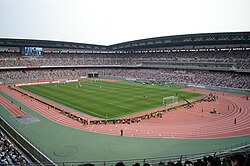
The game was played at the International Stadium in Yokohama, where three other matches in the World Cup were previously held. The stadium was the largest in the tournament as well as the largest in Japan, seating over 70,000 spectators. The aggregate attendance across all World Cup matches at the stadium was 260,000.
The match ball for this game was the Adidas Fevernova, which was specifically made for the World Cup. Its design was different from the normal "Tango" type of three-pointed shapes connecting each hexagon, instead introducing a different, triangle-like shape on four hexagons. This look and colour usage was based on Asian culture. It was manufactured using a syntactic foam layer and Adidas said should give the ball a "more precise and predictable flight path". Adidas said the ball was smaller and heavier than the average permitted circumference and weight, but several players criticised it for being too large and too light. Italian goalkeeper Gianluigi Buffon called the ball "a ridiculous kiddy's bouncing ball," while Brazil's Edílson criticised the ball as being "too big and too light".
In the previous World Cup in 1998, Germany were eliminated by surprise debutants Croatia in the quarter-finals. The team suffered several injuries prior to the 2002 World Cup finals including a knee issue for Sebastian Deisler, who was ruled out two days before the team departed for the tournament with an injury sustained in a friendly match against Austria. Midfielder Mehmet Scholl and defenders Christian Wörns and Jens Nowotny also missed the tournament due to injury. Brazil had reached the final of the 1998 tournament, where they lost 3–0 to France. Between that defeat and 2002, Brazil went through a series of managers. The first was Vanderlei Luxemburgo, whose contract was terminated after the team lost another FIFA final at the Confederations Cup against another host of the tournament at the time Mexico in the final and were eliminated at the quarter-finals of the 2000 Olympic football tournament. He was followed by Émerson Leão, who was dismissed in 2001 after winning four of eleven games in charge and with Brazil at risk of not qualifying for the World Cup for the first time. The incumbent going into the tournament was Luiz Felipe Scolari, who favoured a different style of football from his predecessors which he called "bullyboy soccer". In describing the style, Soccer America's Scott French said "the object is to disrupt and destroy, foul and waste time". The two teams had met previously in several friendlies as well as the 1980 World Champions' Gold Cup, the 1993 U.S. Cup and the 1999 FIFA Confederations Cup – their most recent meeting, which resulted in a 4–0 Brazil win – but the 2002 final was their first meeting at a World Cup.
This final was also the third straight for Brazil, having won the match in 1994, only the second team to do so—after the Germans did that in 1982 (lost), 1986 (lost), and 1990 (won). Brazil were aiming to become the first team to win five world titles, having won the tournament in 1958, 1962, 1970, and 1994. Germany were hoping to become only the second team to win four World Cup titles, having won it as West Germany in 1954, 1974, and 1990.
2002 FIFA World Cup final
The 2002 FIFA World Cup final was the final match of the 2002 World Cup, the 17th edition of FIFA's competition for national football teams. The match was played at the International Stadium in Yokohama, Japan, on 30 June 2002, and was contested by Germany and Brazil. The tournament comprised hosts Japan and South Korea, holders France, and 29 other teams who emerged from the qualification phase, organised by the six FIFA confederations. The 32 teams competed in a group stage, from which 16 teams qualified for the knockout stage. En route to the final, Germany finished first in Group E, with two wins and a draw, after which they defeated Paraguay in the round of 16, the United States in the quarter-finals and South Korea in the semi-finals. Brazil finished top of Group C with three wins, before defeating Belgium in the round of 16, England in the quarter-final, and Turkey in the semi-final. The final took place in front of 69,029 supporters, with an estimated 1.1 billion watching on television, and was refereed by Pierluigi Collina from Italy.
After a goalless first half, Brazil took the lead through Ronaldo on 67 minutes, scoring after what German goalkeeper Oliver Kahn called his "only mistake in the finals". They extended their lead twelve minutes later when Kléberson ran towards the German penalty area before passing towards Rivaldo. He let the ball pass through his legs and it reached Ronaldo, who used his first touch to take the ball away from German player Gerald Asamoah, and then shot the ball into the bottom corner of Kahn's net. The final score was 2–0 to Brazil.
Brazil's win was their fifth World Cup title, which remains a record as of 2025[update]. Ronaldo was named the man of the match, while Kahn was awarded the Golden Ball as FIFA's outstanding player of the tournament. Brazil's manager, Luiz Felipe Scolari, expressed "the joy of knowing we did our job", while noting that it was "full of very hard work". His German counterpart Rudi Völler said, "When you lose a game, the disappointment is great, of course. But it is no shame to lose against a team like Brazil." At the next World Cup in Germany in 2006, Brazil were eliminated in the quarter-final by France while Germany reached the semi-final stage on home soil and eventually finished third.
The 2002 FIFA World Cup was the 17th edition of the World Cup, FIFA's football competition for national teams, held in Japan and South Korea between 31 May and 30 June 2002. The national teams of Japan and South Korea qualified for the finals automatically as tournament hosts, as did the previous hosts France, the winners of the previous World Cup in 1998. The remaining 29 spots were decided through qualifying rounds held between March 2000 and November 2001, organised by the six FIFA confederations and involving 193 teams. In the finals, the teams were divided into eight groups of four with each team playing each other once in a round-robin format. The two top teams from each group advanced to a knock-out stage. Holders France were eliminated in the group stage in 2002, losing games against Senegal and Denmark as they finished bottom of Group A.
The game was played at the International Stadium in Yokohama, where three other matches in the World Cup were previously held. The stadium was the largest in the tournament as well as the largest in Japan, seating over 70,000 spectators. The aggregate attendance across all World Cup matches at the stadium was 260,000.
The match ball for this game was the Adidas Fevernova, which was specifically made for the World Cup. Its design was different from the normal "Tango" type of three-pointed shapes connecting each hexagon, instead introducing a different, triangle-like shape on four hexagons. This look and colour usage was based on Asian culture. It was manufactured using a syntactic foam layer and Adidas said should give the ball a "more precise and predictable flight path". Adidas said the ball was smaller and heavier than the average permitted circumference and weight, but several players criticised it for being too large and too light. Italian goalkeeper Gianluigi Buffon called the ball "a ridiculous kiddy's bouncing ball," while Brazil's Edílson criticised the ball as being "too big and too light".
In the previous World Cup in 1998, Germany were eliminated by surprise debutants Croatia in the quarter-finals. The team suffered several injuries prior to the 2002 World Cup finals including a knee issue for Sebastian Deisler, who was ruled out two days before the team departed for the tournament with an injury sustained in a friendly match against Austria. Midfielder Mehmet Scholl and defenders Christian Wörns and Jens Nowotny also missed the tournament due to injury. Brazil had reached the final of the 1998 tournament, where they lost 3–0 to France. Between that defeat and 2002, Brazil went through a series of managers. The first was Vanderlei Luxemburgo, whose contract was terminated after the team lost another FIFA final at the Confederations Cup against another host of the tournament at the time Mexico in the final and were eliminated at the quarter-finals of the 2000 Olympic football tournament. He was followed by Émerson Leão, who was dismissed in 2001 after winning four of eleven games in charge and with Brazil at risk of not qualifying for the World Cup for the first time. The incumbent going into the tournament was Luiz Felipe Scolari, who favoured a different style of football from his predecessors which he called "bullyboy soccer". In describing the style, Soccer America's Scott French said "the object is to disrupt and destroy, foul and waste time". The two teams had met previously in several friendlies as well as the 1980 World Champions' Gold Cup, the 1993 U.S. Cup and the 1999 FIFA Confederations Cup – their most recent meeting, which resulted in a 4–0 Brazil win – but the 2002 final was their first meeting at a World Cup.
This final was also the third straight for Brazil, having won the match in 1994, only the second team to do so—after the Germans did that in 1982 (lost), 1986 (lost), and 1990 (won). Brazil were aiming to become the first team to win five world titles, having won the tournament in 1958, 1962, 1970, and 1994. Germany were hoping to become only the second team to win four World Cup titles, having won it as West Germany in 1954, 1974, and 1990.
Recent media
Recent media