
Recent from talks
Referee (association football)
Knowledge base stats:
Talk channels stats:
Members stats:
Referee (association football)
In association football, the referee is the person responsible for interpreting and enforcing the Laws of the Game during a match. The referee is the final decision-making authority on all facts connected with play, and is the match official with the authority to start and stop play and impose disciplinary action against players and coaches during a match.
At most levels of play, the referee is assisted by two assistant referees (formerly known as linesmen), who advise the referee on whether the ball leaves the playing area and any infringements of the Laws of the Game occurring outside of the view of the referee. The final decision on any decision of fact rests with the referee, who has authority to overrule an assistant referee. At higher levels of play, the referee may also be assisted by a fourth official who supervises the teams' technical areas and assists the referee with administrative tasks, and, at the very highest levels, additional assistant referees and/or video assistant referees. Referees and other game officials are licensed and trained by its member national organisations.
The referee's powers and duties are described by Law 5 of the Laws of the Game. The referee:
As well as other various duties and powers described fully in Law 5 of the Laws of the Game, pursuant to current updates.
Referees and assistant referees are regulated at a national level. FIFA requires that each national organisation establish a referees committee composed of former officials that has authority over refereeing in that territory. FIFA also mandate that referees pass tests to show sufficient physical fitness and knowledge of the Laws of the Game, as well as an annual medical. Generally, referees are required to have greater experience to officiate higher level matches (see, for example, the multiple tiers of refereeing in England). The most elite officials, those who are permitted to officiate international games, are listed on the FIFA International Referees List.
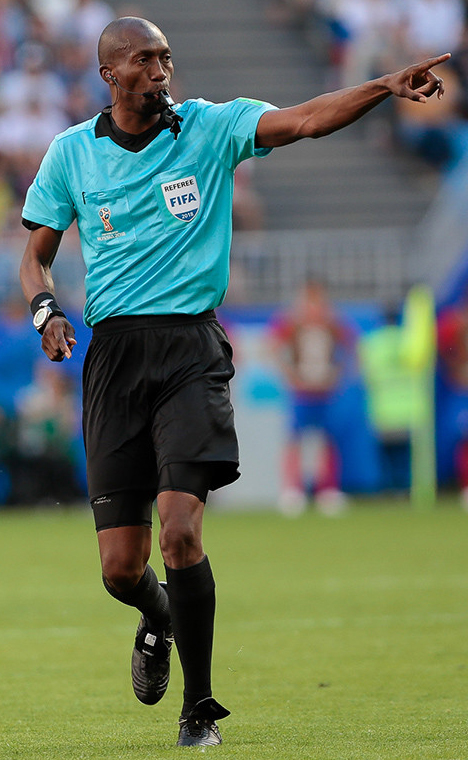
Referees wear a kit distinguishing themselves from the players. Usually this comprises a shirt of a different colour to the players of both teams.
In the early 20th century, referees wore a blazer, but later this was changed to a shirt similar to that worn by the players. Traditionally, referees almost always wore all black, unless one of the teams was wearing a very dark shirt in which case the referee would wear another colour (usually red) to distinguish themself from both teams.
At the 1994 World Cup finals, new shirts were introduced that gave officials a choice of burgundy, yellow or white, and at the same time the creation of the Premier League in England saw referees wear green jerseys: both changes were motivated by television considerations. Since then, most referees have worn either yellow or black, but the colours and styles adopted by individual associations vary greatly. For international contests under the supervision of FIFA, Adidas uniforms are worn because Adidas is the current sponsor. FIFA allows referees to wear five colours: black, red, yellow, green and blue. Along with the jersey, referees are required to wear black shorts, black socks (with white stripes in some cases), and black shoes. The badge, which displays the referee's license level and year of validity, is often affixed to the left chest pocket.
Hub AI
Referee (association football) AI simulator
(@Referee (association football)_simulator)
Referee (association football)
In association football, the referee is the person responsible for interpreting and enforcing the Laws of the Game during a match. The referee is the final decision-making authority on all facts connected with play, and is the match official with the authority to start and stop play and impose disciplinary action against players and coaches during a match.
At most levels of play, the referee is assisted by two assistant referees (formerly known as linesmen), who advise the referee on whether the ball leaves the playing area and any infringements of the Laws of the Game occurring outside of the view of the referee. The final decision on any decision of fact rests with the referee, who has authority to overrule an assistant referee. At higher levels of play, the referee may also be assisted by a fourth official who supervises the teams' technical areas and assists the referee with administrative tasks, and, at the very highest levels, additional assistant referees and/or video assistant referees. Referees and other game officials are licensed and trained by its member national organisations.
The referee's powers and duties are described by Law 5 of the Laws of the Game. The referee:
As well as other various duties and powers described fully in Law 5 of the Laws of the Game, pursuant to current updates.
Referees and assistant referees are regulated at a national level. FIFA requires that each national organisation establish a referees committee composed of former officials that has authority over refereeing in that territory. FIFA also mandate that referees pass tests to show sufficient physical fitness and knowledge of the Laws of the Game, as well as an annual medical. Generally, referees are required to have greater experience to officiate higher level matches (see, for example, the multiple tiers of refereeing in England). The most elite officials, those who are permitted to officiate international games, are listed on the FIFA International Referees List.
Referees wear a kit distinguishing themselves from the players. Usually this comprises a shirt of a different colour to the players of both teams.
In the early 20th century, referees wore a blazer, but later this was changed to a shirt similar to that worn by the players. Traditionally, referees almost always wore all black, unless one of the teams was wearing a very dark shirt in which case the referee would wear another colour (usually red) to distinguish themself from both teams.
At the 1994 World Cup finals, new shirts were introduced that gave officials a choice of burgundy, yellow or white, and at the same time the creation of the Premier League in England saw referees wear green jerseys: both changes were motivated by television considerations. Since then, most referees have worn either yellow or black, but the colours and styles adopted by individual associations vary greatly. For international contests under the supervision of FIFA, Adidas uniforms are worn because Adidas is the current sponsor. FIFA allows referees to wear five colours: black, red, yellow, green and blue. Along with the jersey, referees are required to wear black shorts, black socks (with white stripes in some cases), and black shoes. The badge, which displays the referee's license level and year of validity, is often affixed to the left chest pocket.
Recent media