


Community hub
Recent from talks
Contribute something to knowledge base
Content stats: 0 posts, 0 articles, 1 media, 0 notes
Members stats: 0 subscribers, 0 contributors, 0 moderators, 0 supporters
Subscribers
Supporters
Contributors
Moderators
Hub AI
2004 Boscastle flood AI simulator
(@2004 Boscastle flood_simulator)
Hub AI
2004 Boscastle flood AI simulator
(@2004 Boscastle flood_simulator)
2004 Boscastle flood
The 2004 Boscastle flood occurred on Monday 16 August 2004 in the villages of Boscastle and Crackington Haven on the north-west coast of Cornwall, England, UK. The villages suffered extensive damage after eight hours of exceptionally heavy rain caused flash floods. The flooding in Boscastle was filmed and extensively reported, but the floods in Crackington Haven and Rocky Valley were not mentioned beyond the local news. The floods were the worst in local memory. A study commissioned by the Environment Agency from hydraulics consulting firm HR Wallingford concluded that the flooding was among the most extreme ever experienced in Britain. The cost of the damage was estimated to be £50 million.
The last time Boscastle had suffered notable flooding was in 1996, as a result of Hurricane Lili. Floods are recorded in 1847, 1957, on 3 June 1958 (one man drowned) and on 6 February 1963 during the Winter of 1962–63 in the United Kingdom. On 16 August 1952, 52 years to the day before Boscastle's 2004 flood, the small town of Lynmouth, 50 miles (80 km) to the north-east on the north coast in Devon, near Exmoor, had suffered extensive damage in a catastrophic flood in which 34 people lost their lives.
At midday on 16 August 2004, heavy thundery showers had developed across the South West "as a result of a weak disturbance" to the northeast of the United Kingdom. A "great black wedge of cloud," a "seven-mile deep flank of cumulonimbus", appeared in a clear blue sky and took up position on the high ground over the Valency valley above Boscastle. According to David Crichton, Visiting Professor at the Benfield Hazard Research Centre at University College, London, "Westerly winds carrying the remnants of Hurricane Alex, which had picked up vast amounts of water from the Atlantic, hit the peninsula of Cornwall from the sea to the north and south and converged over the hills, pushing clouds up to 40,000 feet high and producing a prolonged stationary thunderstorm." Warm air which was picking up moisture as a result of residual heat from the Atlantic Ocean had moved towards the Cornish coast as prevailing winds. When the winds met the topographically vertical coast they experienced a strong updraft, which caused internal moisture to rise and then cool into a string of storm clouds. Convergence and coalescence of the enhanced moisture levels produced heavy rainfall.
By 1:15pm the rain was torrential. 185mm (7 inches) of rain fell on high ground inland from Boscastle and at the peak of the downpour, at about 15:40 GMT, 24.1mm of rain (almost one inch) was recorded as falling in 15 minutes at Lesnewth, 2.5 miles (4 km) up the valley. In Boscastle, 89 millimetres (3.5 in) of rain was recorded in 60 minutes. The rain was very localised: Otterham and Lesnewth, both a few miles inland from Boscastle, recorded 24-hour totals of 200mm and 185mm respectively on the day, whereas four of the nearest 10 rain gauges showed less than 3mm of rain in the same period.
The torrential rainfall caused a 2 m (7 ft) rise in river levels in one hour. By 3:30pm the river was level with its banks; by 3:45pm it was a raging torrent and had burst its banks. By 4pm cars were being carried down in the flood from the visitors' car park. The force of thousands of tons of water carrying rocks and debris started to demolish buildings. A 3 m (10 ft) wave, believed to have been triggered by water pooling behind debris caught under a bridge and then being suddenly released as the bridge collapsed, surged down the main road into the village. The first lifeboat on the scene, from Port Isaac, encountered a wall of water pushing about 50 cars ahead of it down to the sea. Residents and visitors were trapped in buildings which were being battered by the torrent, in cars and in trees. The Valency river was now a 50-yard-wide, 15 feet deep torrent.
Water speed was over 4 m/s (10 mph), more than enough to cause severe structural damage. It is estimated that 20,000,000 cubic metres (5.3×10⁹ US gal) of water flowed through Boscastle. The steep-sided valley and saturated surface ensured a high amount of surface run-off. Changes in farming practice in the area may also possibly have contributed, and a reduction in trees and hedges higher up the valley would have allowed water to flow through more quickly.[citation needed] The peak flow was about 140 m3/s, between 5:00pm and 6:00pm BST. The chance of this or a greater flood happening in any one year is about 1 in 400. The probability each year of the heaviest three-hour rainfall is about 1 in 1300, although rainfall probability is not the same as flood probability.
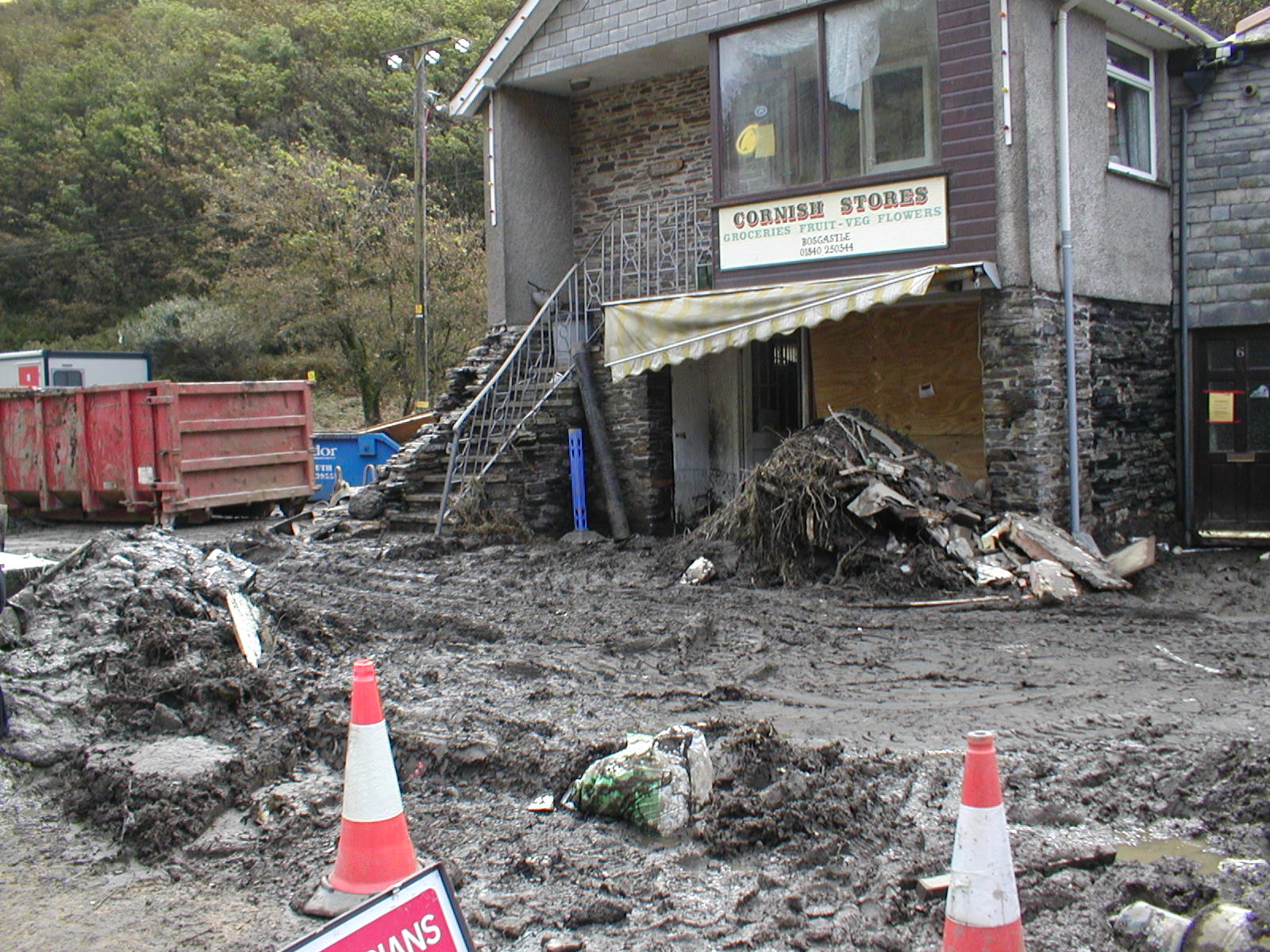
No one died in the flood. 79 cars, five caravans, six buildings and several boats were washed into the sea. 60 properties were flooded in Boscastle and approximately 40 others in Canworthy Water, Bude, Helebridge and Crackington Haven. Approximately 100 homes and businesses were destroyed and some had to be demolished. Trees were uprooted and debris was scattered over a large area. Four bridges were washed away. Emergency staff at Cornwall County Council received more than 100 calls in the afternoon, rising to 170 in the early evening, from residents and visitors trapped by the water. In an operation lasting from mid-afternoon until 2:30am, a fleet of seven Westland Sea King helicopters, from RAF Chivenor, Royal Naval Air Station at Culdrose, RAF St Mawgan near Newquay, and a Coastguard helicopter from Portland, Dorset, rescued about 150 people who were clinging to trees and the roofs of buildings and cars. No major injuries or loss of life were reported. The estimated cost of damage was £15 million. The disaster became worldwide news within hours and made headlines in countries including the US, Canada, Australia, New Zealand, France, India and China. The next day, Falmouth Coastguards had to broadcast warnings to shipping in the area because there were cars, fridges and other items floating up the coast between Boscastle and Hartland Point.
Most of the ensuing repair work took place in the winter season (October–May), during the off-season. The car park was reduced to half-capacity (120 spaces) in winter, in order for works to take place, and returned to 240 spaces in the summer.
2004 Boscastle flood
The 2004 Boscastle flood occurred on Monday 16 August 2004 in the villages of Boscastle and Crackington Haven on the north-west coast of Cornwall, England, UK. The villages suffered extensive damage after eight hours of exceptionally heavy rain caused flash floods. The flooding in Boscastle was filmed and extensively reported, but the floods in Crackington Haven and Rocky Valley were not mentioned beyond the local news. The floods were the worst in local memory. A study commissioned by the Environment Agency from hydraulics consulting firm HR Wallingford concluded that the flooding was among the most extreme ever experienced in Britain. The cost of the damage was estimated to be £50 million.
The last time Boscastle had suffered notable flooding was in 1996, as a result of Hurricane Lili. Floods are recorded in 1847, 1957, on 3 June 1958 (one man drowned) and on 6 February 1963 during the Winter of 1962–63 in the United Kingdom. On 16 August 1952, 52 years to the day before Boscastle's 2004 flood, the small town of Lynmouth, 50 miles (80 km) to the north-east on the north coast in Devon, near Exmoor, had suffered extensive damage in a catastrophic flood in which 34 people lost their lives.
At midday on 16 August 2004, heavy thundery showers had developed across the South West "as a result of a weak disturbance" to the northeast of the United Kingdom. A "great black wedge of cloud," a "seven-mile deep flank of cumulonimbus", appeared in a clear blue sky and took up position on the high ground over the Valency valley above Boscastle. According to David Crichton, Visiting Professor at the Benfield Hazard Research Centre at University College, London, "Westerly winds carrying the remnants of Hurricane Alex, which had picked up vast amounts of water from the Atlantic, hit the peninsula of Cornwall from the sea to the north and south and converged over the hills, pushing clouds up to 40,000 feet high and producing a prolonged stationary thunderstorm." Warm air which was picking up moisture as a result of residual heat from the Atlantic Ocean had moved towards the Cornish coast as prevailing winds. When the winds met the topographically vertical coast they experienced a strong updraft, which caused internal moisture to rise and then cool into a string of storm clouds. Convergence and coalescence of the enhanced moisture levels produced heavy rainfall.
By 1:15pm the rain was torrential. 185mm (7 inches) of rain fell on high ground inland from Boscastle and at the peak of the downpour, at about 15:40 GMT, 24.1mm of rain (almost one inch) was recorded as falling in 15 minutes at Lesnewth, 2.5 miles (4 km) up the valley. In Boscastle, 89 millimetres (3.5 in) of rain was recorded in 60 minutes. The rain was very localised: Otterham and Lesnewth, both a few miles inland from Boscastle, recorded 24-hour totals of 200mm and 185mm respectively on the day, whereas four of the nearest 10 rain gauges showed less than 3mm of rain in the same period.
The torrential rainfall caused a 2 m (7 ft) rise in river levels in one hour. By 3:30pm the river was level with its banks; by 3:45pm it was a raging torrent and had burst its banks. By 4pm cars were being carried down in the flood from the visitors' car park. The force of thousands of tons of water carrying rocks and debris started to demolish buildings. A 3 m (10 ft) wave, believed to have been triggered by water pooling behind debris caught under a bridge and then being suddenly released as the bridge collapsed, surged down the main road into the village. The first lifeboat on the scene, from Port Isaac, encountered a wall of water pushing about 50 cars ahead of it down to the sea. Residents and visitors were trapped in buildings which were being battered by the torrent, in cars and in trees. The Valency river was now a 50-yard-wide, 15 feet deep torrent.
Water speed was over 4 m/s (10 mph), more than enough to cause severe structural damage. It is estimated that 20,000,000 cubic metres (5.3×10⁹ US gal) of water flowed through Boscastle. The steep-sided valley and saturated surface ensured a high amount of surface run-off. Changes in farming practice in the area may also possibly have contributed, and a reduction in trees and hedges higher up the valley would have allowed water to flow through more quickly.[citation needed] The peak flow was about 140 m3/s, between 5:00pm and 6:00pm BST. The chance of this or a greater flood happening in any one year is about 1 in 400. The probability each year of the heaviest three-hour rainfall is about 1 in 1300, although rainfall probability is not the same as flood probability.
No one died in the flood. 79 cars, five caravans, six buildings and several boats were washed into the sea. 60 properties were flooded in Boscastle and approximately 40 others in Canworthy Water, Bude, Helebridge and Crackington Haven. Approximately 100 homes and businesses were destroyed and some had to be demolished. Trees were uprooted and debris was scattered over a large area. Four bridges were washed away. Emergency staff at Cornwall County Council received more than 100 calls in the afternoon, rising to 170 in the early evening, from residents and visitors trapped by the water. In an operation lasting from mid-afternoon until 2:30am, a fleet of seven Westland Sea King helicopters, from RAF Chivenor, Royal Naval Air Station at Culdrose, RAF St Mawgan near Newquay, and a Coastguard helicopter from Portland, Dorset, rescued about 150 people who were clinging to trees and the roofs of buildings and cars. No major injuries or loss of life were reported. The estimated cost of damage was £15 million. The disaster became worldwide news within hours and made headlines in countries including the US, Canada, Australia, New Zealand, France, India and China. The next day, Falmouth Coastguards had to broadcast warnings to shipping in the area because there were cars, fridges and other items floating up the coast between Boscastle and Hartland Point.
Most of the ensuing repair work took place in the winter season (October–May), during the off-season. The car park was reduced to half-capacity (120 spaces) in winter, in order for works to take place, and returned to 240 spaces in the summer.
Recent media
Recent media