
Recent from talks
2012 Bahrain Grand Prix protests
Knowledge base stats:
Talk channels stats:
Members stats:
2012 Bahrain Grand Prix protests
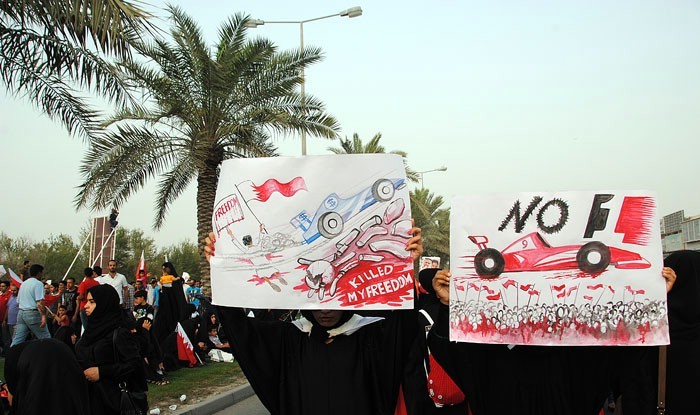
The 2012 Bahrain Grand Prix returned to Bahrain after the 2011 race was cancelled due to anti-government protests.
The decision to hold the race despite ongoing, during the race, protests and violence has been described as "controversial" by Al Jazeera English, CNN, AFP and Sky News. The Independent named it "one of the most controversial in the history of the sport".
The 2011 Bahrain Grand Prix was cancelled due to civil unrest on 21 February 2011 at the request of Crown Prince Salman bin Hamad bin Isa Al Khalifa and the Bahrain Motor Federation. One month after an attempt by the FIA World Motor Sport Council to reinstate the race with an October date failed, the FIA released a provisional calendar for the 2012 season, re-instating the Bahrain Grand Prix. The event was originally given a November date so as to allow for stability to return to the country. A second provisional calendar was released in July, with the Bahrain Grand Prix brought forward to 22 April. This was later confirmed with the release of the final season calendar in December 2011.
With pre-season testing for the 2012 season starting in February 2012, the future of the Bahrain Grand Prix became the focus of renewed speculation. Several teams expressed concern over the state of the country as early as the 2011 Japanese Grand Prix, while the Bahrain Centre for Human Rights urged the teams to boycott the race amid renewed political disturbances in the country, claiming that the Bahrain government was attempting to use the race to present the country as being stable. Bernie Ecclestone maintained his stance on the race going ahead, while 1996 World Champion Damon Hill stated his belief that Formula One could return to Bahrain "with a clear conscience" after visiting the country. However, Hill changed his stance just two weeks later, stating that the race could "create more problems than it solved". He elaborated further, cautioning against "indifference" and urging the sport not to take political sides. Fellow former World Champion Jackie Stewart expressed his support for the race taking place, warning that cancelling the Grand Prix could be even more damaging to the sport than holding it.
"The FIA, like many in the diplomatic community in the kingdom, the main political opposition [...] believes the staging of a Grand Prix would be beneficial in bridging some of the difficulties Bahrain is experiencing. The FIA is not in a position to influence political matters in a sovereign country such as Bahrain and we can only wish for a long-term peaceful solution."
"What we must put above all else is what will be the penalty in terms of human cost if the race goes ahead. It would be a bad state of affairs, and bad for Formula One, to be seen to be enforcing martial law in order to hold the race. That is not what this sport should be about."
"You've got to be very careful because if you were to say the Bahrain Grand Prix should not take place, then will there be pressure on Russia, for example, for the Winter Olympics when they come round in 2014? Will there be demonstrations because Russia is still trying to create democracy? [...] You've got to be very careful. If this race is cancelled then I think it is a very backward position to have in sport. We have already got a model in Northern Ireland where football continued to be played and so did rugby and so did motorcycling."
In January 2012, human rights groups in the country urged teams to boycott the 2012 race amid ongoing conflict in the country. In February, a protest organisation calling itself the February 14 Youth Coalition wrote to Bernie Ecclestone, threatening to "do everything in [their] capacity to ensure the failure of the race" if it went ahead. They further added they could not guarantee the safety of teams, drivers, and spectators if the race went ahead. Ecclestone was unconcerned about the threat, stating he did not feel the protesters needed to resort to violence, and expressing confidence event organisers would not respond to any opposition with force. World Drivers' Champions Sebastian Vettel and Michael Schumacher also supported the race going ahead.
Hub AI
2012 Bahrain Grand Prix protests AI simulator
(@2012 Bahrain Grand Prix protests_simulator)
2012 Bahrain Grand Prix protests
The 2012 Bahrain Grand Prix returned to Bahrain after the 2011 race was cancelled due to anti-government protests.
The decision to hold the race despite ongoing, during the race, protests and violence has been described as "controversial" by Al Jazeera English, CNN, AFP and Sky News. The Independent named it "one of the most controversial in the history of the sport".
The 2011 Bahrain Grand Prix was cancelled due to civil unrest on 21 February 2011 at the request of Crown Prince Salman bin Hamad bin Isa Al Khalifa and the Bahrain Motor Federation. One month after an attempt by the FIA World Motor Sport Council to reinstate the race with an October date failed, the FIA released a provisional calendar for the 2012 season, re-instating the Bahrain Grand Prix. The event was originally given a November date so as to allow for stability to return to the country. A second provisional calendar was released in July, with the Bahrain Grand Prix brought forward to 22 April. This was later confirmed with the release of the final season calendar in December 2011.
With pre-season testing for the 2012 season starting in February 2012, the future of the Bahrain Grand Prix became the focus of renewed speculation. Several teams expressed concern over the state of the country as early as the 2011 Japanese Grand Prix, while the Bahrain Centre for Human Rights urged the teams to boycott the race amid renewed political disturbances in the country, claiming that the Bahrain government was attempting to use the race to present the country as being stable. Bernie Ecclestone maintained his stance on the race going ahead, while 1996 World Champion Damon Hill stated his belief that Formula One could return to Bahrain "with a clear conscience" after visiting the country. However, Hill changed his stance just two weeks later, stating that the race could "create more problems than it solved". He elaborated further, cautioning against "indifference" and urging the sport not to take political sides. Fellow former World Champion Jackie Stewart expressed his support for the race taking place, warning that cancelling the Grand Prix could be even more damaging to the sport than holding it.
"The FIA, like many in the diplomatic community in the kingdom, the main political opposition [...] believes the staging of a Grand Prix would be beneficial in bridging some of the difficulties Bahrain is experiencing. The FIA is not in a position to influence political matters in a sovereign country such as Bahrain and we can only wish for a long-term peaceful solution."
"What we must put above all else is what will be the penalty in terms of human cost if the race goes ahead. It would be a bad state of affairs, and bad for Formula One, to be seen to be enforcing martial law in order to hold the race. That is not what this sport should be about."
"You've got to be very careful because if you were to say the Bahrain Grand Prix should not take place, then will there be pressure on Russia, for example, for the Winter Olympics when they come round in 2014? Will there be demonstrations because Russia is still trying to create democracy? [...] You've got to be very careful. If this race is cancelled then I think it is a very backward position to have in sport. We have already got a model in Northern Ireland where football continued to be played and so did rugby and so did motorcycling."
In January 2012, human rights groups in the country urged teams to boycott the 2012 race amid ongoing conflict in the country. In February, a protest organisation calling itself the February 14 Youth Coalition wrote to Bernie Ecclestone, threatening to "do everything in [their] capacity to ensure the failure of the race" if it went ahead. They further added they could not guarantee the safety of teams, drivers, and spectators if the race went ahead. Ecclestone was unconcerned about the threat, stating he did not feel the protesters needed to resort to violence, and expressing confidence event organisers would not respond to any opposition with force. World Drivers' Champions Sebastian Vettel and Michael Schumacher also supported the race going ahead.
Recent media