
Recent from talks
24th United States Congress
Knowledge base stats:
Talk channels stats:
Members stats:
24th United States Congress
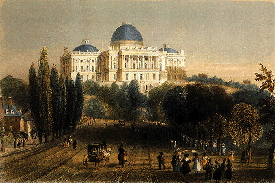
The 24th United States Congress was a meeting of the legislative branch of the United States federal government, consisting of the United States Senate and the United States House of Representatives. It met in Washington, D.C. from March 4, 1835, to March 4, 1837, during the seventh and eighth years of Andrew Jackson's presidency. The apportionment of seats in the House of Representatives was based on the 1830 United States census. Both chambers had a Jacksonian majority.
Throughout 1835, relations between the United States and France reached an all-time low. Andrew Jackson had America's ambassador to France travel aboard a gunboat and after negotiations broke down had the American ambassador recalled back to the United States and forced the French ambassador to leave. President Jackson and the French government traded threats and insults throughout the duration of the year. In this conflict, President Jackson got support from many members of the House of Representatives.
In late November 1835, Linn Boyd, Albert G. Hawes, Richard M. Johnson, John E. Coffee, Seaton Grantland, Charles Eaton Haynes, Jabez Young Jackson, George Welshman Owens, Thomas Glascock, William Schley, Reuben Chapman, Joshua L. Martin, Joab Lawler, Jesse Atherton Bynum, Jesse Speight, James Iver McKay, Micajah Thomas Hawkins, William Montgomery, Henry William Connor and James Rogers (congressman) all put in writing that if President Jackson were to ask for a formal declaration of war on France, he would have their full support. Shortly after this when the government of the United Kingdom sought to intervene, the same twenty Congressmen signed a letter stating that they welcomed the "wholesome and moderating influence" of British Prime Minister William Lamb, 2nd Viscount Melbourne, British foreign secretary Henry John Temple, 3rd Viscount Palmerston and the British Secretary of State for War and the Colonies Charles Grant, 1st Baron Glenelg, who the letter referred to as "our thoughtful cousins." The same document referred to the France's leader Louis Philippe I as "dastardly and pusinallimous."
Senators Bedford Brown, Robert J. Walker, Felix Grundy, John Pendleton King and Alfred Cuthbert all wrote to President Jackson saying that they felt the same way as the aforementioned twenty members of the house "with respects to our relations with Britain and France" and "any potential war" that might break out between the United States and France. In a series of popular outbursts in July 1836, effigies of Louis Philippe I were burnt in Georgia, South Carolina, North Carolina, Kentucky, Tennessee, Alabama and Mississippi.
In October 1836, it became known the French were "backing down," celebrations that were "overtly triumphant" and "distinctly anti-French" were held throughout Kentucky, Tennessee, North Carolina, Georgia, Alabama and Mississippi during the last two weeks of October 1836.
The count below identifies party affiliations at the beginning of the first session of this congress. Changes resulting from subsequent replacements are shown below in the "Changes in membership" section.
National Republicans held the Senate in the first Congressional session; Jacksonians flipped the Senate before the start of the second Congressional session and held that Senate majority for the remainder of the Congressional term.
During this congress two Senate seats were added for each of the new states of Arkansas and Michigan.
Hub AI
24th United States Congress AI simulator
(@24th United States Congress_simulator)
24th United States Congress
The 24th United States Congress was a meeting of the legislative branch of the United States federal government, consisting of the United States Senate and the United States House of Representatives. It met in Washington, D.C. from March 4, 1835, to March 4, 1837, during the seventh and eighth years of Andrew Jackson's presidency. The apportionment of seats in the House of Representatives was based on the 1830 United States census. Both chambers had a Jacksonian majority.
Throughout 1835, relations between the United States and France reached an all-time low. Andrew Jackson had America's ambassador to France travel aboard a gunboat and after negotiations broke down had the American ambassador recalled back to the United States and forced the French ambassador to leave. President Jackson and the French government traded threats and insults throughout the duration of the year. In this conflict, President Jackson got support from many members of the House of Representatives.
In late November 1835, Linn Boyd, Albert G. Hawes, Richard M. Johnson, John E. Coffee, Seaton Grantland, Charles Eaton Haynes, Jabez Young Jackson, George Welshman Owens, Thomas Glascock, William Schley, Reuben Chapman, Joshua L. Martin, Joab Lawler, Jesse Atherton Bynum, Jesse Speight, James Iver McKay, Micajah Thomas Hawkins, William Montgomery, Henry William Connor and James Rogers (congressman) all put in writing that if President Jackson were to ask for a formal declaration of war on France, he would have their full support. Shortly after this when the government of the United Kingdom sought to intervene, the same twenty Congressmen signed a letter stating that they welcomed the "wholesome and moderating influence" of British Prime Minister William Lamb, 2nd Viscount Melbourne, British foreign secretary Henry John Temple, 3rd Viscount Palmerston and the British Secretary of State for War and the Colonies Charles Grant, 1st Baron Glenelg, who the letter referred to as "our thoughtful cousins." The same document referred to the France's leader Louis Philippe I as "dastardly and pusinallimous."
Senators Bedford Brown, Robert J. Walker, Felix Grundy, John Pendleton King and Alfred Cuthbert all wrote to President Jackson saying that they felt the same way as the aforementioned twenty members of the house "with respects to our relations with Britain and France" and "any potential war" that might break out between the United States and France. In a series of popular outbursts in July 1836, effigies of Louis Philippe I were burnt in Georgia, South Carolina, North Carolina, Kentucky, Tennessee, Alabama and Mississippi.
In October 1836, it became known the French were "backing down," celebrations that were "overtly triumphant" and "distinctly anti-French" were held throughout Kentucky, Tennessee, North Carolina, Georgia, Alabama and Mississippi during the last two weeks of October 1836.
The count below identifies party affiliations at the beginning of the first session of this congress. Changes resulting from subsequent replacements are shown below in the "Changes in membership" section.
National Republicans held the Senate in the first Congressional session; Jacksonians flipped the Senate before the start of the second Congressional session and held that Senate majority for the remainder of the Congressional term.
During this congress two Senate seats were added for each of the new states of Arkansas and Michigan.
Recent media