Recent from talks
Nothing was collected or created yet.
2nd Chapter of Acts
View on Wikipedia
This article may rely excessively on sources too closely associated with the subject, potentially preventing the article from being verifiable and neutral. (April 2020) |
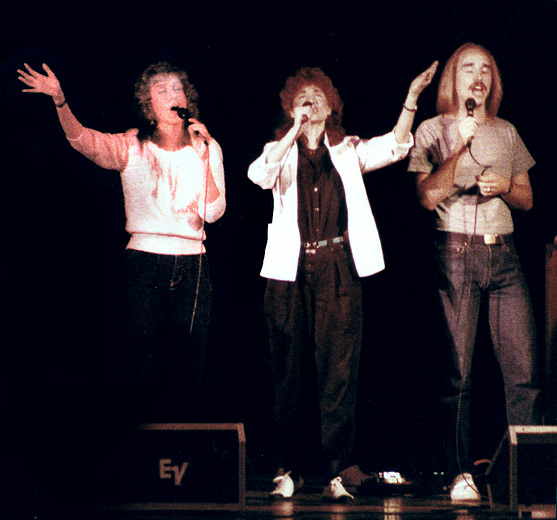
The 2nd Chapter of Acts was a Jesus music and early contemporary Christian music group composed of sisters Annie Herring and Nelly Greisen and brother Matthew Ward. They began performing in 1972[1] and enjoyed their period of greatest success during the 1970s. The group disbanded in 1988.
Key Information
History
[edit]The 2nd Chapter of Acts began as a result of the trio singing at home together as Annie played the piano. Following the death of their parents (Elizabeth in 1968 and Walter Ward in 1970),[2] Nelly and Matthew, still minors, moved in with their older sister, Annie, and her husband, recording engineer and producer, Buck Herring.[3] Annie was a self-taught singer and songwriter who composed and played her songs around the family piano. Her brother and sister would often join in as she played, and eventually they developed extremely tight and intricate harmonies.[4][5]
They started singing for local coffee houses and small gatherings, then gained the notice of Pat Boone who arranged a contract to record and release two singles with MGM, "Jesus Is" (1972) and "I'm So Happy" (1973). The fledgling trio also came to the attention of 1960s folk singer Barry McGuire, who had recently become a Christian and was preparing to record his first Christian music album, produced by Buck Herring. The siblings provided background vocals for Seeds and McGuire's 1974 follow-up Lighten Up.
The trio released their debut album, With Footnotes, in 1974. This album featured "Easter Song" which would become a signature piece for the group and has been recorded by many other artists since. This was followed up with In the Volume of the Book in 1975, the year that also saw the release of a live album with Barry McGuire, To the Bride, which included "a band called David", who supported 2nd Chapter of Acts on tour. 2nd Chapter of Acts' first three releases were issued by Myrrh Records, and the group toured with McGuire intermittently for three years.
The group went on a touring hiatus in 1976. Annie released her first solo record on the Sparrow Records label founded that year by the executive who had signed them to the Myrrh label, Billy Ray Hearn. For the summer of 1977, they were joined on an 18-city tour by Phil Keaggy and the result was the live triple album, How the West Was One. Their contract with Myrrh fulfilled, they moved as a group to Sparrow.[5]
Their Sparrow debut, Mansion Builder (1978) was followed up with The Roar of Love (1980) (a concept album inspired by C. S. Lewis' The Lion, the Witch, and the Wardrobe), Rejoice (1981), Singer Sower (1983), and Together Live (1983) (with Michael and Stormie Omartian). 2nd Chapter moved to their own Live Oak label with the release of Night Light in 1985, and their final recording of original material, Faraway Places in 1987.
Their voices can be heard among other Christian artists on two benefit singles in 1985. Do Something Now! credited to The Cause on Sparrow Records to aid famine relief in Africa and Fight the Fight, Rescue the Unborn which featured over 100 Christian artists, to benefit the Christian Pro-Life Movement, released on Live Oak.
2nd Chapter of Acts broadened their appeal with the release of Hymns and Hymns 2, reaching audiences with more traditional music. Hymns proved to be their best-selling release, receiving a Dove Award for "Best Praise and Worship Album of the Year" in 1987.[6]
Except for two sabbatical years in 1976 and 1983, 2nd Chapter of Acts continued to tour until 1988. Their final concert was in Houston, Texas on August 12 of that year.[5]
2nd Chapter was recognized by the Gospel Music Association in 1999 by their induction into its Gospel Music Hall of Fame.[7]
Annie and Matthew also recorded several solo projects during the 2nd Chapter of Acts years. Both have continued to release new material and perform concerts as of 2011.
Roles of group members
[edit]Annie was the main songwriter of the group and the only one who played an instrument (piano). Her admittedly unschooled compositional style, with its frequent irregular rhythms, sometimes added almost progressive rock-like elements to what was otherwise an easy listening or soft-rock sound. Matthew and Nelly initially made the occasional small contribution to the lyrics, and Matthew developed as a songwriter for the group as his solo career grew.
Annie and Matthew sang most of the solo parts. Nelly — whose voice could be hard to distinguish from Annie's — most commonly sang lead only on songs where each member took a verse. Other songs where she sang lead were "I Don't Wanna Go Home," "Make My Life a Prayer to You," "Mountain Tops," "My Jesus I Love Thee" and "Sing Over Me." Some of the group's albums, such as The Roar of Love and Night Light, do not have any lead vocals by her.
Discography
[edit]Albums
[edit]- 1974: With Footnotes (Myrrh)
- 1975: In the Volume of the Book (Myrrh)
- 1975: To the Bride (two LPs; with Barry McGuire and "a band called David") (Myrrh). Most of this is by McGuire. The 2nd Chapter's section — one side plus two songs — consists mostly of songs they never released anywhere else.
- 1976: Firewind (a "dramatic musical" based on Acts chapters 1–4) featuring Barry McGuire, Anne Herring, Terry Talbot, John Talbot, Nelly Ward, Keith Green and Matthew Ward, with narration by David Young (Sparrow SPR 1004)
- 1977: How the West Was One (Three LPs; with Phil Keaggy and "a band called David") (Myrrh). Half of this was by 2nd Chapter, half by Phil Keaggy. It was later reissued on two CDs.
- 1978: Mansion Builder (Sparrow Records)
- 1980: The Roar of Love (Sparrow)
- 1981: Rejoice (Sparrow)
- 1983: Singer Sower (Sparrow)
- 1983: Together Live (Two LPs; with Michael and Stormie Omartian) (Sparrow). One side plus one song was by the Omartians; the rest was by 2nd Chapter. It includes one 2nd Chapter song that was never released anywhere else. This is the only 2nd Chapter album that has never been released on CD.
- 1985: Night Light (Live Oak Records)
- 1986: Hymns (Live Oak Records)
- 1987: Far Away Places (Live Oak Records)
- 1988: Hymns II (Live Oak Records)
- 1989: Hymns Instrumental (Live Oak Records)
Compilations
[edit]- 1981: Encores (Myrrh)
- 1992: 20 (Navarre) [includes early singles and 2 previously unreleased songs] Issued on two CDs or two cassettes.
- 2006: Very Best of 2nd Chapter of Acts
Video
[edit]- 1983: Together Live [with Michael and Stormie Omartian] (Sparrow)
- 1998: First Love Various Artists
Footnotes
[edit]- ^ Matthew Ward (2010). My Second Chapter The Matthew Ward Story. Crown Publishing Group. pp. 63–67. ISBN 9780307550569.
- ^ Booklet included with compilation 20 (1992), chapter "Simple Faith", section "Trouble at Home".
- ^ "Matthew Ward Biography: 2nd Chapter of Acts". Archived from the original on June 10, 2004. Retrieved April 6, 2020.
- ^ Powell, Mark Allan (2002). Encyclopedia of Contemporary Christian Music. Peabody, Massachusetts: Hendrickson Publishers. p. 801. ISBN 1-56563-679-1.
2nd Chapter was better than any of those groups--they had a more consistent songeriter, stronger vocals and, especially, tighter harmonies
- ^ a b c "The Frame Never Outdid the Picture: The 2nd Chapter of Acts Story". 2ndchapterofacts.com. Archived from the original on September 27, 2011. Retrieved November 29, 2011.
- ^ "Dove Award History Artist". Doveawards.com. Archived from the original on June 5, 2012. Retrieved November 29, 2011.
- ^ "Gospel Music Hall of Fame: Year of 1999". Gmahalloffame.org. Archived from the original on September 29, 2011. Retrieved November 29, 2011.
External links
[edit]2nd Chapter of Acts
View on GrokipediaHistory
Formation and Early Influences
The 2nd Chapter of Acts was formed by siblings Annie Ward (later Herring), Nelly Ward (later Greisen), and Matthew Ward in the early 1970s in Los Angeles, California, following profound family losses that drew them toward Christian faith and music as outlets for healing.[2][4] Their mother, Elizabeth, died of a brain tumor in 1968, when Matthew was 10 and Nelly 12; their father, Walter, passed away in 1970, prompting Nelly and Matthew to relocate from relatives' homes to live with their older sister Annie and her husband, Buck Herring.[1][2] The family had roots in rural North Dakota, where music was a staple—Annie performed publicly as early as age 5—and they relocated to California in the 1950s for Elizabeth's health.[1] Annie's conversion to Christianity in 1969, spurred by Buck's influence amid her prior experimentation with drugs and mysticism, marked a pivotal shift; the siblings began harmonizing spontaneously around an old upright piano in her home, with Annie composing and playing self-taught songs rooted in their emerging faith.[1][2] This intimate practice evolved into informal gatherings that served as emotional release, as Matthew later described: "We were just singing to the Lord and it was a way of releasing our pain."[2] By 1972, word of their vocal blend spread through friends, leading to initial performances in local churches and Christian coffeehouses, where their natural three-part harmonies—honed from childhood family singing—resonated with audiences in the burgeoning Jesus Movement.[1][4] Early momentum built through connections in the contemporary Christian scene: the group provided background vocals for Barry McGuire's 1970s album Seeds, and McGuire mentored them on engaging crowds, facilitating tours starting in Sacramento.[1][4] Their debut recording, the single "Jesus Is," was cut in 1972 for MGM Records—coinciding with Matthew's 13th birthday—and achieved Top 10 status on California charts, though the label's secular orientation created mismatches for their explicitly faith-driven content.[1][4] Influences included the raw, testimony-focused ethos of the Jesus Movement, Buck Herring's production expertise from secular folk scenes, and McGuire's guidance, all shaping their transition from home worship to public ministry while emphasizing scriptural themes akin to the early church depicted in the biblical Acts.[1][2]Breakthrough and Mainstream Integration
Following the personal tragedies of their parents' deaths in 1970, Annie Herring, Nelly Greisen, and Matthew Ward relocated to Los Angeles, where they began harmonizing informally around a piano, leading to their discovery by entertainer Pat Boone. Boone facilitated their signing with MGM Records, a prominent mainstream secular label, in 1972, resulting in the recording of "Jesus Is"—a track that achieved Top 10 status on California secular radio stations and marked an initial foray into broader commercial music circuits.[2] [1] This mainstream exposure highlighted the group's vocal prowess but underscored tensions, as their explicit Christian themes clashed with MGM's expectations, prompting the unfinished album's shelving and their release from the contract by early 1973.[4] [5] Transitioning to the emerging contemporary Christian music sector, the trio signed with Myrrh Records—a Word Records imprint focused on modern faith-based sounds—under Billy Ray Hearn in 1973, who recognized their potential after hearing their demos. Their Myrrh debut, With Footnotes (1974), encapsulated this shift, featuring polished arrangements of songs like "Which Way's Up" and establishing a template for vocal-driven Christian albums with over 10 tracks blending folk-rock elements and scriptural references.[1] Concurrently, their collaboration with Barry McGuire on his 1972 album Seeds—including backing vocals on the hit "Easter Song," which later gained cross-genre radio play—propelled further visibility, as the track charted on both Christian outlets and select secular stations in California.[4] [1] Integration into wider audiences accelerated through intensive touring, beginning with McGuire's circuit in 1972–1973, where they performed as opening acts and backups, reaching thousands across U.S. venues like Sacramento auditoriums before expanding to Canada, New Zealand, Australia, and Western Europe by mid-decade. These efforts, combined with Myrrh's distribution reaching Christian bookstores and radio networks, positioned 2nd Chapter of Acts as trailblazers in professionalizing Jesus Movement music for concert halls and recordings, with nearly 2,000 total performances amassed over their career but rooted in this foundational phase of label stability and road exposure.[1] [4] Their sound, emphasizing tight three-part harmonies over instrumentation, influenced early CCM production standards while retaining niche appeal, though secular radio successes like "Jesus Is" demonstrated viable crossover potential absent full mainstream embrace.[1]Peak Years and Evolving Sound
The late 1970s marked the peak of 2nd Chapter of Acts' popularity, with album sales and concert attendance surging as their vocal harmonies gained widespread acclaim in contemporary Christian music circles. In 1978, the group released Mansion Builder on Sparrow Records, their third studio album, which featured a more polished production style compared to earlier folk-influenced works, incorporating sophisticated arrangements by producer Michael Omartian.[6][1] Concert audiences doubled that year, with performances shifting to "offering only" formats that reflected strong fan support without fixed ticket prices.[1] This period saw an evolution in their sound from intimate, piano-driven family harmonies rooted in Jesus music to fuller, studio-enhanced arrangements blending pop and light rock elements, emphasizing thematic depth in lyrics drawn from Scripture.[1] The 1980 release of The Roar of Love, a concept album adapting C.S. Lewis's The Lion, the Witch and the Wardrobe, showcased experimental prog-pop structures while maintaining tight vocal interplay, further broadening their appeal through narrative storytelling.[7] A live recording, Rejoice in 1981, captured their stage energy and harmony precision during extensive tours.[8] By the mid-1980s, after relocating to Texas in 1981 and building a personal studio following a 1983 sabbatical, the group refined their production with albums like Singer Sower (1983) and Night Light (1985), integrating contemporary synthesizers and worship-oriented tracks that encouraged believers amid shifting CCM trends.[1][9] These works highlighted a maturation in sound, prioritizing encouragement and scriptural focus over early raw simplicity, solidifying their influence before transitioning to traditional hymns later in the decade.[1]Disbandment and Transition
In January 1988, the members of 2nd Chapter of Acts received what they interpreted as divine guidance to complete existing commitments without accepting new ones, signaling the end of their collective ministry; this stemmed from the realization that their professional activities had eclipsed family bonds and required a redefinition of purpose.[1] To avoid sensationalism, they publicly announced a farewell tour, which drew large crowds and maintained a focus on spiritual ministry rather than emotional exploitation.[1] The tour concluded with their final concert on August 12, 1988, in Houston, Texas, attended by 7,500 people.[1][10] Post-disbandment, each sibling pursued distinct paths aligned with personal callings. Annie Herring released eight solo albums beginning in 1990, emphasizing worship-oriented music, and conducted 40 to 50 concerts annually through the 1990s and early 2000s in church settings.[1][11] Nelly Greisen relocated to Colorado, prioritizing family life, community involvement, and collaboration with her husband's film production company.[1] Matthew Ward issued solo recordings, such as Toward Eternity in 1989, battled and recovered from cancer, and sustained a career in touring, speaking, and music ministry.[1][12] By 1988, the group had performed over 100 concerts yearly for much of their tenure, excluding brief sabbaticals, marking a substantive shift from ensemble to individual endeavors.[10]Musical Style and Contributions
Vocal Harmony Techniques
The 2nd Chapter of Acts specialized in three-part vocal harmonies that emphasized tight blending and intricate layering, leveraging the innate vocal compatibility of siblings Annie Herring, Nelly Greisen, and Matthew Ward.[13][4] This genetic affinity enabled a seamless fusion of voices, producing a unified sound distinct from groups relying on trained but unrelated singers.[4] Their harmonies originated from informal home sessions where Annie accompanied on piano, fostering early intuitive part-singing among the trio.[10][3] Matthew Ward honed his harmonic instincts through self-taught methods, such as listening to AM radio and deliberately selecting off-lead notes to improvise supporting lines.[14] This ear-based approach contributed to the group's ability to create dynamic, non-parallel harmonies that added depth without overpowering the melody.[14] Nelly Greisen's alto range functioned as the intermediary layer, providing connective fills that bridged Matthew's tenor ad-libs and Annie's soprano leads, often described as the structural "glue" in their arrangements.[10] Over a decade of live performances and recordings from 1973 to 1988, these techniques refined into exceptionally precise executions, with minimal overdubs relying instead on live vocal interplay.[13] Their style drew from folk and gospel traditions but innovated through close voicing and subtle dissonances resolved in real-time, enhancing emotional expressiveness in Christian music contexts.[15] Critics and contemporaries noted the ethereal quality of these harmonies, attributing their impact to the trio's prolonged rehearsal discipline rather than studio manipulation.[16] This method contrasted with contemporaneous pop acts by prioritizing organic blend over polished production effects.[17]Lyrical Content and Theological Emphasis
The lyrics of the 2nd Chapter of Acts were characterized by direct, biblically oriented expressions of evangelical faith, often originating from spontaneous compositions rooted in the group's personal spiritual encounters during the Jesus Movement. Primary songwriter Annie Herring drew from scriptural narratives and daily Christian living, producing songs that highlighted joy in salvation, divine healing, and relational intimacy with God, as evidenced in their organic piano-based songwriting sessions.[14][4] This approach contrasted with secular pop by addressing cultural and moral issues through a Christian lens, such as affirming Jesus' identity and lordship in tracks like "Jesus Is."[4] Theological emphasis evolved from initial evangelistic outreach to edification of believers, mirroring the group's ministry progression after 1978, when concerts shifted to worship-focused formats without overt preaching.[14] Early albums prioritized proclaiming Christ's resurrection and love, as in "Easter Song" from their 1974 debut With Everything I Am, which celebrates the empty tomb and redemptive power of the gospel.[14] Subsequent works incorporated themes of spiritual warfare and ethical application of scripture, including pro-life advocacy in "Fight the Fight" from the 1981 album Rejoice, urging perseverance amid societal challenges through faith in God's sovereignty.[14] Later releases, such as the 1986 album Hymns, adapted traditional hymns like "Great Is Thy Faithfulness" to underscore doctrines of God's immutability and providential care, blending contemporary arrangements with unaltered scriptural content to reinforce core evangelical tenets of grace and assurance.[14] Overall, the lyrics avoided speculative theology in favor of practical, scripture-affirming messages that promoted personal transformation and communal worship, aligning with the group's commitment to "biblically based" songcraft amid the rise of contemporary Christian music.[14][15]Production and Arrangements
The production of the 2nd Chapter of Acts' albums often involved Buck Herring, husband of Annie Herring and a key figure in their management, serving as primary producer for releases such as the Hymns collection, where he oversaw engineering and mixing.[18] For Hymns II, Herring again produced and mixed, with additional vocal production by Dan Willard, emphasizing clean, layered recordings that highlighted the group's vocal strengths.[19] Instrumental arrangements on these albums were typically handled by John Andrew Schreiner, providing subtle accompaniment to support rather than overshadow the trio's harmonies.[20] Vocal arrangements were a collaborative effort by the group members—Annie Herring, Nelly Greisen, and Matthew Ward—who crafted intricate, multi-part harmonies central to their sound, as credited across multiple projects including the Hymns series.[18] Annie Herring, as primary songwriter, frequently led these, focusing on tight blending and dynamic phrasing to evoke emotional depth in their Christian-themed material.[21] This approach minimized studio effects, relying on natural vocal stacking recorded at facilities like Easter Song Studio, to achieve an ethereal, choir-like quality without heavy instrumentation.[20] In earlier albums like Mansion Builder (1978), arrangements incorporated string and horn elements orchestrated by Michael Omartian, expanding the production palette while maintaining vocal primacy.[22] Later works, such as Night Light (1985), credited the group with direct arrangements for most tracks, reflecting their evolving control over the creative process amid shifting label dynamics. Overall, their production philosophy prioritized authenticity and simplicity, avoiding overproduction to preserve the raw, faith-driven essence of performances.Group Members and Roles
Annie Herring
Annie Herring, born Annie Ward on September 22, 1945, in North Dakota, was the eldest sibling in the family trio that formed the 2nd Chapter of Acts, alongside her sister Nelly Greisen and brother Matthew Ward.[23] As a self-taught pianist, singer, and songwriter, she played a foundational role in the group's creative direction, composing the majority of their original material and providing lead and harmony vocals that defined their signature sound.[3] [11] Her contributions began informally around the family piano, where she would perform songs that her siblings often joined, evolving into the structured performances of the group formed in 1971.[10] Herring's songwriting emphasized personal faith testimonies and scriptural themes, with notable examples including "Easter Song," which she penned and which became one of the group's early breakthroughs in the Jesus music movement.[24] She credited over 40 compositions to the group's discography across their 11 studio albums from 1973 to 1985, often drawing from her own spiritual journey, including the influence of her husband Buck Herring's conversion to Christianity in 1969, which preceded the group's formation.[25] Buck Herring also produced most of their recordings, blending her melodic structures with polished arrangements that highlighted vocal interplay.[26] Her lyrics typically avoided abstract theology in favor of direct, experiential expressions of redemption and worship, as seen in tracks like "Mansion Builder" and "Well, Haven't You Heard." In live and studio settings, Herring's versatile voice anchored the group's tight harmonies, frequently taking lead on introspective ballads while harmonizing on upbeat anthems, a technique honed through years of familial singing.[27] This vocal leadership, combined with her compositional authority, positioned her as the creative core of the 2nd Chapter of Acts, influencing the trajectory of contemporary Christian music toward more accessible, harmony-driven formats.[1] Post-disbandment in 1988, she pursued solo work and collaborations, but her foundational impact remained tied to the group's pioneering era.[11]Nelly Greisen
Nelly Greisen (née Ward; born December 11, 1955) provided vocal harmonies as a core member of the 2nd Chapter of Acts alongside her siblings Annie Herring and Matthew Ward from the group's inception in 1972 until its final performance on August 12, 1988.[28][1] The eighth of nine children born to Walter and Elizabeth Ward in North Dakota, Greisen was 12 years old when her mother died of cancer in 1968, prompting her father to assume additional household duties while the family navigated grief through music.[1] Following her father's death in a 1970 plane crash, the 14-year-old Greisen relocated from Minnesota to Los Angeles to live with sister Annie and brother-in-law Buck Herring, where the siblings began collaborating musically amid the Jesus Movement.[1][29] Within the trio, Greisen specialized in alto harmonies that completed the group's intricate, layered vocal arrangements, often credited with intuitively locating "missing notes" to achieve their distinctive ethereal sound.[1] She contributed background vocals to early releases, including the 1972 single "Jesus Is" and the debut album With Footnotes (1974), and occasionally took lead or co-lead parts on tracks across their discography.[1][30] Greisen also co-wrote select songs, such as material on In the Volume of the Book (1975) and How the West Was One (1977 live album), enhancing the group's emphasis on scriptural themes through familial collaboration.[30] Greisen married Steve Greisen on January 28, 1978; the couple had two sons, Andrew and Jesse, and relocated from Lindale, Texas, to Colorado Springs in 1983 to prioritize family amid touring demands.[31][29] During a 1978 hiatus following the Mansion Builder album, she focused on domestic responsibilities, reflecting the personal toll of the group's rigorous schedule.[1] Post-disbandment, Greisen largely withdrew from public performance, supporting the legacy through archival reissues and occasional tributes to the trio's pioneering role in contemporary Christian music.[32]Matthew Ward
![2nd Chapter of Acts, c. 1985][float-right] Matthew Ward, born February 15, 1958, is the younger brother of Annie Herring and Nelly Greisen, and served as the male vocalist for the 2nd Chapter of Acts from the group's inception in 1971 until its disbandment in 1988.[33] At age 13, Ward joined his sisters in nightly sing-alongs following their mother Elizabeth's death from cancer on February 15, 1971—coincidentally Ward's 13th birthday—which evolved into the formation of the trio as a means of emotional healing and musical expression.[34] His familial vocal synergy with the sisters contributed to the group's hallmark tight harmonies, blending his baritone and tenor ranges against their soprano voices for a distinctive, layered sound in contemporary Christian music.[4] In performances and recordings, Ward typically handled lower harmony parts and occasional lead vocals, providing contrapuntal depth that contrasted the female-dominated leads often sung by Herring.[2] This dynamic allowed the group to achieve complex, gospel-influenced arrangements without additional musicians, emphasizing acoustic purity in early albums like With Everything I Am (1976).[1] Ward's contributions extended to live settings, where the trio's unamplified vocal focus highlighted his role in sustaining long, intricate harmonies during concerts across churches and arenas from the 1970s onward.[4] During the group's active years, Ward also pursued parallel solo endeavors, releasing his debut album Toward Eternity in 1979 on Sparrow Records, which featured original material and further showcased his individual vocal timbre outside the trio context.[34] Post-1988, following the group's retirement after 17 years and over 3 million albums sold, Ward continued as a solo artist, producer, and songwriter, releasing additional projects that built on techniques honed in 2nd Chapter of Acts, though his foundational role remains tied to the pioneering vocal group.[33][35]Discography
Studio Albums
The 2nd Chapter of Acts produced nine primary studio albums from 1974 to 1988, focusing on vocal harmony-driven contemporary Christian music, original compositions, and later hymn arrangements, released mainly via Myrrh, Sparrow, and Live Oak labels.[36] These recordings emphasized the group's sibling trio dynamic, with Annie Herring contributing most songwriting and lead vocals, supported by intricate arrangements.[37]| Year | Title | Label |
|---|---|---|
| 1974 | With Footnotes | Myrrh |
| 1975 | In the Volume of the Book | Myrrh |
| 1978 | Mansion Builder | Sparrow |
| 1980 | The Roar of Love | Sparrow |
| 1981 | Rejoice | Sparrow |
| 1983 | Singer Sower | Sparrow |
| 1986 | Hymns | Live Oak |
| 1987 | Far Away Places | Live Oak |
| 1988 | Hymns II | Live Oak |
