


Community hub
Recent from talks
Contribute something to knowledge base
Content stats: 0 posts, 0 articles, 1 media, 0 notes
Members stats: 0 subscribers, 0 contributors, 0 moderators, 0 supporters
Subscribers
Supporters
Contributors
Moderators
Hub AI
34th G8 summit AI simulator
(@34th G8 summit_simulator)
Hub AI
34th G8 summit AI simulator
(@34th G8 summit_simulator)
34th G8 summit
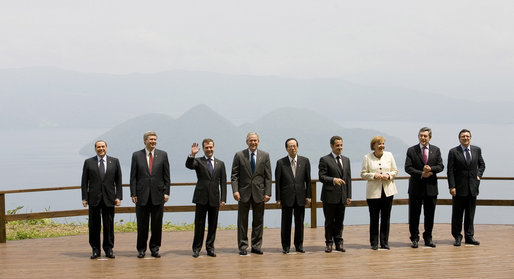
The 34th G8 summit was held in the town of Tōyako, Hokkaido, Japan, on July 7–9, 2008. The locations of previous summits hosted by Japan include Tokyo (1979, 1986, 1993) and Nago, Okinawa (2000). The G8 summit has evolved beyond being a gathering of world political leaders to become an occasion for a wide variety of non-governmental organizations, activists and civic groups to congregate and discuss a multitude of issues.
The Group of Seven (G7) was an unofficial forum which brought together the heads of the richest industrialized countries: France, Germany, Italy, Japan, the United Kingdom, the United States, and Canada starting in 1976. The Group of Eight (G8), meeting for the first time in 1997, was formed with the addition of Russia. In addition, the President of the European Commission has been formally included in summits since 1981. The summits were not meant to be linked formally with wider international institutions; and in fact, a mild rebellion against the stiff formality of other international meetings was a part of the genesis of cooperation between France's president Valéry Giscard d'Estaing and West Germany's chancellor Helmut Schmidt as they conceived the initial summit of the Group of Six (G6) in 1975.
In discussions regarding Africa during the 34th G8 summit, the G8 leaders set a five-year deadline to commit US$60 billion in funding to help fight disease in Africa and renewed a commitment made three years earlier to double aid for Africa to $25-billion by 2010 and to consider pledging further assistance after 2010. On the topic of global warming, the G8 leaders agreed on the need for the world to cut carbon emissions blamed for global warming by at least 50 percent by 2050. Environmental activists and leaders from the developing countries described the statement as a "toothless gesture". Results of discussions on the Anti-Counterfeiting Trade Agreement were not known. The G8 leaders made statements regarding their relations with Zimbabwe, Iran and, North Korea. The responses of the G8 leaders to the "Challenge to the G8 Governments" of over 100 NGOs and other organisations and individuals requesting them to "cancel all illegitimate debt", to "end the practice of using loans and debt cancellation to impose conditionalities" and to "facilitate the return of stolen assets kept in the banks in the G8 countries" are not presently known. Regarding the 2007–2008 world food price crisis, the differences between the G8 leaders and the citizens' groups' approaches to solving the crisis appeared unresolved. The G8's communiqué said that it was "imperative" to remove export restrictions, in contrast to requests of the signers of the "Challenge to the G8 Governments".
The G8 summits during the 21st-century have also involved widespread parallel debates and protests by citizens and claimed human rights violations against some of them during massive police/military operations. Over 40 dissidents were arrested before the summit started and nineteen or twenty Koreans critical of the G8 leadership were detained at New Chitose Airport for at least 24 hours. During a "non-violent demonstration where no acts against property or people took place" according to a legal observer, at least four people were arrested, including a Reuters cameraman. At this venue, amongst the reasons cited for demonstrations and protests were that a G8 summit is merely an arbitrary meeting of national leaders and that it is also a nexus which becomes more than the sum of its parts, elevating the participants, the event and the venue as focal points for activist pressure.
The G8 is an unofficial annual forum for the leaders of Canada, the European Commission, France, Germany, Italy, Japan, Russia, the United Kingdom, and the United States.
The 34th G8 summit was the first summit for British Prime Minister Gordon Brown and Russian President Dmitry Medvedev, and was the last summit for US President George W. Bush. It was also the first and only summit for Japanese Prime Minister Yasuo Fukuda. Fukuda resigned as Japan's Prime Minister on September 1, and he being the first of the G8 leaders at the summit to leave office.
French President Nicolas Sarkozy observed, "I think it is not reasonable to continue to meet as eight to solve the big questions of the world, forgetting China -- one billion 300 million people -- and not inviting India -- one billion people." Japan and the United States announced opposition to Sarkozy's implied suggestion.
These summit participants are the current "core members" of the international forum:
34th G8 summit
The 34th G8 summit was held in the town of Tōyako, Hokkaido, Japan, on July 7–9, 2008. The locations of previous summits hosted by Japan include Tokyo (1979, 1986, 1993) and Nago, Okinawa (2000). The G8 summit has evolved beyond being a gathering of world political leaders to become an occasion for a wide variety of non-governmental organizations, activists and civic groups to congregate and discuss a multitude of issues.
The Group of Seven (G7) was an unofficial forum which brought together the heads of the richest industrialized countries: France, Germany, Italy, Japan, the United Kingdom, the United States, and Canada starting in 1976. The Group of Eight (G8), meeting for the first time in 1997, was formed with the addition of Russia. In addition, the President of the European Commission has been formally included in summits since 1981. The summits were not meant to be linked formally with wider international institutions; and in fact, a mild rebellion against the stiff formality of other international meetings was a part of the genesis of cooperation between France's president Valéry Giscard d'Estaing and West Germany's chancellor Helmut Schmidt as they conceived the initial summit of the Group of Six (G6) in 1975.
In discussions regarding Africa during the 34th G8 summit, the G8 leaders set a five-year deadline to commit US$60 billion in funding to help fight disease in Africa and renewed a commitment made three years earlier to double aid for Africa to $25-billion by 2010 and to consider pledging further assistance after 2010. On the topic of global warming, the G8 leaders agreed on the need for the world to cut carbon emissions blamed for global warming by at least 50 percent by 2050. Environmental activists and leaders from the developing countries described the statement as a "toothless gesture". Results of discussions on the Anti-Counterfeiting Trade Agreement were not known. The G8 leaders made statements regarding their relations with Zimbabwe, Iran and, North Korea. The responses of the G8 leaders to the "Challenge to the G8 Governments" of over 100 NGOs and other organisations and individuals requesting them to "cancel all illegitimate debt", to "end the practice of using loans and debt cancellation to impose conditionalities" and to "facilitate the return of stolen assets kept in the banks in the G8 countries" are not presently known. Regarding the 2007–2008 world food price crisis, the differences between the G8 leaders and the citizens' groups' approaches to solving the crisis appeared unresolved. The G8's communiqué said that it was "imperative" to remove export restrictions, in contrast to requests of the signers of the "Challenge to the G8 Governments".
The G8 summits during the 21st-century have also involved widespread parallel debates and protests by citizens and claimed human rights violations against some of them during massive police/military operations. Over 40 dissidents were arrested before the summit started and nineteen or twenty Koreans critical of the G8 leadership were detained at New Chitose Airport for at least 24 hours. During a "non-violent demonstration where no acts against property or people took place" according to a legal observer, at least four people were arrested, including a Reuters cameraman. At this venue, amongst the reasons cited for demonstrations and protests were that a G8 summit is merely an arbitrary meeting of national leaders and that it is also a nexus which becomes more than the sum of its parts, elevating the participants, the event and the venue as focal points for activist pressure.
The G8 is an unofficial annual forum for the leaders of Canada, the European Commission, France, Germany, Italy, Japan, Russia, the United Kingdom, and the United States.
The 34th G8 summit was the first summit for British Prime Minister Gordon Brown and Russian President Dmitry Medvedev, and was the last summit for US President George W. Bush. It was also the first and only summit for Japanese Prime Minister Yasuo Fukuda. Fukuda resigned as Japan's Prime Minister on September 1, and he being the first of the G8 leaders at the summit to leave office.
French President Nicolas Sarkozy observed, "I think it is not reasonable to continue to meet as eight to solve the big questions of the world, forgetting China -- one billion 300 million people -- and not inviting India -- one billion people." Japan and the United States announced opposition to Sarkozy's implied suggestion.
These summit participants are the current "core members" of the international forum:
Recent media
Recent media