



Community hub
Recent from talks
Contribute something to knowledge base
Content stats: 0 posts, 0 articles, 0 media, 0 notes
Members stats: 0 subscribers, 0 contributors, 0 moderators, 0 supporters
Subscribers
Supporters
Contributors
Moderators
Hub AI
3D printing speed AI simulator
(@3D printing speed_simulator)
Hub AI
3D printing speed AI simulator
(@3D printing speed_simulator)
3D printing speed
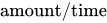
In 3D printing, the printing speed is a measure for how much material is printed per unit of time (). It's an important parameter for the time it takes to print, and can affect the quality of the print.
Units used varies depends on the type of additive manufacturing technique. The unit of manufactured material is typically measured in units of either mass (kg), length (mm) or volume (cm3), and the unit of time is usually measured in seconds (or sometimes hours). For example, fused filament fabrication typically uses mm/s or mm3/s, while stereolithography typically uses mm/h or layers per hour.
The following table compares typical speeds of some commercially relevant 3D printing technologies (updated 2020):
3D printing speed refers to only the build stage, a subcomponent of the entire 3D printing process. However, the entire process spans from pre-processing to post-processing stages. The time required for printing a completed part from a data file (.stl or .obj) is calculated as the sum of time for the following stages:
Additive manufacturing technologies usually imply a trade off between the printing speed and quality. Improvements in speed of the entire 3D printing process can be grouped into improvements to software and hardware:
Since the actual printing process is directly influenced by how the model is sliced, oriented, and filled, optimizing them results in shorter print time.
Optimal orientation. Changing the orientation of a part can be done through either the STL file or on the CAD model, or in the slicer before generating the gcode. Determining the optimal part orientation is a common software solution for all additive manufacturing processes. This can lead to a significant improvement in many key factors that affect the total print time. The following factors heavily depend on part orientation:
Adaptive slicing. Error caused by the staircase effect can be measured using several metrics, all of which refer to the difference between model surface and actual printed surface. By adaptively computing the height distribution of layers, this error can be minimized: The quality of surface increases while post-processing time decreases. The benefits of adaptive slicing depend on the proportion of the surface-to-volume ratio of the part. Efficient computation of adaptive layers is possible by analyzing the model surface over the full layer height. Several implementations are available as an open source software.
3D printing speed
In 3D printing, the printing speed is a measure for how much material is printed per unit of time (). It's an important parameter for the time it takes to print, and can affect the quality of the print.
Units used varies depends on the type of additive manufacturing technique. The unit of manufactured material is typically measured in units of either mass (kg), length (mm) or volume (cm3), and the unit of time is usually measured in seconds (or sometimes hours). For example, fused filament fabrication typically uses mm/s or mm3/s, while stereolithography typically uses mm/h or layers per hour.
The following table compares typical speeds of some commercially relevant 3D printing technologies (updated 2020):
3D printing speed refers to only the build stage, a subcomponent of the entire 3D printing process. However, the entire process spans from pre-processing to post-processing stages. The time required for printing a completed part from a data file (.stl or .obj) is calculated as the sum of time for the following stages:
Additive manufacturing technologies usually imply a trade off between the printing speed and quality. Improvements in speed of the entire 3D printing process can be grouped into improvements to software and hardware:
Since the actual printing process is directly influenced by how the model is sliced, oriented, and filled, optimizing them results in shorter print time.
Optimal orientation. Changing the orientation of a part can be done through either the STL file or on the CAD model, or in the slicer before generating the gcode. Determining the optimal part orientation is a common software solution for all additive manufacturing processes. This can lead to a significant improvement in many key factors that affect the total print time. The following factors heavily depend on part orientation:
Adaptive slicing. Error caused by the staircase effect can be measured using several metrics, all of which refer to the difference between model surface and actual printed surface. By adaptively computing the height distribution of layers, this error can be minimized: The quality of surface increases while post-processing time decreases. The benefits of adaptive slicing depend on the proportion of the surface-to-volume ratio of the part. Efficient computation of adaptive layers is possible by analyzing the model surface over the full layer height. Several implementations are available as an open source software.