


Community hub
Recent from talks
Contribute something to knowledge base
Content stats: 0 posts, 0 articles, 1 media, 0 notes
Members stats: 0 subscribers, 0 contributors, 0 moderators, 0 supporters
Subscribers
Supporters
Contributors
Moderators
Hub AI
Formation (association football) AI simulator
(@Formation (association football)_simulator)
Hub AI
Formation (association football) AI simulator
(@Formation (association football)_simulator)
Formation (association football)
In association football, the formation of a team refers to the position players take in relation to each other on a pitch. As association football is a fluid and fast-moving game, a player's position (with the exception of the goalkeeper) in a formation does not define their role as tightly as that of rugby player, nor are there breaks in play where the players must line up in formation (as in gridiron football). A player's position in a formation typically defines whether a player has a mostly defensive or attacking role, and whether they tend to play centrally or towards one side of the pitch.
Formations are usually described by three or more numbers in order to denote how many players are in each row of the formation, from the most defensive to the most advanced. For example, the "4–5–1" formation has four defenders, five midfielders, and a single forward. The choice of formation is normally made by a team's manager or head coach. Different formations can be used depending on whether a team wishes to play more attacking or defensive football, and a team may switch formations between or during games for tactical reasons. Teams may also use different formations for attacking and defending phases of play in the same game.
In the early days of football, most team members would play in attacking roles, whereas modern formations are generally split more evenly between defenders, midfielders, and forwards.
Formations are described by categorising the players (not including the goalkeeper) according to their positioning along (not across) the pitch, with the more defensive players given first. For example, 4–4–2 means four defenders, four midfielders, and two forwards.
Traditionally, those within the same category (for example the four midfielders in a 4–4–2) would generally play as a fairly flat line across the pitch, with those out wide often playing in a slightly more advanced position. In many modern formations, this is not the case, which has led to some analysts splitting the categories in two separate bands, leading to four- or even five-numbered formations. A common example is 4–2–1–3, where the midfielders are split into two defensive and one offensive player; as such, this formation can be considered a type of 4–3–3. An example of a five-numbered formation would be 4–1–2–1–2, where the midfield consists of a defensive midfielder, two central midfielders and an offensive midfielder; this is sometimes considered to be a kind of 4–4–2 (specifically a 4–4–2 diamond, referring to the lozenge shape formed by the four midfielders).
The numbering system was not present until the 4–2–4 system was developed in the 1950s.
Diagrams in this article use a "goal keeper at the bottom" convention but initially it was the opposite. The first numbering systems started with the number 1 for the goalkeeper (top of diagrams) and then defenders from left to right and then to the bottom with the forwards at the end.
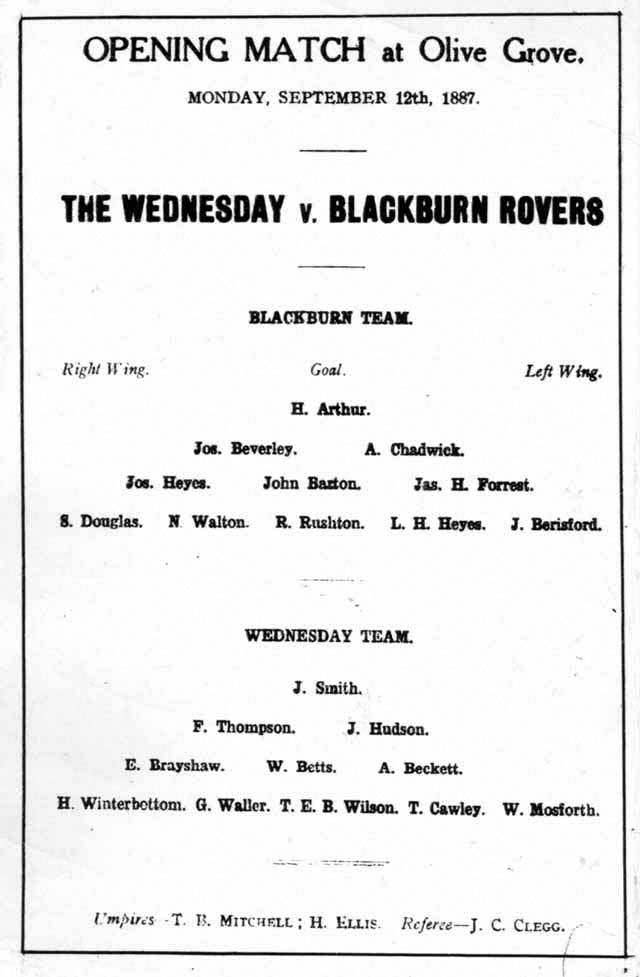
In the football matches of the 19th century, defensive football was not played, and the line-ups reflected the all-attacking nature of these games.
Formation (association football)
In association football, the formation of a team refers to the position players take in relation to each other on a pitch. As association football is a fluid and fast-moving game, a player's position (with the exception of the goalkeeper) in a formation does not define their role as tightly as that of rugby player, nor are there breaks in play where the players must line up in formation (as in gridiron football). A player's position in a formation typically defines whether a player has a mostly defensive or attacking role, and whether they tend to play centrally or towards one side of the pitch.
Formations are usually described by three or more numbers in order to denote how many players are in each row of the formation, from the most defensive to the most advanced. For example, the "4–5–1" formation has four defenders, five midfielders, and a single forward. The choice of formation is normally made by a team's manager or head coach. Different formations can be used depending on whether a team wishes to play more attacking or defensive football, and a team may switch formations between or during games for tactical reasons. Teams may also use different formations for attacking and defending phases of play in the same game.
In the early days of football, most team members would play in attacking roles, whereas modern formations are generally split more evenly between defenders, midfielders, and forwards.
Formations are described by categorising the players (not including the goalkeeper) according to their positioning along (not across) the pitch, with the more defensive players given first. For example, 4–4–2 means four defenders, four midfielders, and two forwards.
Traditionally, those within the same category (for example the four midfielders in a 4–4–2) would generally play as a fairly flat line across the pitch, with those out wide often playing in a slightly more advanced position. In many modern formations, this is not the case, which has led to some analysts splitting the categories in two separate bands, leading to four- or even five-numbered formations. A common example is 4–2–1–3, where the midfielders are split into two defensive and one offensive player; as such, this formation can be considered a type of 4–3–3. An example of a five-numbered formation would be 4–1–2–1–2, where the midfield consists of a defensive midfielder, two central midfielders and an offensive midfielder; this is sometimes considered to be a kind of 4–4–2 (specifically a 4–4–2 diamond, referring to the lozenge shape formed by the four midfielders).
The numbering system was not present until the 4–2–4 system was developed in the 1950s.
Diagrams in this article use a "goal keeper at the bottom" convention but initially it was the opposite. The first numbering systems started with the number 1 for the goalkeeper (top of diagrams) and then defenders from left to right and then to the bottom with the forwards at the end.
In the football matches of the 19th century, defensive football was not played, and the line-ups reflected the all-attacking nature of these games.
Recent media
Recent media