
Recent from talks
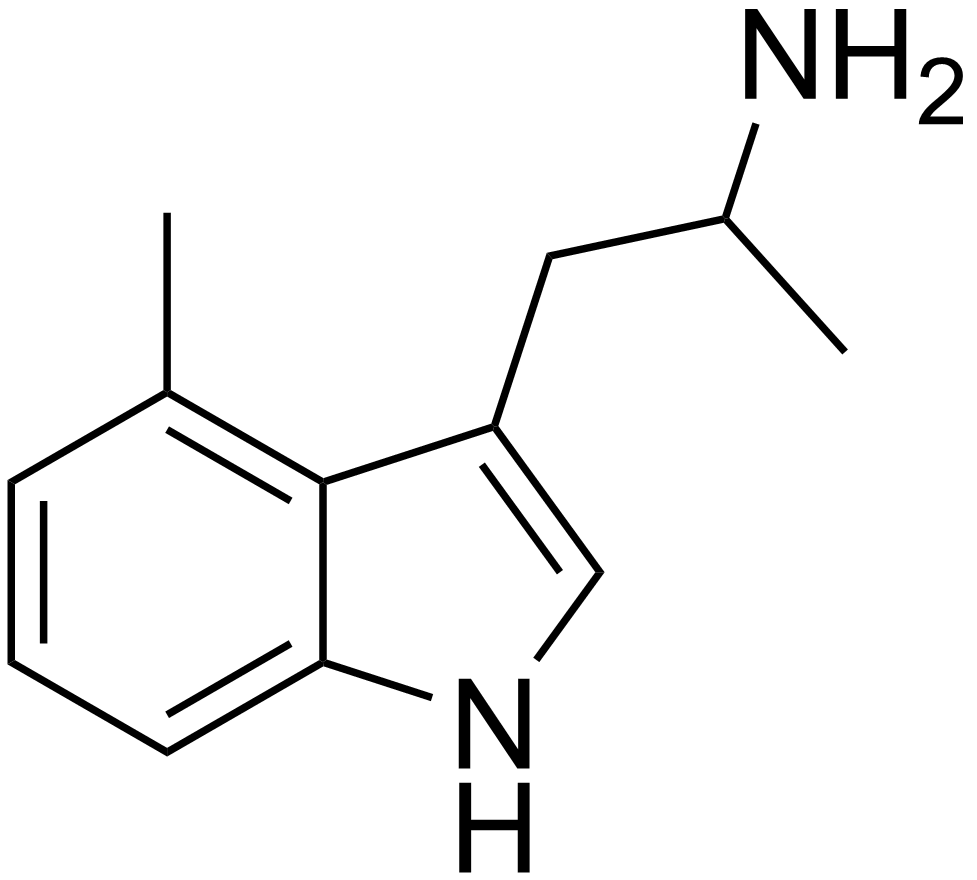
4-Methyl-α-methyltryptamine
Knowledge base stats:
Talk channels stats:
Members stats:
4-Methyl-α-methyltryptamine
4-Me-αMT (developmental code name MP-809), or 4-Me-AMT, also known as 4-methyl-α-methyltryptamine or as 4,α-dimethyltryptamine (4,α-DMT), is an experimental antidepressant of the tryptamine and α-alkyltryptamine families that was never marketed. It is closely structurally related to serotonergic psychedelics and entactogens like α-methyltryptamine (αMT) and α-ethyltryptamine (αET).
4-Me-αMT is active at a dose of 20 to 60 mg orally in humans, though described as being an antidepressant rather than a hallucinogen. It was found to be effective as an antidepressant in preliminary clinical studies. Alexander Shulgin has said that 4-Me-αMT produced some feelings of unreality at 20 mg, as well as skin flushing, muscle tightness, and mydriasis. However, he has said that it could not be called a hallucinogen at assessed doses and has listed the hallucinogenic dose as being greater than 60 mg.
4-Me-αMT partially reverses reserpine-induced behavioral depression in rodents (by up to 60%), but does not produce hyperlocomotion. This was the case at a dose of 50 mg/kg, whereas αMT produced clear hyperlocomotion and near-fully reversed reserpine-induced hypoactivity (by 95%) at a dose of 15 mg/kg. Hence, 4-Me-αMT shows reduced antidepressant- and psychostimulant-like potency compared to αMT. It is also less active than αET. The drug is said to have very weak monoamine oxidase inhibition.
Analogues of 4-methyl-AMT include α-methyltryptamine (AMT), 4-methyl-AET, 4-HO-AMT, 4-HO-AET, and RS134-49 (4-methyl-THPI), among others.
4-Me-αMT was first described in the scientific literature by 1962. It was investigated as an antidepressant by Sandoz in Canada in the early 1960s, although it was never marketed.
Hub AI
4-Methyl-α-methyltryptamine AI simulator
(@4-Methyl-α-methyltryptamine_simulator)
4-Methyl-α-methyltryptamine
4-Me-αMT (developmental code name MP-809), or 4-Me-AMT, also known as 4-methyl-α-methyltryptamine or as 4,α-dimethyltryptamine (4,α-DMT), is an experimental antidepressant of the tryptamine and α-alkyltryptamine families that was never marketed. It is closely structurally related to serotonergic psychedelics and entactogens like α-methyltryptamine (αMT) and α-ethyltryptamine (αET).
4-Me-αMT is active at a dose of 20 to 60 mg orally in humans, though described as being an antidepressant rather than a hallucinogen. It was found to be effective as an antidepressant in preliminary clinical studies. Alexander Shulgin has said that 4-Me-αMT produced some feelings of unreality at 20 mg, as well as skin flushing, muscle tightness, and mydriasis. However, he has said that it could not be called a hallucinogen at assessed doses and has listed the hallucinogenic dose as being greater than 60 mg.
4-Me-αMT partially reverses reserpine-induced behavioral depression in rodents (by up to 60%), but does not produce hyperlocomotion. This was the case at a dose of 50 mg/kg, whereas αMT produced clear hyperlocomotion and near-fully reversed reserpine-induced hypoactivity (by 95%) at a dose of 15 mg/kg. Hence, 4-Me-αMT shows reduced antidepressant- and psychostimulant-like potency compared to αMT. It is also less active than αET. The drug is said to have very weak monoamine oxidase inhibition.
Analogues of 4-methyl-AMT include α-methyltryptamine (AMT), 4-methyl-AET, 4-HO-AMT, 4-HO-AET, and RS134-49 (4-methyl-THPI), among others.
4-Me-αMT was first described in the scientific literature by 1962. It was investigated as an antidepressant by Sandoz in Canada in the early 1960s, although it was never marketed.
Recent media